Cairo International Airport
Cairo International Airport
About
Cairo International Airport (IATA: CAI | ICAO: HECA) is Egypt’s principal gateway and one of the most strategically significant aviation hubs on the African continent. Positioned at the crossroads of Africa, the Middle East, and Europe, CAI serves as the primary point of entry for millions of travellers, business delegations, journalists, and researchers moving between these regions each year. Its geographic position — sitting at the northeastern tip of Africa, roughly equidistant between sub-Saharan capitals and major European cities — gives it a connectivity advantage that few airports on the continent can match. For aviation analysts, it represents a bellwether for African air traffic trends; for travellers, it is often the first or last impression of Egypt and, by extension, of the wider region.
Cairo International Airport opened in 1945, originally developed to serve military and early commercial aviation needs during the latter stages of the Second World War. It was subsequently expanded and modernised as Egypt’s civil aviation sector grew following independence, transitioning into a full international commercial facility under the authority of the Egyptian Airports Company (EAC), a state-owned entity operating under the umbrella of the Egyptian Ministry of Civil Aviation. The airport has undergone several significant phases of infrastructure development over the decades, with Terminal 3 — the airport’s most modern facility — opening in 2008 and designed to international standards comparable to major European hubs of that era.
Subsequent years brought incremental upgrades to Terminal 1 and Terminal 2, alongside improvements to airside infrastructure, cargo handling, and ground transport links. Egypt’s broader national development agenda, including the government’s Vision 2030 framework, has placed aviation infrastructure among its stated priorities, with CAI identified as a key node in plans to increase Egypt’s tourism receipts and position Cairo as a regional logistics hub.
Country
Egypt is a transcontinental country spanning northeastern Africa and the Sinai Peninsula of western Asia, with Cairo as its capital and largest city. Home to a population that, by current estimates, exceeds 100 million people, Egypt is one of Africa’s most populous nations and its most visited tourist destination by international arrivals. It occupies a pivotal geopolitical position as a member of the African Union, the Arab League, and a key partner in Mediterranean and Red Sea trade corridors. Its economy is among the largest on the continent, with tourism, remittances, Suez Canal revenues, and hydrocarbons forming the principal pillars. → Read the Egypt expert briefing
Airlines based here
EgyptAir is the dominant carrier at Cairo International Airport, operating the airport as its primary hub and accounting for the largest share of seat capacity across all terminals. As the national flag carrier and a member of the Star Alliance, EgyptAir connects CAI to destinations across Africa, Europe, Asia, and North America, and its maintenance, training, and operational headquarters are all based at or adjacent to the airport. EgyptAir Express, the carrier’s regional subsidiary, also operates shorter-haul domestic and regional routes from CAI.
Beyond the national carrier, Cairo International hosts a substantial roster of visiting international airlines that treat CAI as a focus city or point-to-point destination. These include major Gulf carriers such as Emirates, Qatar Airways, and Etihad Airways, which provide onward connectivity to Asia and Australasia. European network carriers including Lufthansa, Air France, British Airways, and Turkish Airlines maintain regular scheduled services to CAI. Within Africa, airlines such as Ethiopian Airlines, Kenya Airways, and Air Arabia Egypt — a low-cost joint venture operating from Cairo — contribute to the airport’s intra-continental connectivity. Several charter and leisure carriers from European markets also operate seasonal services, particularly serving Egypt’s Red Sea resort corridors via Cairo.
Flights and destinations
Cairo International Airport supports one of the most extensive route networks of any airport in Africa, spanning intercontinental, continental, and short-haul regional services. Intercontinental routes connect CAI to major hubs including London Heathrow, Paris Charles de Gaulle, Frankfurt, New York JFK, Toronto Pearson, Beijing Capital, and Tokyo Narita, typically operated by EgyptAir or partner Star Alliance carriers. Within the Middle East, Riyadh, Dubai, Doha, Beirut, and Amman are among the most frequently served cities, reflecting strong labour migration flows and business travel demand. On the African continent, Nairobi, Addis Ababa, Lagos, Casablanca, Khartoum, and Johannesburg represent key destinations, served by a combination of EgyptAir and visiting African carriers. Domestic services connect Cairo to Luxor, Aswan, Sharm el-Sheikh, and Hurghada, feeding international tourists into Egypt’s leisure economy.
Facilities and capacity
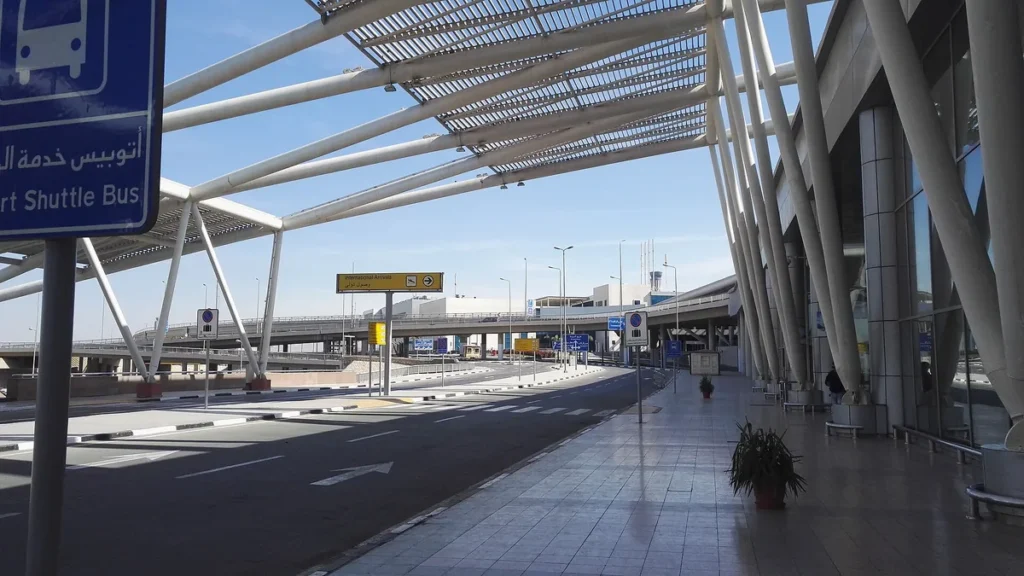
Cairo International Airport operates three passenger terminals. Terminal 1 handles a mix of international and domestic traffic and has been subject to ongoing refurbishment works. Terminal 2 primarily serves regional and charter operations. Terminal 3, the newest and largest facility, is the home terminal of EgyptAir and handles the bulk of long-haul international traffic; it features a dedicated pier structure, airside retail and dining, and facilities designed to international standards. The airport is served by three runways, configured to accommodate wide-body aircraft including the Boeing 777, Airbus A380, and Boeing 787 Dreamliner. Cargo operations are handled through a dedicated freight terminal, and CAI serves as an important transhipment point for air freight moving between Africa, Europe, and the Gulf. According to publicly disclosed traffic data, Cairo International ranks among the top five busiest airports in Africa by passenger throughput, placing it firmly in the large-hub category by continental standards.
Visa regulations
Egypt operates a relatively accessible visa regime for most major source markets arriving at Cairo International Airport. Citizens of the United States, the United Kingdom, and European Union member states are generally eligible to obtain a visa on arrival or to apply in advance through Egypt’s official eVisa portal, making pre-travel arrangements straightforward. Gulf Cooperation Council (GCC) nationals and holders of valid GCC or US residence permits have historically benefited from simplified entry arrangements. For travellers holding passports from other African nations, eligibility varies considerably by nationality, with some benefiting from visa-on-arrival access and others required to obtain a visa from an Egyptian diplomatic mission prior to travel. Visa fees, validity periods, and eligible nationalities are subject to change without notice. Travellers are strongly advised to verify current requirements before departure. → Check live visa requirements for Egypt
Recent developments
In the period leading into 2026, Cairo International Airport has seen a number of operationally significant developments. EgyptAir has continued to expand its long-haul network, with new or reinstated routes to destinations in Asia and North America reflecting the airline’s post-pandemic recovery trajectory. Terminal refurbishment works at Terminal 1 have progressed, aimed at improving passenger flow and modernising landside facilities. The Egyptian Ministry of Civil Aviation has publicly signalled interest in attracting additional low-cost carrier operations to CAI, and Air Arabia Egypt has grown its footprint accordingly. Industry observers have also noted increased cargo activity at the airport, linked in part to Egypt’s growing role in regional e-commerce logistics. Regulatory coordination between the Egyptian Civil Aviation Authority (ECAA) and ICAO’s Middle East regional office has continued, with safety oversight and airspace management modernisation among the stated priorities.
News and reports
Ongoing operational and commercial news relating to Cairo International Airport is published through several authoritative channels. The Egyptian Airports Company (EAC) and the Egyptian Civil Aviation Authority (ECAA) release official statements and traffic data through their respective institutional communications. IATA’s Africa regional publications and annual air transport reports provide comparative benchmarking data for CAI within the continental context. ICAO’s Middle East regional office publishes safety and regulatory updates relevant to Egyptian airspace. Trade publications including ch-aviation, anna.aero, and the Air Transport World provide route-level analysis and airline capacity data. For researchers and journalists, Egypt’s Official Gazette and parliamentary transport committee records can provide primary-source documentation on regulatory and infrastructure decisions affecting the airport.