EgyptAir
EgyptAir
About
EgyptAir is Africa’s oldest continuously operating airline and one of the continent’s most strategically significant carriers, serving as the primary flag carrier of the Arab Republic of Egypt and a critical bridge between Africa, the Middle East, Europe, and Asia. Operating under IATA code MS and ICAO code MSR, the airline occupies a rare position in African aviation: a full-service network carrier with intercontinental reach, a diversified group structure, and a hub at Cairo International Airport (CAI) that functions as one of the busiest aviation crossroads on the African continent.
EgyptAir traces its origins to 1932, when it was founded as Misr Airwork, making it one of the oldest airlines in the world and the oldest in Africa and the Middle East. It was rebranded as EgyptAir in 1971 and has operated under state ownership ever since, sitting within the EgyptAir Holding Company — a group that encompasses cargo, maintenance, ground handling, and in-flight catering subsidiaries. This vertically integrated structure gives the airline a degree of operational self-sufficiency uncommon among African peers.
Ownership remains firmly in the hands of the Egyptian government, and the airline has historically operated with the dual mandate of commercial viability and national connectivity. In recent years, Egyptian authorities have signalled interest in modernising the group’s commercial orientation, with discussions around partial privatisation and governance reform periodically surfacing in policy circles, though no definitive structural change had been completed as of early 2026.
Bases and Hubs
Cairo International Airport (CAI) — The airline’s principal hub and operational heartland, CAI serves as EgyptAir’s primary connecting point for intercontinental, regional, and domestic traffic, and is one of the busiest airports in Africa by passenger volume.
Sharm el-Sheikh International Airport (SSH) — A key leisure focus city supporting EgyptAir’s charter and scheduled services to the Red Sea resort region, particularly relevant for European leisure traffic.
Hurghada International Airport (HRG) — A secondary leisure gateway on the Red Sea coast, served by EgyptAir on domestic trunk routes and select international services.
Luxor International Airport (LXR) — A culturally significant domestic focus city connecting Upper Egypt’s tourism heartland to Cairo and select international points.
Fleet
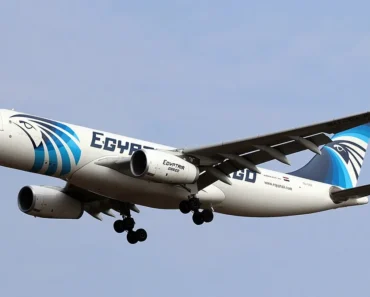
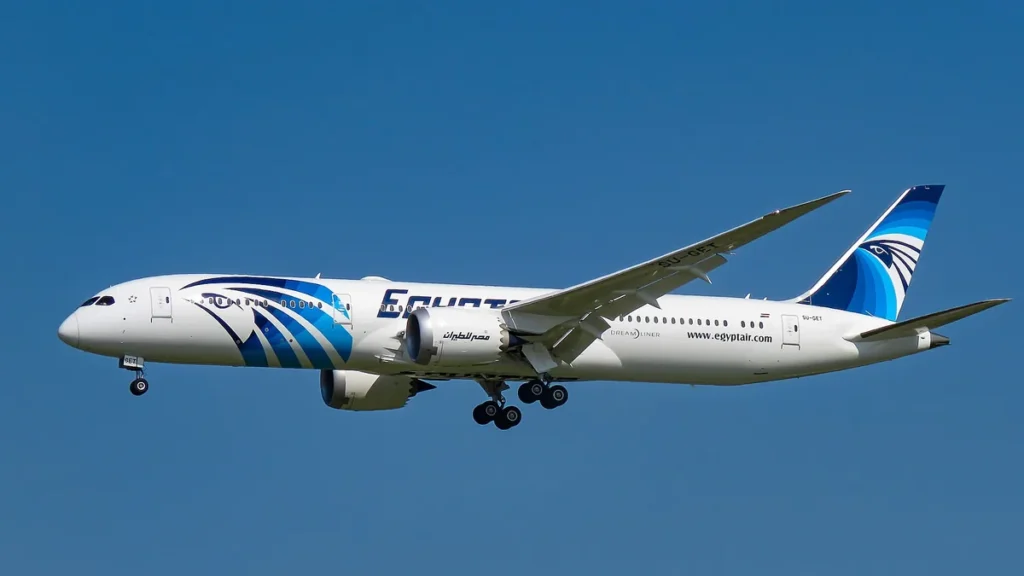
EgyptAir operates a mixed fleet drawn primarily from Boeing and Airbus families. The widebody intercontinental operation is anchored by Boeing 777 and Boeing 787 Dreamliner aircraft, with the 787 representing the airline’s most modern long-haul asset and a centrepiece of its fleet renewal ambitions. Narrowbody and medium-haul flying is conducted on Airbus A320-family aircraft, including A320 and A321 variants, which serve regional and intra-African routes as well as thinner European sectors. According to publicly disclosed fleet data, the airline has also operated Boeing 737 variants on domestic and short-haul regional routes, though fleet composition on these segments has evolved in recent years. EgyptAir has pursued fleet modernisation incrementally, and industry observers have noted ongoing discussions around additional widebody and narrowbody acquisitions to address both capacity growth and the retirement of older airframes.
Destinations
EgyptAir’s network spans four broad categories: domestic Egyptian services, intra-African routes, Middle Eastern and Gulf connections, and intercontinental long-haul flying to Europe, Asia, and North America. The domestic network links Cairo to Luxor, Aswan, Sharm el-Sheikh, Hurghada, and Alexandria, among others. On the African continent, the airline serves a range of sub-Saharan and North African destinations, including Nairobi, Lagos, Accra, Khartoum, Addis Ababa, Casablanca, and Tunis, positioning CAI as a viable African transit hub. Intercontinental headline routes include Cairo to London Heathrow, Paris Charles de Gaulle, Frankfurt, New York JFK, Toronto, Beijing, and Tokyo — a network that reflects the airline’s ambition to serve both diaspora and business travel markets. Gulf and Middle East connectivity, including services to Dubai, Riyadh, Jeddah, and Doha, represents a high-frequency, commercially important segment of the operation.
Codeshare and Alliance
EgyptAir is a full member of Star Alliance, having joined in 2008 — the first African carrier to do so and still one of only a small number of African airlines holding full alliance membership. This affiliation provides EgyptAir passengers with reciprocal frequent flyer benefits, lounge access, and interline connectivity across the Star Alliance network of over two dozen member carriers. Notable codeshare partners include Lufthansa, United Airlines, Air Canada, Turkish Airlines, and Singapore Airlines, among others within the alliance framework. The airline also maintains bilateral codeshare arrangements with select carriers outside the alliance to extend its effective network reach.
Notable Incidents
EgyptAir’s safety record includes two well-documented historical incidents that remain part of the public record and are relevant context for researchers. EgyptAir Flight 990, a Boeing 767, crashed into the Atlantic Ocean in October 1999 with significant loss of life; the cause remained a subject of differing conclusions between Egyptian and American investigators. EgyptAir Flight 804, an Airbus A320 operating the Paris–Cairo route, disappeared over the Mediterranean in May 2016, also with fatal consequences; investigations pointed to a fire on board, and the incident prompted a period of intense scrutiny of the airline’s safety and maintenance procedures. No major incidents have been recorded on the airline’s public safety record in the years since, and EgyptAir has continued to operate under standard international regulatory oversight through Egypt’s Civil Aviation Authority.
Financial and Operational Situation
As a state-owned enterprise, EgyptAir does not publish detailed financial results in the manner of publicly listed carriers, and independent verification of profitability is limited. Industry estimates suggest the airline has faced persistent financial pressure common to full-service African flag carriers, including fuel cost exposure, currency volatility — particularly given Egypt’s managed exchange rate environment and periodic devaluations of the Egyptian pound — and the structural cost burden of maintaining a large group organisation. The recovery of Egyptian tourism following the disruptions of the early 2020s has provided a meaningful tailwind for passenger volumes, and load factors on European leisure and Gulf routes are understood to have improved materially. Restructuring conversations within the EgyptAir Holding Company have touched on efficiency, fleet rationalisation, and the potential for greater commercial autonomy, though the pace of reform has been measured.
Recent Developments
In the 24 months leading into 2026, EgyptAir has pursued a number of operationally and commercially significant moves. The airline has expanded or reinstated several European routes as inbound tourism to Egypt recovered strongly, with increased frequencies to key source markets in Germany, Italy, and the United Kingdom. On the fleet side, the airline has continued to take delivery of Boeing 787 Dreamliner aircraft, with the type progressively assuming a larger share of long-haul operations. EgyptAir has also invested attention in its African network, recognising the commercial opportunity presented by growing intra-African travel demand and the competitive positioning of CAI as a transit hub relative to Gulf carrier hubs. Digitisation of customer-facing services, including mobile booking and loyalty programme enhancements under the EgyptAir Plus frequent flyer brand, has been an area of stated corporate focus. Regulatory engagement with the African Union’s Single African Air Transport Market (SAATM) framework remains relevant context for the airline’s medium-term network strategy.