Cape Town International Airport
Cape Town International Airport
About
Cape Town International Airport (IATA: CPT | ICAO: FACT) is South Africa’s second-busiest commercial airport and one of the most strategically significant gateways on the African continent. Situated approximately 20 kilometres east of the Cape Town city centre in the suburb of Matroosfontein, the airport serves as the primary aviation hub for the Western Cape province and functions as a critical node connecting sub-Saharan Africa to Europe, the Middle East, and beyond. For travellers, it is the arrival point for one of the world’s most celebrated tourist destinations; for aviation analysts, it is a bellwether for the health of South African and southern African air travel demand.
The airport traces its origins to the 1930s, when a modest aerodrome was established to serve the growing needs of the Cape Colony’s successor state. Commercial jet operations expanded significantly through the latter half of the twentieth century, and the facility was formally developed into a full international airport capable of handling wide-body aircraft. Ownership and operation of the airport rests with Airports Company South Africa (ACSA), the state-owned entity that manages South Africa’s principal commercial airports under a long-term concession framework established by the Airports Company Act of 1993.
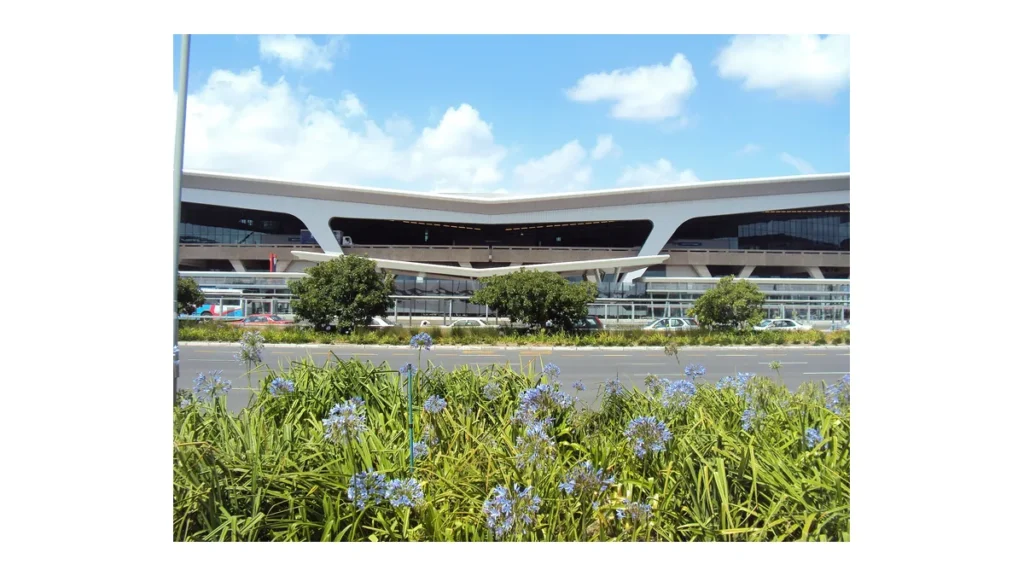
Major infrastructure investment accelerated in the years preceding the 2010 FIFA World Cup, when South Africa hosted the tournament and Cape Town served as one of the host cities. A substantial terminal redevelopment programme was completed in time for that event, delivering a modernised domestic and international terminal complex, improved airside facilities, and expanded retail and passenger processing capacity. Subsequent years have seen incremental upgrades to baggage handling, security infrastructure, and landside access roads, though industry observers have noted that sustained passenger growth continues to place pressure on the airport’s core processing capacity.
Country
South Africa is a constitutional republic located at the southern tip of the African continent, bordered by Namibia, Botswana, Zimbabwe, Mozambique, and Eswatini, and entirely surrounding the Kingdom of Lesotho. The country maintains three capital cities — Pretoria (executive), Cape Town (legislative), and Bloemfontein (judicial) — and is home to a population estimated in the hundreds of millions range by regional demographers, making it one of Africa’s most populous and economically influential nations. As the continent’s most industrialised economy by several measures, South Africa anchors the Southern African Development Community (SADC) and serves as a primary gateway for international business, tourism, and humanitarian operations across the region.
→ Read the South Africa expert briefing
Airlines based here
Cape Town International Airport is a focus city — though not a primary hub — for South Africa’s dominant full-service carrier, South African Airways (SAA), which operates scheduled services between CPT and O.R. Tambo International Airport in Johannesburg as part of its domestic trunk network. Airlink, an independently owned regional carrier that operates under a commercial agreement with SAA branding on certain routes, maintains a significant presence at the airport and connects Cape Town to a wide range of secondary South African cities and neighbouring countries. Kulula.com and FlySafair, both low-cost carriers registered in South Africa, operate high-frequency domestic services from Cape Town, particularly on the competitive Cape Town–Johannesburg corridor, which is among the busiest air routes on the continent by frequency. Cemair provides additional regional connectivity. None of these carriers treats Cape Town as their primary operational base — that distinction belongs to Johannesburg — but the airport is commercially essential to all of them.
Flights and destinations
The airport supports a broad network spanning domestic, continental, and long-haul intercontinental routes. Domestically, the most heavily served route is Cape Town to Johannesburg (O.R. Tambo and Lanseria), operated by multiple carriers at high daily frequencies. Continental services connect Cape Town to Nairobi, Mauritius, Luanda, Harare, and Windhoek, among other African cities, reflecting both business and leisure demand across the region. On intercontinental routes, Cape Town maintains direct or one-stop connections to London Heathrow (served by British Airways and historically by SAA), Amsterdam (KLM), Frankfurt (Lufthansa), Dubai (Emirates), Doha (Qatar Airways), and São Paulo. Emirates in particular operates a high-profile daily service that has become a key conduit for connecting Cape Town to the broader global network via Dubai. Seasonal charter and leisure services to European leisure markets — including the United Kingdom and Germany — supplement the scheduled network during the southern hemisphere summer, which aligns with peak tourist season in the Western Cape.
Facilities and capacity
Cape Town International Airport operates from a single integrated terminal building that houses both domestic and international departures and arrivals, though the two functions are processed through distinct piers and check-in zones. The airport has two asphalt runways: the primary runway designated 01/19, which is capable of accommodating wide-body aircraft including the Boeing 747 and Airbus A380 class, and a shorter secondary runway used primarily for general aviation and as an operational contingency. The airfield also supports a dedicated cargo terminal operated in conjunction with ACSA and third-party logistics providers, handling both belly-hold freight from passenger aircraft and dedicated freighter operations. According to publicly disclosed traffic data published by ACSA, the airport handles passenger volumes that place it firmly in the large regional hub category for Africa, though it remains smaller than O.R. Tambo by a considerable margin. Industry estimates suggest that capacity constraints — particularly in peak summer months — remain a structural challenge, and ACSA has indicated in public communications that long-term masterplan studies are ongoing.
Visa regulations
South Africa operates a tiered visa regime that varies significantly by passport nationality. Citizens of the United States, United Kingdom, and most European Union member states are generally permitted to enter South Africa visa-free for short stays — typically up to 30 or 90 days depending on bilateral agreements — for tourism and business purposes, without requiring a visa obtained in advance. Many regional African passport holders also benefit from visa-free or visa-on-arrival arrangements under SADC protocols, though the specifics differ by country. South Africa does not currently operate a widely available eVisa system comparable to those of Kenya or Ethiopia, meaning that nationals who do require a visa must typically apply in advance through a South African diplomatic mission. Travellers are strongly advised to verify current entry requirements before travel, as visa policies are subject to change by ministerial notice. For a live, country-by-country visa lookup tool, visit our dedicated resource: Visa Requirements.
Recent developments
In the period leading into 2026, Cape Town International Airport has seen a number of operationally significant developments. The post-pandemic recovery of international travel demand — which was severe and prolonged across southern Africa — has continued to consolidate, with several carriers restoring or expanding services that were suspended or reduced during 2020–2022. Qatar Airways has maintained and in some periods expanded its Doha–Cape Town service, reinforcing the Gulf hub model as a key enabler of long-haul connectivity for the airport. FlySafair has continued to grow its domestic market share, adding frequencies on trunk routes and placing competitive pressure on legacy carriers. ACSA has publicly referenced ongoing infrastructure planning discussions related to terminal capacity and airside upgrades, though specific project timelines and budgets remain subject to regulatory and procurement processes. The South African Civil Aviation Authority (SACAA) has also maintained its oversight activities at the airport in line with ICAO standards, with periodic audits forming part of South Africa’s compliance obligations under international aviation safety frameworks.
News and reports
Researchers, journalists, and analysts tracking Cape Town International Airport should consult several authoritative primary sources. Airports Company South Africa publishes operational updates, annual reports, and press releases through its official corporate communications channels, and these represent the most reliable source of traffic statistics and infrastructure announcements. The South African Civil Aviation Authority (SACAA) issues regulatory notices, safety directives, and audit outcomes relevant to all airports operating under South African jurisdiction. At the continental level, the African Airlines Association (AFRAA) and IATA’s Africa and Middle East regional office publish periodic market intelligence reports that contextualise Cape Town’s performance within broader African aviation trends. ICAO’s Eastern and Southern African Regional Office also produces safety and air navigation oversight documentation relevant to the region. Industry publications including ch-aviation, OAG, and Cirium provide schedule and capacity data that analysts use to track route development at CPT on an ongoing basis.