Takealot Group
Takealot Group
Takealot Group is South Africa’s dominant e-commerce conglomerate, operating the country’s most visited online retail destination alongside a portfolio of specialist digital brands. Majority-owned by Naspers — through its global internet subsidiary Prosus — the group sits at the centre of South Africa’s fast-evolving digital economy and serves as a benchmark for e-commerce development across sub-Saharan Africa.
About
Takealot.com was founded in 2011, emerging from the rebranding and restructuring of Take2, an earlier online retail venture. The business was built on the premise that South African consumers were underserved by formal retail and that a logistics-first, technology-driven marketplace could unlock significant latent demand. Early backing from Tiger Global Management provided the capital runway to build out warehousing and last-mile delivery infrastructure at a scale that most local competitors could not match.
Naspers, the Johannesburg-listed media and technology giant, began acquiring stakes in the group from 2014 and consolidated majority ownership in 2017 through a transaction that also brought the fashion platform Superbalist into the fold. Following Naspers’s corporate restructuring, the Takealot Group now sits within the Prosus ecosystem — one of the largest technology investment groups in the world by market capitalisation — giving it access to global capital, technology partnerships and operational expertise drawn from Prosus portfolio companies across dozens of markets.
The group is not independently listed on any stock exchange. Its financial performance is reported as part of Prosus’s e-commerce segment disclosures, meaning granular standalone figures are disclosed selectively rather than in a full standalone annual report.
Sector and competitive position
Takealot Group operates in South Africa’s e-commerce sector, which — while still representing a relatively modest share of total retail compared with more mature markets — has grown materially since the acceleration triggered by the COVID-19 pandemic. Takealot.com consistently ranks as the country’s most-visited online retail platform by traffic metrics, and the group’s logistics network gives it a structural advantage that newer entrants find difficult to replicate quickly. Its primary domestic competitors include Checkers Sixty60 and Woolworths Dash in grocery delivery, Bob Shop (formerly Bidorbuy) in marketplace listings, and the South African operations of global players such as Amazon, which launched its localised South Africa storefront in 2024. The entry of Amazon.co.za is widely regarded as the most significant competitive development the group has faced, intensifying pressure on pricing, seller acquisition and fulfilment speed. In food delivery, Mr D Food competes directly with Uber Eats and the Bolt Food platform for urban market share.
Operations and footprint
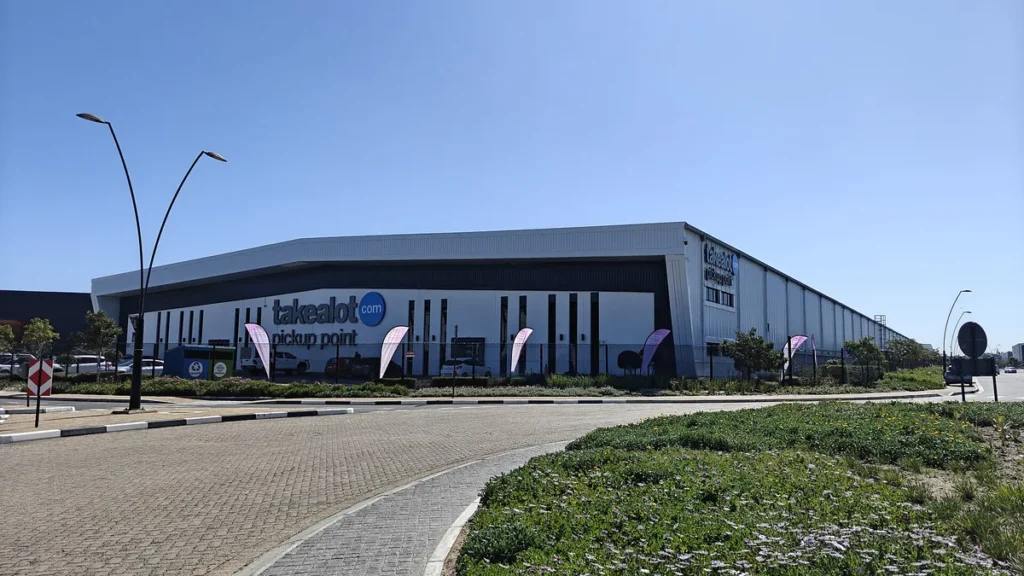
The group’s operations are concentrated in South Africa, where it maintains large fulfilment centres in Johannesburg and Cape Town, supplemented by a network of smaller distribution and collection points that extend its reach into secondary cities. The group employs thousands of permanent and contracted staff across technology, logistics, customer service and commercial functions, making it one of the more significant private-sector digital employers in the country. Takealot.com’s marketplace model also supports tens of thousands of third-party sellers, effectively extending its economic footprint well beyond its own headcount. The group has not pursued a material geographic expansion beyond South Africa’s borders, focusing instead on deepening penetration within the domestic market.
Products and brands
The group’s customer-facing portfolio comprises three principal brands. Takealot.com is the flagship general merchandise marketplace, offering electronics, appliances, books, toys, sporting goods, homeware and a broad range of everyday consumables through a combination of first-party retail and a third-party seller marketplace. Mr D Food is the group’s on-demand food and grocery delivery platform, operating in major South African urban centres and connecting consumers with restaurant partners and retail stores for rapid delivery. Superbalist is a dedicated fashion and lifestyle e-commerce platform targeting a younger, style-conscious demographic, stocking both international and South African designer and contemporary brands. Together the three brands allow the group to address a wide spectrum of consumer spending occasions, from planned large-ticket purchases to impulse food orders.
Financial situation
As a subsidiary of Prosus, Takealot Group does not publish standalone audited financial statements. Prosus’s periodic results disclosures have indicated that the group’s e-commerce segment — of which Takealot is the primary South African contributor — has followed a trajectory common to growth-stage online retail: strong revenue expansion accompanied by sustained investment in logistics, technology and marketing that has weighed on near-term profitability. Industry estimates suggest that Takealot.com’s gross merchandise value has grown significantly over the past five years, though the pace of growth has moderated as the post-pandemic normalisation of consumer behaviour took hold. Prosus has publicly signalled a group-wide shift toward profitability and capital discipline, which has implications for the level of investment directed into the Takealot portfolio. The group carries no independently rated debt; its funding requirements are met through the Prosus parent structure.
Recent developments
The most consequential external development of the past 24 months has been the formal launch of Amazon’s South African marketplace in 2024, which introduced a well-capitalised global competitor with an established seller ecosystem and strong brand recognition among South African consumers. The group has responded by investing in seller support tools, expanding its same-day and next-day delivery capabilities, and reinforcing loyalty and rewards mechanisms to retain its existing customer base. On the brand portfolio side, industry observers have noted ongoing strategic reviews of Superbalist’s positioning as the fashion e-commerce segment faces margin pressure from both global fast-fashion platforms and local competitors. Mr D Food has continued to expand its grocery and retail delivery partnerships, broadening the platform beyond restaurant meals. Prosus’s broader push for profitability across its portfolio has also prompted internal efficiency programmes within the group, including reported restructuring of support functions.
Outlook
The group’s strategic priorities for the near term centre on defending and extending its logistics advantage, growing the third-party marketplace to improve unit economics, and deepening engagement through data-driven personalisation and loyalty programmes. The competitive arrival of Amazon represents a sustained headwind, but Takealot’s localised knowledge, established seller relationships and physical fulfilment infrastructure provide meaningful incumbency advantages that will take time to erode. South Africa’s constrained consumer environment — shaped by elevated interest rates, persistent unemployment and load-shedding legacy costs — remains a structural challenge for discretionary e-commerce spending. Growth plays include expanding same-day delivery coverage, scaling the Mr D Food grocery vertical, and leveraging Prosus’s global network for technology and logistics innovation. Whether Superbalist is retained, repositioned or divested will be a key strategic signal to watch. Over a longer horizon, any move toward independent listing or a South African-focused capital raise would materially change the group’s public profile and disclosure obligations.
Related research
- South Africa Expert Briefing
- African Business Coverage
- African Business Research
- Country Comparison Tool