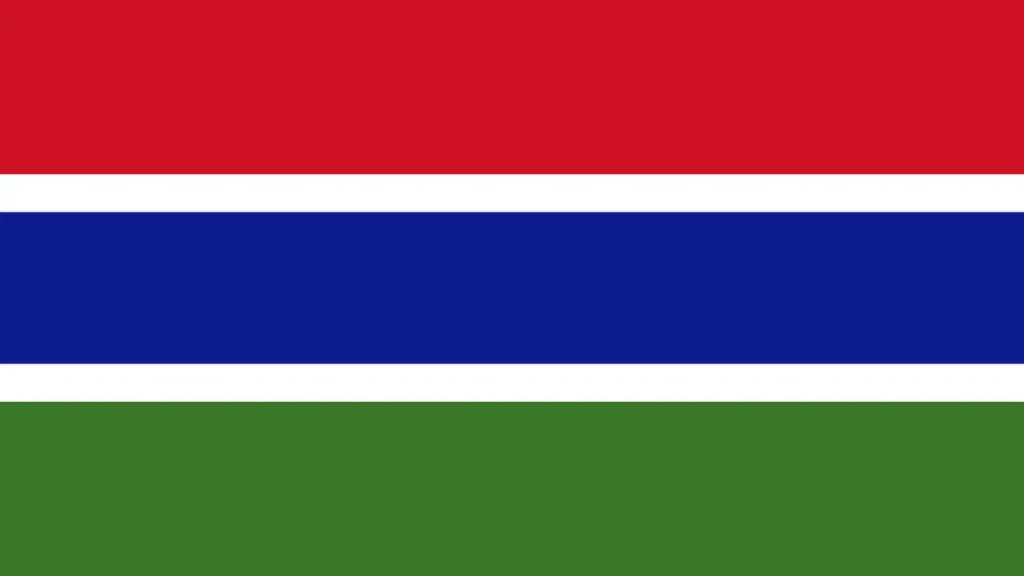
Gambia — Expert Briefing
Gambia at a glance: Africa’s smallest mainland country is navigating a fragile democratic transition, a tourism-dependent economy under climate stress, and a society still reckoning with the legacy of 22 years of authoritarian rule.
Overview
The Republic of The Gambia is a narrow sliver of territory — averaging just 48 kilometres in width — that follows the course of the Gambia River and is almost entirely surrounded by Senegal, with a short Atlantic coastline to the west. The capital is Banjul, though the commercial and administrative centre of gravity has long shifted to the Greater Banjul Area, which encompasses Kanifing and the Kombo Saint Mary Division. The population is estimated at approximately 2.8 million as of 2025, according to World Bank projections, making it one of the most densely populated countries on the African continent relative to its land area. The official language is English, a legacy of British colonial administration, though Mandinka, Wolof, Fula, and several other languages function as everyday vernaculars. The currency is the Gambian Dalasi (GMD). GDP per capita sits in the low-income band, estimated at roughly USD 800–850 in current terms, placing The Gambia firmly among the world’s least developed economies as classified by the United Nations. In 2026, The Gambia matters for two reasons that extend beyond its size: it is a live test case for post-authoritarian democratic consolidation in West Africa at a moment when the region is experiencing democratic backsliding elsewhere, and its coastline and river basin are among the most acutely climate-vulnerable environments on the continent, making it a bellwether for adaptation policy.
Government and Politics
The Gambia is a presidential republic. Executive power is vested in a directly elected president who serves as both head of state and head of government. The current president is Adama Barrow, who first came to power in January 2017 following the historic electoral defeat of Yahya Jammeh, who had ruled since a military coup in 1994. Barrow was re-elected in December 2021 with approximately 53 percent of the vote, defeating a fragmented opposition field. His party, the National People’s Party (NPP), subsequently secured a strong majority in the April 2022 National Assembly elections, giving the executive considerable legislative leverage. The legislature is the unicameral National Assembly, comprising 58 directly elected members and five nominated by the president, sitting for five-year terms. The next presidential election is constitutionally due in late 2026, and the political calendar is already shaping domestic discourse. The most consequential constitutional question of recent years has been the fate of the draft constitution produced by the Constitutional Review Commission in 2020, which sought to introduce presidential term limits, strengthen judicial independence, and entrench transitional justice provisions. That draft was rejected by the National Assembly in September 2020, largely due to NPP opposition to a clause that would have barred Barrow from standing again. A revised constitutional reform process has proceeded slowly, and as of early 2026 a new constitutional text has not been enacted, meaning The Gambia continues to operate under the 1997 constitution — a document drafted under Jammeh — with amendments. The Truth, Reconciliation and Reparations Commission (TRRC), which concluded its public hearings in 2021 and submitted its final report to the government, recommended prosecutions of former officials including Jammeh himself, who remains in exile in Equatorial Guinea. Implementation of those recommendations has been partial and contested, a source of ongoing civil society pressure.
Economy
The Gambia’s GDP is estimated at approximately USD 2.3–2.5 billion in nominal terms as of 2024–2025, a figure that understates the importance of the informal economy and remittances. The economy rests on three principal pillars: tourism, agriculture, and remittances. Tourism — centred on the Atlantic coast resorts of the Kombo peninsula — historically accounts for around 20 percent of GDP and is the country’s largest formal employer, though the sector remains highly sensitive to European consumer confidence and global travel disruptions. Agriculture, dominated by groundnut cultivation, employs the majority of the rural population but contributes a declining share of export revenue. Groundnut products, fish and fish preparations, and re-exports through the port of Banjul remain the primary merchandise exports. Remittances from the large Gambian diaspora in Europe — particularly the United Kingdom, Spain, and Sweden — are estimated to exceed 20 percent of GDP, functioning as a critical household-level social safety net. The Dalasi has faced persistent depreciation pressure, and inflation, while easing from the post-pandemic peak, remained elevated through 2024. The Gambia is classified as a Heavily Indebted Poor Country (HIPC) completion-point graduate, but external debt sustainability remains a concern, with the IMF and World Bank both flagging elevated debt-service ratios in recent Article IV consultations. The single most consequential economic story of the past 24 months has been the government’s engagement with the International Monetary Fund under an Extended Credit Facility arrangement, which has conditioned budget support on fiscal consolidation measures including energy sector reform. The Gambia National Water and Electricity Company (NAWEC) has long been a fiscal drain, and efforts to restructure its tariffs and reduce fuel subsidies have created political friction while being essential to macroeconomic stabilisation. A modest uptick in tourist arrivals in 2024 provided some relief, but structural vulnerabilities — import dependence, a narrow export base, and climate exposure — remain unresolved.
Demographics and Society
The Gambia’s population is young and growing rapidly, with a median age estimated below 20 years and a total fertility rate that, while declining, remains above four births per woman according to recent Demographic and Health Survey data. Urbanisation is accelerating: the Greater Banjul Area now accounts for roughly 40 percent of the national population, and secondary towns along the river corridor — Brikama, Farafenni, Basse Santa Su — are expanding. The country is ethnically diverse. The Mandinka are the largest group, comprising approximately 34 percent of the population; the Fula (Fulani) account for around 22 percent; the Wolof for approximately 16 percent; and the Jola, Serahule, and several smaller groups make up the remainder. These ethnic communities broadly correspond to linguistic communities, though multilingualism is the norm and Wolof functions as a widespread urban lingua franca alongside English. Islam is the religion of approximately 95–96 percent of the population, with Christianity practised primarily by the Jola and some other communities in the west and south. The defining social trend of the current moment is irregular migration: The Gambia has one of the highest per-capita rates of irregular migration to Europe of any country in the world. The “backway” — the overland route through Senegal, Mali, Burkina Faso, Niger, Libya, and across the Mediterranean — has claimed thousands of Gambian lives over the past decade. This phenomenon reflects youth unemployment, limited economic opportunity, and a culture of migration that is deeply embedded in certain communities, particularly in the provinces. Returnee reintegration and the psychological and economic consequences of failed migration journeys are now recognised policy challenges.
Key Issues Right Now
Transitional justice and the 2026 electoral cycle. The unresolved question of accountability for crimes committed under the Jammeh regime intersects directly with electoral politics. Civil society organisations, victims’ groups, and international human rights bodies have maintained pressure on the Barrow government to establish a special tribunal and pursue prosecutions recommended by the TRRC. The government has moved cautiously, wary of political blowback and the diplomatic complexities of pursuing a former head of state in exile. As the 2026 presidential election approaches, the handling of transitional justice is becoming a campaign issue, with opposition figures and civil society actors questioning whether genuine democratic consolidation is possible without accountability. The constitutional reform impasse adds a further layer of uncertainty about the rules under which the election will be conducted.
Climate vulnerability and coastal erosion. The Gambia is ranked among the countries most exposed to climate change impacts relative to its adaptive capacity. Coastal erosion along the Atlantic shoreline is advancing at rates that threaten both tourist infrastructure and residential communities in the Kombo peninsula. Saltwater intrusion into the Gambia River — exacerbated by reduced upstream rainfall and increased tidal penetration — is degrading agricultural land and freshwater supplies in the river basin. The 2024 rainy season brought both flooding in low-lying urban areas and erratic rainfall patterns that disrupted groundnut and rice cultivation. The government has committed to ambitious Nationally Determined Contributions under the Paris Agreement, but implementation capacity and financing remain severely constrained. Adaptation funding from multilateral climate funds has been slow to disburse, and the gap between policy commitment and on-the-ground action is wide.
Regional security spillover from the Sahel. The Gambia does not face an active internal insurgency, but the deteriorating security environment across the broader West African Sahel — including the military-governed states of Mali, Burkina Faso, and Niger — has indirect consequences. Irregular migration routes that pass through conflict zones expose Gambian migrants to trafficking, kidnapping, and violence. The withdrawal of French and Western security presences from the Sahel, and the expanding influence of Russian-linked Wagner Group successor entities in the region, has altered the regional security architecture in ways that Banjul is monitoring with concern. Senegal, which surrounds The Gambia on three sides, has its own political volatility following the turbulent 2024 election cycle there, and any instability in Dakar would have immediate economic and security consequences for Banjul. The Gambia’s small military, the Gambia Armed Forces, has participated in ECOWAS missions and maintains a modest security partnership with the United States and European partners.
Travel and Connectivity
The principal international gateway is Banjul International Airport (also known as Yundum International Airport), located approximately 22 kilometres from the city centre. The airport handles direct charter and scheduled services from the United Kingdom, the Netherlands, Belgium, Germany, and several other European markets, as well as regional connections within West Africa. There are no other commercial airports of significance within the country. The principal cities, in addition to Banjul, are Serekunda (the largest urban agglomeration), Brikama, Bakau, and Farafenni. Tourism is concentrated along the Atlantic coast resort strip — the Senegambia area, Kololi, and Kotu — which offers a well-established package holiday infrastructure catering primarily to European visitors seeking winter sun. The Gambia River itself offers growing potential for eco-tourism and river cruises, though this segment remains underdeveloped. Internet penetration stands at approximately 35–45 percent of the population, with mobile internet access via smartphone the dominant mode of connectivity; fixed broadband infrastructure is limited and concentrated in urban areas. Mobile money adoption has grown significantly, with services operated through the major telecoms providers — Africell and QCell are the dominant operators — enabling digital payments, remittance receipt, and basic financial services for populations without formal bank accounts. The mobile money ecosystem is less mature than in regional leaders such as Ghana or Senegal, but growth has been consistent and is supported by Central Bank of Gambia regulatory frameworks encouraging financial inclusion.
Further Research
Analysts, journalists, and investors seeking to deepen their understanding of The Gambia should consult the following institutions and resources. The Gambia Bureau of Statistics (GBoS) is the primary source for national census data, household surveys, and economic statistics, including the Gambia Integrated Household Survey series. The Central Bank of The Gambia publishes monetary policy reports, financial stability assessments, and balance of payments data that are essential for any economic analysis. The World Bank’s Gambia country page provides access to project documentation, poverty assessments, and the most recent Country Economic Memoranda. The Africa Center for Strategic Studies, based in Washington DC, produces regular analysis on West African security dynamics and democratic governance trends relevant to The Gambia’s regional context. The Truth, Reconciliation and Reparations Commission (TRRC) final report, submitted to the Gambian government in 2021, remains the most comprehensive documented account of the Jammeh era and its human rights record; it is publicly available through the TRRC’s official documentation. Finally, the ECOWAS Commission and its associated research outputs provide essential context for understanding The Gambia’s position within the regional integration framework and the evolving political economy of West Africa.