STP Airways
STP Airways
About
STP Airways is the flag carrier of São Tomé and Príncipe, the small island-state straddling the equator in the Gulf of Guinea, and occupies a distinctive niche in African aviation as one of the continent’s smallest national carriers serving one of its least-connected sovereign territories. Operating under IATA code 8F and ICAO designator STP, the airline functions as a critical lifeline for an archipelago nation whose economy depends on air connectivity for tourism, trade, and diaspora travel in ways that no surface alternative can replicate.
The airline traces its origins to efforts by the São Tomé and Príncipe government to establish reliable scheduled air service after earlier national aviation ventures struggled to sustain consistent operations. Like many small African flag carriers, STP Airways emerged from a combination of state ambition and the practical recognition that without a dedicated national carrier, the islands risked being underserved by larger regional operators whose commercial priorities lay elsewhere. The precise founding date of the current operating entity has been subject to corporate restructuring, and interested parties should consult the airline’s official filings and the São Tomé and Príncipe civil aviation authority for the most current registration details.
Ownership has historically reflected the mixed public-private model common across Lusophone African aviation, with the state retaining a strategic interest while private and diaspora investors have participated at various stages. In recent years, the airline has undergone periods of operational consolidation aimed at stabilising its schedule and improving reliability — a challenge familiar to carriers operating from thin-market island hubs with limited domestic revenue to cushion international route volatility.
Bases and Hubs
São Tomé International Airport (TMS) — The airline’s principal and primary hub, located on the main island of São Tomé, serving as the sole international gateway for the archipelago and the operational base for all scheduled services.
Príncipe Island Airport (PCP) — A secondary focus point for any inter-island domestic or regional positioning operations, reflecting the two-island geography of the nation, though international capacity at Príncipe remains constrained by runway and infrastructure limitations.
Fleet
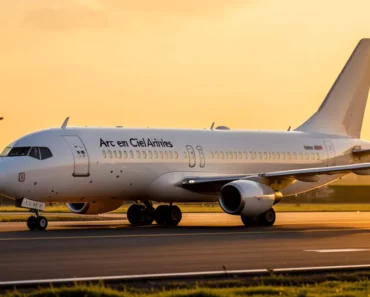
According to publicly disclosed fleet data and industry tracking sources, STP Airways has historically operated narrowbody turboprop and regional jet equipment suited to the relatively short to medium-haul routes that define its network. Aircraft types associated with the carrier’s operations have included turboprop workhorses in the ATR family, which are well-suited to the runway characteristics and passenger volumes typical of Gulf of Guinea island routes. Industry estimates suggest the operational fleet remains modest in size, consistent with the airline’s thin-market positioning. Any fleet renewal or expansion plans, including potential introduction of larger regional jets to support route development ambitions, should be verified against current ANAC São Tomé and Príncipe registry data and the airline’s own communications, as fleet composition at small carriers can shift materially within short timeframes.
Destinations
STP Airways’ network is shaped primarily by the connectivity imperatives of a small island state rather than by commercial hub-and-spoke logic. The core of the route map is intra-African, with services linking São Tomé to key regional centres in Central and West Africa. Historically documented and commercially significant routes have included connections to Libreville (LBV) in Gabon, Douala (DLA) in Cameroon, and Luanda (LAD) in Angola — the latter reflecting the strong Lusophone cultural and economic corridor between São Tomé and Príncipe and Angola. Connections to Lisbon (LIS) represent the airline’s most strategically important intercontinental route, serving the large Portuguese and São Tomean diaspora communities in Europe and underpinning the tourism economy. West African connections, including services toward Lagos (LOS) and Accra (ACC), have featured in the network at various points, reflecting the commercial gravity of Nigeria and Ghana for the sub-region.
Codeshare and Alliance
STP Airways is not a member of any of the three major global airline alliances — Star Alliance, SkyTeam, or oneworld. For a carrier of its size and market, standalone operations are the norm, and formal alliance membership would bring compliance costs that are difficult to justify on current network scale. The airline has at various times pursued interline and commercial cooperation arrangements with regional African carriers and with TAP Air Portugal, the natural partner given the Lusophone connection and the importance of the Lisbon route, though the precise current status of any codeshare agreements should be confirmed directly with the airline or through IATA partner databases.
Notable Incidents
No major safety incidents involving STP Airways appear on its publicly available safety record in recent years. Researchers and journalists requiring a comprehensive safety history should consult the Aviation Safety Network database and the São Tomé and Príncipe civil aviation authority’s official records, as these represent the authoritative sources for any documented occurrences. This profile does not speculate beyond verified public record.
Financial and Operational Situation
Like the majority of small African flag carriers operating from single-island hubs, STP Airways faces structural financial pressures that are well understood across the industry: thin passenger volumes, high per-seat fuel and maintenance costs relative to larger operators, limited domestic revenue diversification, and exposure to currency and fuel price volatility. Industry observers note that the airline’s financial sustainability is closely tied to the health of the São Tomé and Príncipe tourism sector and to remittance-driven diaspora travel demand, both of which are sensitive to broader economic conditions in Portugal, Angola, and the Gulf of Guinea region. State support, whether through direct subsidy, route guarantees, or airport fee arrangements, has historically played a role in sustaining operations, as is common among carriers fulfilling a public service obligation on thin-market island routes. Specific profitability figures are not publicly disclosed in a form that permits reliable independent verification, and any financial claims in third-party reporting should be treated with appropriate caution.
Recent Developments
In the period leading into 2026, STP Airways has been navigating the post-pandemic recalibration that has affected small African carriers disproportionately, as recovery in leisure and diaspora travel has been uneven across the Gulf of Guinea sub-region. Industry attention has focused on whether the airline can stabilise its Lisbon corridor — commercially its most significant route — in the face of competition from larger carriers with greater frequency and connectivity. Discussions around fleet modernisation, including the potential introduction of more fuel-efficient regional equipment, have been reported in aviation trade media, though no confirmed firm orders have been publicly announced as of the time of writing. Regulatory engagement with ICAO and the African Civil Aviation Commission (AFCAC) frameworks, including alignment with the Single African Air Transport Market (SAATM) liberalisation agenda, represents a longer-term structural consideration for the airline’s network development strategy. Travellers and investors monitoring the carrier should track announcements through the airline’s official channels and the São Tomé and Príncipe Ministry of Infrastructure.
Related Research
- São Tomé and Príncipe Expert Briefing — full country profile for investors, journalists and analysts
- African Airlines — the africa-research.org carrier directory and analysis hub
- African Airports — infrastructure profiles across the continent including TMS
- Country Comparison Tool — benchmark São Tomé and Príncipe against peer markets