United Nigeria Airlines
United Nigeria Airlines
About
United Nigeria Airlines is one of the most closely watched privately owned carriers to have emerged from Nigeria’s turbulent aviation sector in recent years — a scheduled airline operating under IATA code NU and ICAO designator UNA, headquartered in Enugu and positioning itself as a credible challenger in a domestic market long dominated by Air Peace and a revolving cast of undercapitalised start-ups. In a continent where airline mortality rates remain stubbornly high, United Nigeria’s continued operation and measured network expansion have drawn cautious optimism from regional aviation analysts.
The airline was founded in 2021, receiving its Air Operator Certificate from the Nigerian Civil Aviation Authority (NCAA) and commencing scheduled passenger services the same year. It was established with backing from Nigerian business interests, with the Obiora Okonkwo-linked investment group widely cited in Nigerian business press as a principal stakeholder — though the precise ownership structure, as is common with privately held Nigerian carriers, has not been disclosed in full to the public record. The airline launched with an explicit mandate to serve underserved routes connecting Nigeria’s south-east to the commercial and political centres of the country.
Since its founding, United Nigeria has pursued a disciplined, if cautious, growth strategy. Rather than chasing intercontinental ambitions prematurely — a trap that has undone several Nigerian carriers — management has focused on consolidating its domestic footprint and building operational reliability. Industry observers note that the airline has navigated Nigeria’s chronic aviation infrastructure challenges, including fuel supply disruptions and foreign-exchange pressures on aircraft leasing costs, with greater resilience than some peers.
Bases and Hubs
Enugu (ENU) — Primary Hub: Akanu Ibiam International Airport serves as the airline’s principal base and spiritual home, reflecting its south-eastern Nigerian identity and giving it a differentiated geographic anchor from Lagos-centric rivals.
Lagos (LOS) — Murtala Muhammed International Airport: Lagos functions as a critical secondary node, connecting United Nigeria’s network to Nigeria’s dominant commercial gateway and its largest passenger catchment area.
Abuja (ABV) — Nnamdi Azikiwe International Airport: The federal capital serves as a focus city, enabling government and business travellers to connect across the carrier’s domestic network.
Port Harcourt (PHC): Port Harcourt International Airport is served as a key focus city, tapping into the oil-sector business travel market of the Niger Delta region.
Fleet
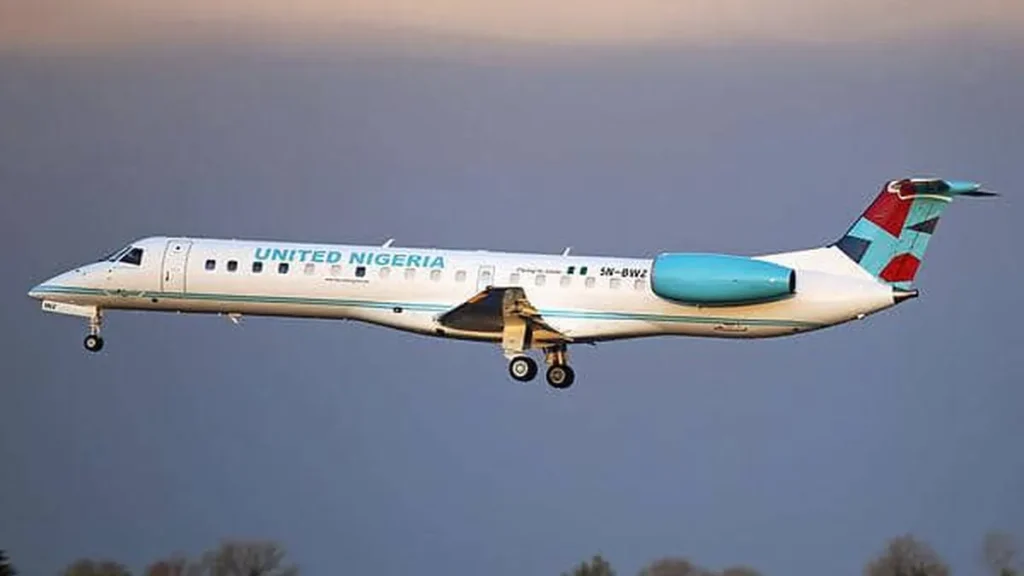
United Nigeria Airlines has operated a fleet centred on the Embraer E-Jet family, with the E195 and E190 variants forming the backbone of its operations — aircraft well-suited to Nigeria’s thinner domestic routes where the economics of narrowbody jets such as the Boeing 737 can be harder to justify at lower frequencies. According to publicly disclosed fleet data and reporting by Nigerian aviation trade media, the airline has also introduced or evaluated Boeing 737 Next Generation series aircraft as it has sought to scale capacity on higher-demand trunk routes. The fleet remains relatively modest in size by global standards, consistent with the airline’s stage of development. Industry estimates suggest the carrier has pursued wet-lease and dry-lease arrangements with international lessors to manage capacity flexibly against Nigeria’s volatile demand environment, rather than committing to large outright purchase orders. Any fleet renewal or expansion announcements as of 2025–2026 should be verified against NCAA registry updates and the airline’s own communications.
Destinations
United Nigeria’s network is primarily domestic in character, reflecting the airline’s strategic focus on connecting Nigerian cities efficiently. Key trunk routes link its Enugu hub to Lagos and Abuja, while additional services reach Port Harcourt, Owerri (QOW), and other secondary Nigerian cities that have historically suffered from poor air connectivity. The airline has publicly signalled interest in regional West African expansion — destinations such as Accra (ACC) in Ghana and Lomé (LFW) in Togo represent the logical near-term international step for a carrier of its profile — though as of the time of writing, its certificated scheduled network remains predominantly within Nigeria. No long-haul intercontinental services are currently operated. The domestic network shape prioritises the south-east to south-west corridor and the south-east to north-central corridor, serving both VFR (visiting friends and relatives) traffic and the business segment.
Codeshare and Alliance
United Nigeria Airlines is not a member of any of the three major global airline alliances — Star Alliance, SkyTeam, or oneworld — which is consistent with its current stage of development and domestic focus. No major codeshare agreements with international network carriers have been publicly confirmed as of 2026. As the airline matures and if it pursues regional international routes, interline or codeshare arrangements with West African carriers or Gulf hub operators would represent a natural commercial evolution, but no such partnerships have been formally announced in the public record at the time of writing.
Notable Incidents
United Nigeria Airlines does not appear on the public record as having been involved in any major hull-loss accidents or fatal incidents since commencing operations in 2021. The airline has not featured in Accident Investigation Bureau (AIB) Nigeria final reports relating to serious accidents as of the research date. Travellers and analysts should, as with any carrier, monitor NCAA and AIB communications for any operational safety notices, and consult the JACDEC or ASN (Aviation Safety Network) databases for the most current independent safety assessments.
Financial and Operational Situation
Like virtually all Nigerian carriers, United Nigeria Airlines operates in one of the world’s most financially demanding aviation environments. The naira’s significant depreciation against the US dollar since 2023 has placed acute pressure on aircraft lease payments, maintenance contracts, and fuel procurement — all of which are typically dollar-denominated — while ticket revenues are collected in local currency. Industry estimates suggest the airline, in common with its domestic peers, has had to implement successive fare adjustments to partially offset these structural cost pressures. The airline is privately held and does not publish audited financial statements in the public domain, making independent profitability assessment difficult. What can be said qualitatively is that the carrier has remained operational and has not undergone the suspension of services or NCAA-imposed groundings that have periodically afflicted other Nigerian operators — itself a meaningful indicator of relative financial and operational stability in this market context.
Recent Developments
In the 2024–2026 period, United Nigeria Airlines has continued to navigate the post-pandemic normalisation of Nigerian air travel demand alongside the macroeconomic headwinds created by Nigeria’s foreign exchange reforms. The airline has been reported in Nigerian aviation and business media as actively reviewing fleet options to support potential network growth, with the Embraer E2 family and additional 737 variants cited in industry speculation as candidates for future operations. The NCAA’s ongoing push to raise safety and operational standards across the Nigerian industry has required all domestic carriers, including United Nigeria, to maintain compliance investment. The airline has also been attentive to the competitive dynamics created by Air Peace’s aggressive domestic and regional expansion, as well as the entry and exit of other domestic competitors. Investors and journalists tracking the carrier should monitor NCAA licence status updates, the airline’s own social and press channels, and Nigerian Aviation Handling Company (NAHCO) and FAAN (Federal Airports Authority of Nigeria) operational announcements for the most current picture.