Ibom Air
Ibom Air
About
Ibom Air occupies a distinctive position in Nigerian and West African aviation: a state-backed carrier that has nonetheless pursued a commercially disciplined, customer-focused model at a time when the broader Nigerian airline sector has been marked by turbulence, consolidation, and high-profile collapses. Launched as a regional carrier rooted in Akwa Ibom State, Ibom Air has grown steadily into one of Nigeria’s more operationally consistent scheduled airlines, drawing attention from industry observers who see it as a template for how sub-national government investment in aviation can be structured without the dysfunction that has historically plagued state-owned carriers on the continent.
Ibom Air was founded by the Akwa Ibom State Government and commenced commercial operations in June 2019, making it one of the younger entrants in Nigeria’s scheduled aviation market. The airline was established partly as an economic development instrument for Akwa Ibom State — home to significant oil and gas activity — and partly as a commercial enterprise intended to be self-sustaining over time. Ownership remains anchored in the state government, though the airline has been managed with a degree of operational independence that distinguishes it from purely political aviation projects seen elsewhere in Africa.
In the years since launch, Ibom Air has navigated the severe disruptions of the COVID-19 pandemic, Nigeria’s persistent foreign-exchange constraints, and the broader cost pressures — particularly fuel costs denominated in dollars — that have challenged every Nigerian carrier. Corporate governance has remained relatively stable by the standards of the sector, and the airline has avoided the sudden suspensions of operations that have periodically affected competitors. As of 2026, Ibom Air is regarded by industry analysts as one of the more resilient domestic Nigerian carriers currently in active scheduled service.
Bases and Hubs
Uyo / Victor Attah International Airport (QUO) — Principal Hub. The airline’s founding base and primary operational centre, located in the capital of Akwa Ibom State in southern Nigeria; all scheduling and maintenance coordination is anchored here.
Lagos / Murtala Muhammed International Airport (LOS) — Key Focus City. Nigeria’s busiest aviation gateway and the airline’s most commercially significant point-to-point market, providing access to the country’s dominant business and consumer hub.
Abuja / Nnamdi Azikiwe International Airport (ABV) — Secondary Focus City. The federal capital serves as an important political and administrative traffic generator, and Ibom Air has maintained scheduled service connecting it to its core network.
Port Harcourt International Airport (PHC) — Regional Focus City. Located in Rivers State and central to Nigeria’s oil and gas industry, Port Harcourt represents a natural market for an airline with deep roots in the Niger Delta region.
Fleet
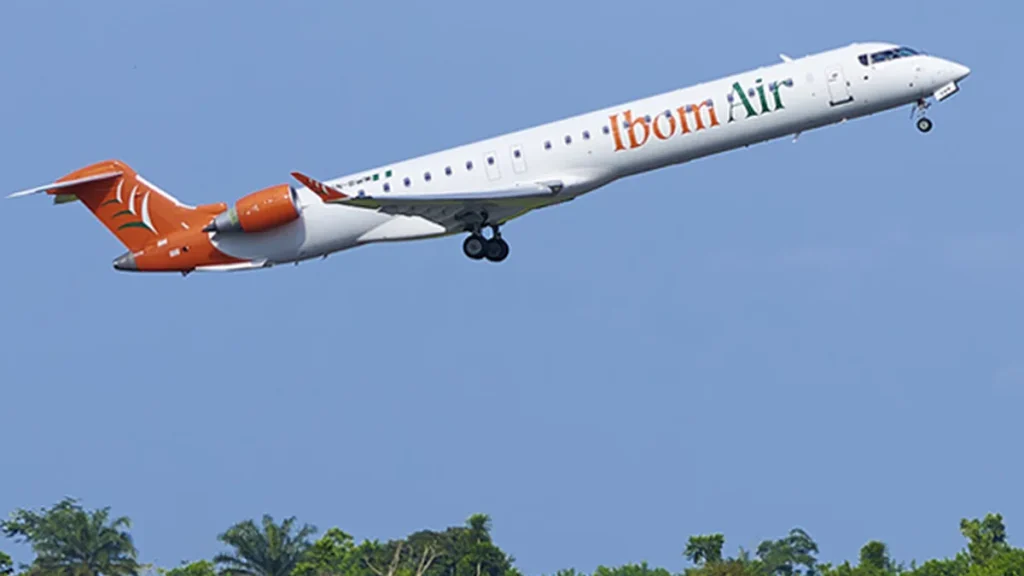
Ibom Air operates an all-Airbus narrowbody fleet, having built its operations around the Airbus A220 family — specifically the A220-300 variant, an aircraft well-suited to the thin-to-medium density routes that characterise the Nigerian domestic market. The A220-300, formerly known as the Bombardier C Series, offers fuel efficiency, a modern cabin, and the range flexibility to support both short domestic sectors and potential regional expansion. According to publicly disclosed fleet data and industry tracking sources, the airline has operated a modest but growing number of these aircraft since launch, with fleet size expanding incrementally as the airline has added routes and frequencies.
The choice of the A220 platform has been noted by aviation analysts as strategically sound: the type’s lower seat-mile costs relative to older narrowbody families provide a structural cost advantage in a market where fuel prices and maintenance expenses are acute operational pressures. Industry estimates suggest Ibom Air has pursued a measured fleet growth strategy rather than aggressive expansion, prioritising utilisation rates and operational reliability over headline capacity numbers.
Destinations
Ibom Air’s network is primarily domestic Nigerian in character, connecting its Uyo hub to the country’s principal commercial, administrative, and regional cities. Key trunk routes include Uyo–Lagos and Uyo–Abuja, which represent the airline’s highest-frequency services and its most commercially critical city pairs. Additional domestic points served have included Port Harcourt, Owerri, and Enugu, reflecting the airline’s focus on the southern and south-eastern Nigerian market where its state-government ownership gives it natural brand recognition and political support.
As of 2026, Ibom Air’s network remains predominantly intra-Nigerian, with no established intercontinental scheduled services. The airline has, at various points, signalled interest in West African regional expansion — routes to neighbouring countries such as Ghana and Cameroon would represent logical extensions given the A220’s range capability and the trade and diaspora flows in the region — though any such expansion would be subject to bilateral air service agreements and the regulatory environment governing Nigerian carriers operating internationally.
Codeshare and Alliance
Ibom Air is not a member of any of the three major global airline alliances — Star Alliance, SkyTeam, or oneworld — a status consistent with its current scale and domestic focus. The airline has not publicly announced significant codeshare agreements with major international carriers as of the time of writing, though such partnerships would be a natural consideration as the airline matures and if it pursues international route authority. Travellers connecting to Ibom Air services from international flights typically do so via interline or self-connect arrangements at Lagos or Abuja rather than through formal codeshare ticketing.
Notable Incidents
Ibom Air has no major accidents or serious incidents on its publicly documented safety record since commencing operations in 2019. The airline has maintained a clean operational safety profile through its first years of service, which industry observers have attributed in part to the relative youth and modernity of its A220 fleet and the operational standards applied during its establishment phase. Researchers and journalists should consult the Aviation Safety Network and Nigeria’s Accident Investigation Bureau (AIB) for the most current and authoritative safety record data.
Financial and Operational Situation
Ibom Air’s financial position reflects both the structural challenges of Nigerian aviation and the relative stability that state backing can provide. The Nigerian airline sector operates in one of the world’s more demanding cost environments: aviation fuel is expensive and subject to supply volatility, aircraft leases and maintenance contracts are priced in US dollars while ticket revenues are collected in naira, and the naira’s significant depreciation in recent years has materially increased the real cost of operations for all carriers. Ibom Air, like its domestic peers, has had to navigate these pressures through fare adjustments and capacity management.
The airline’s state-government ownership provides a degree of financial resilience that purely private Nigerian carriers have lacked, though it also introduces questions about long-term commercial discipline and the sustainability of any implicit subsidy arrangements. Industry estimates suggest the airline has prioritised operational continuity and load factor management over aggressive market-share growth, a posture that has allowed it to remain in continuous scheduled service while several competitors have suspended or ceased operations. No detailed audited financial statements have been made publicly available in a form accessible to external researchers at the time of writing.
Recent Developments
In the 24 months leading into 2026, Ibom Air’s most significant operational story has been its continued resilience in a Nigerian domestic market that has seen considerable upheaval, including the exit or suspension of other carriers. The airline has maintained scheduled services and, according to publicly available schedule data, has sustained frequencies on its core routes despite the macroeconomic headwinds affecting the sector. Fleet utilisation and on-time performance have been cited by Nigerian aviation commentary as areas where Ibom Air compares favourably to some domestic competitors.
The airline has also been the subject of ongoing discussion regarding potential route expansion, both within Nigeria and toward West African regional markets. Nigeria’s aviation regulatory environment, overseen by the Nigerian Civil Aviation Authority (NCAA), has continued to evolve, and any international route launches by Ibom Air would require NCAA approval alongside bilateral clearances. Investors and journalists tracking the airline should monitor announcements from the Akwa Ibom State Government, which as the principal shareholder remains the primary source of strategic direction for the carrier.
Related Research
- Nigeria Expert Briefing — full country profile, economic context, and aviation regulatory environment
- African Airlines — the africa-research.org pillar covering carriers across the continent
- African Airports — infrastructure profiles including Nigerian gateway and regional airports
- Country Comparison Tool — benchmark Nigeria’s aviation market against peer African economies