Museum of Black Civilizations
Museum of Black Civilizations
About
The Museum of Black Civilizations — Musée des Civilisations Noires in French — stands as one of the most ambitious cultural institutions on the African continent. Opened in Dakar, Senegal, in 2018, it was conceived not merely as a repository of objects but as a statement: that the histories, arts, and intellectual traditions of African and diasporic peoples deserve a world-class home on African soil. At a moment when debates about colonial-era collections held in European institutions have grown louder, the museum’s existence carries both symbolic and practical weight.
The idea for the museum traces back decades, to a vision articulated by Senegal’s first president, Léopold Sédar Senghor, whose philosophy of Négritude placed African cultural identity at the centre of political and intellectual life. The project was long delayed by funding and logistical challenges before gaining renewed momentum through a partnership between the Senegalese government and China, which provided significant financing and construction support. The museum formally opened its doors in December 2018, inaugurated by President Macky Sall.
The institution’s mandate is broad by design: it covers African civilisations from prehistory to the contemporary era, and explicitly includes the African diaspora — acknowledging that Black history did not stop at the continent’s shores. Its programming has drawn on collaborations with African scholars, curators, and cultural institutions, positioning Dakar as a hub for pan-African cultural exchange rather than a passive recipient of international museum models.
Country and city context
Senegal is one of West Africa’s most politically stable democracies, with a long tradition of intellectual and artistic life centred on its capital, Dakar. The city sits on the Cap-Vert peninsula — the westernmost point of the African mainland — and has historically served as a crossroads of trade, migration, and ideas. Home to roughly four million people in its greater metropolitan area, Dakar hosts major universities, a thriving contemporary art scene anchored by the Dak’Art Biennale, and a coastline that has made it a destination for travellers from across the continent and beyond. The Museum of Black Civilizations fits naturally into this landscape, occupying a prominent site that underscores the city’s self-image as a capital of African modernity. → Read the Senegal expert briefing
Collection highlights
The museum’s permanent collection and rotating galleries span a wide chronological and geographic range. Visitors should note that the collection continues to develop, and specific holdings may shift as loans and acquisitions evolve. Among the areas and objects that have featured prominently:
- Prehistoric African artefacts — tools and objects situating human origins firmly within the African continent, offering a corrective to Eurocentric timelines of civilisation.
- Ancient Egyptian and Nubian material culture — representations connecting pharaonic Egypt to the broader African world, a curatorial choice that carries deliberate intellectual intent.
- West African royal regalia and ceremonial objects — pieces illustrating the sophistication of pre-colonial kingdoms including those of the Sahel and forest zones.
- Textiles and dress — a gallery exploring the role of cloth — kente, bogolan, and others — as a carrier of identity, status, and resistance across the continent and diaspora.
- Diaspora galleries — material and documentary culture connecting West Africa to the Americas and the Caribbean, tracing the long arc of forced migration and cultural survival.
- Contemporary African art — rotating works by living African artists, ensuring the museum does not treat African culture as a historical artefact alone.
Architecture and building
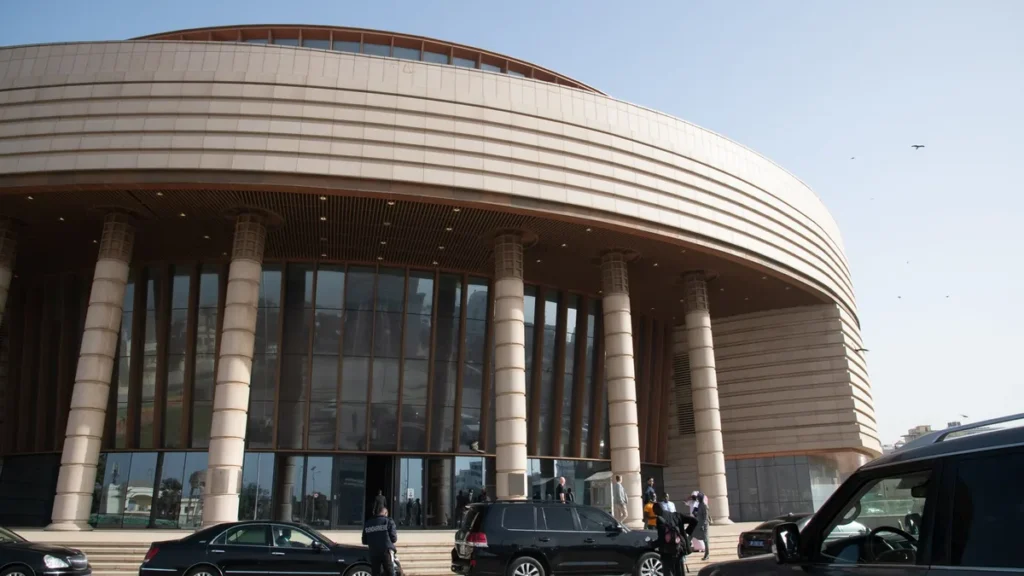
The museum building was designed by a Chinese architectural team working under the framework of the Sino-Senegalese partnership that funded the project. The structure is large-scale and purpose-built, covering approximately 14,000 square metres of exhibition space across multiple floors — a footprint that signals institutional ambition. It opened in December 2018. The exterior has drawn varied responses: some visitors find its scale impressive and fitting for the mission; others have noted that its architectural language does not draw heavily on local or regional building traditions. No major structural renovations have been publicly announced since opening, though interior gallery configurations have been updated as exhibitions change.
Visiting practical
The Museum of Black Civilizations is located in central Dakar, in the area near the Place du Souvenir Africain, making it accessible from most parts of the city by taxi, bus, or the Dakar regional express rail (TER). The museum is generally open Tuesday through Sunday; visitors should confirm current hours directly with the institution before travelling, as schedules can vary seasonally or around national events. Ticket prices fall in a low-to-moderate band by international standards, with reduced rates typically available for students and children. The building is purpose-built and designed with accessibility in mind, including lift access between floors, though visitors with specific mobility requirements are advised to contact the museum in advance.
Repatriation and debates
The Museum of Black Civilizations sits at the centre of one of the most consequential conversations in contemporary museology: the return of African cultural heritage held in European collections. Senegal has been an active voice in these discussions at the governmental level, and the museum’s very existence is partly a response to the reality that a significant proportion of Africa’s material heritage remains outside the continent. The 2018 Sarr-Savoy report, commissioned by France and co-authored by Senegalese scholar Felwine Sarr, called for the large-scale restitution of African objects held in French museums — a report that generated significant debate in Europe and energised advocates across Africa. While the Museum of Black Civilizations has not been the sole or formal recipient of returned objects to date, it represents the kind of institutional infrastructure that repatriation advocates point to when arguing that African nations have the capacity to house and care for their own heritage. The broader debate remains unresolved, with European institutions moving slowly and selectively on returns. Researchers and travellers engaging with this museum will find it impossible — and undesirable — to separate the collection from these ongoing questions.
Recent developments
In the period from 2023 to 2025, the Museum of Black Civilizations has continued to develop its programming and regional profile. Senegal’s political transition in 2024 — which brought a new government to power following a contested electoral period — created some uncertainty around cultural funding priorities, though the museum has continued to operate. The institution has hosted exhibitions connected to pan-African cultural themes and has maintained its role as a venue for dialogue around heritage and restitution. Specific new permanent galleries or major leadership changes have not been widely confirmed in available reporting as of mid-2025; travellers and researchers are encouraged to check the museum’s official communications for the most current exhibition schedule.
Related research
- Senegal expert briefing — political, economic, and cultural context for the country
- Visa requirements — entry requirements for Senegal and the wider region
- Travel industry coverage — trends shaping tourism across Africa
- African airports guide — including Dakar’s Blaise Diagne International Airport
- Country comparison tool — compare Senegal with other African destinations by key indicators