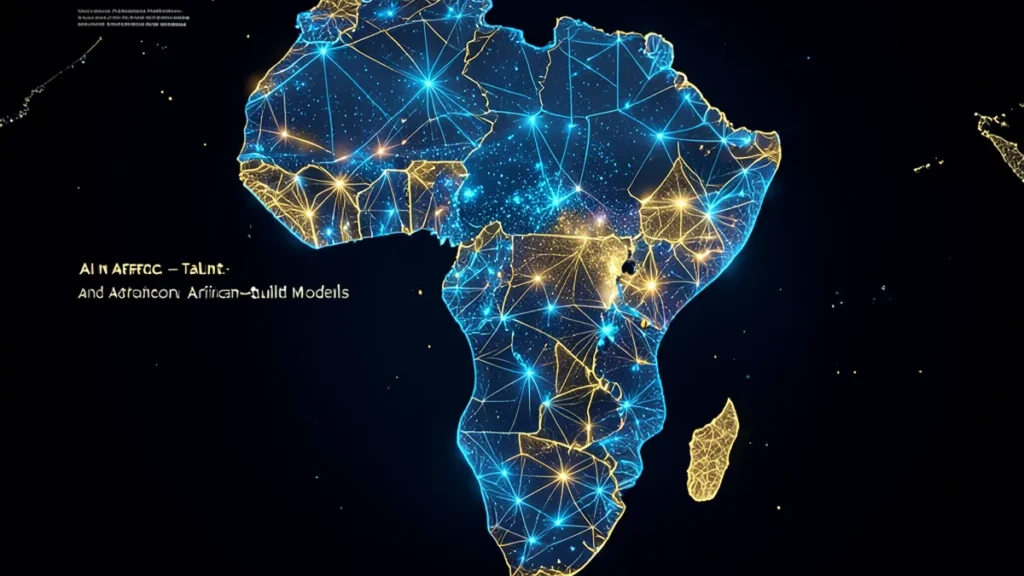
AI in Africa — adoption, talent, and African-built models
Artificial intelligence is reshaping Africa’s research landscape, startup ecosystem, and public-sector ambitions faster than most outside observers anticipated. From Google’s AI research centre in Accra to homegrown large language models trained on Zulu, Yoruba, and Amharic, the continent is no longer simply a recipient of technology developed elsewhere. A distinct African AI identity — rooted in local languages, local problems, and locally trained talent — is emerging, and the institutions, companies, and policy frameworks driving it deserve serious analytical attention.
The Research Infrastructure Taking Shape Across the Continent
The arrival of major global technology companies on African soil has been the most visible signal of the continent’s growing research credibility. Google AI Ghana, headquartered in Accra, opened in 2018 as Google’s first AI research centre on the African continent, focusing on machine learning applications in health, agriculture, and natural language processing for low-resource languages. Microsoft’s Africa Research Institute, with its primary hub in Nairobi and a second node in Lagos, has concentrated on applied AI for agriculture, climate adaptation, and connectivity in low-bandwidth environments. IBM Research Africa, which has operated out of Nairobi and Johannesburg for over a decade, has produced peer-reviewed work on healthcare AI, financial inclusion, and predictive modelling for informal economies. DeepMind, the Alphabet-owned London laboratory behind AlphaFold and AlphaGo, established a presence in Lagos — a move that signalled both the depth of Nigerian technical talent and the strategic importance of training models on African data. These are not satellite offices staffed by expatriates; they are research units publishing at NeurIPS, ICLR, and ICML, and they are hiring locally. The African Institute for Mathematical Sciences network — with nodes in South Africa, Senegal, Ghana, Cameroon, Tanzania, Rwanda, and Ethiopia — functions as the continent’s most important pipeline of mathematically trained graduates into AI research. AIMS has produced hundreds of alumni who now populate both the global research labs and the continent’s own startup ecosystem.
African AI Startups: From Acquisition Targets to Category Builders
The most internationally reported milestone in African AI to date remains BioNTech’s acquisition of InstaDeep in 2023 for approximately £562 million, including milestone payments — a deal that placed a Tunis-founded, London-listed deep learning company at the centre of global biotechnology. InstaDeep, co-founded by Karim Beguir and Zohra Slim, had built reinforcement learning and generative AI infrastructure that BioNTech wanted for drug discovery and mRNA vaccine design. The acquisition validated what African venture investors had argued for years: that AI companies founded by African entrepreneurs, often with African research roots, could compete at the highest level of global technology. Since that deal closed, the ecosystem has continued to mature. Lelapa AI, a South Africa-based research and product company, has positioned itself explicitly around African-language AI, developing models and APIs that allow developers to build applications in Zulu, Sotho, and other Nguni and Sotho-Tswana languages. Awarri, a Nigerian AI company, has focused on building voice and language technology for West African languages, with particular depth in Yoruba and Igbo, targeting use cases in healthcare communication and civic information. Sand Technologies, with operations spanning South Africa, the United Kingdom, and the United States, has built an enterprise AI consultancy and platform business serving clients in utilities, telecommunications, and financial services across multiple continents, demonstrating that African-headquartered AI firms can win large enterprise contracts globally. According to the latest sector reports, AI-focused startup funding across Africa has grown substantially year-on-year since 2021, though it remains concentrated in a small number of hubs and a small number of deals.
The African-Language LLM Frontier
Perhaps the most intellectually distinctive contribution African AI researchers have made to the global field is the systematic effort to build natural language processing resources for the continent’s roughly 2,000 languages, the overwhelming majority of which were absent from the training data of GPT-4, Gemini, Claude, and their predecessors. The Masakhane initiative, a grassroots research collective founded in 2019 by Jade Abbott, Salomey Osei, and a distributed network of African NLP researchers, pioneered the collaborative, community-driven approach to building datasets, benchmarks, and models for African languages. Masakhane’s papers on machine translation, named entity recognition, and sentiment analysis for languages including Amharic, Hausa, Swahili, Twi, and Wolof have been cited widely and have seeded a generation of researchers who understand both the technical and the sociolinguistic complexity of the problem. Lelapa AI’s Inkuba-LM, released in 2024, represented a significant step forward: a genuinely multilingual African-language model trained on curated corpora across several South African languages, designed for deployment in real applications rather than purely as a research artefact. Vulavula, Lelapa’s API platform built on top of that research, allows developers to access speech recognition, text-to-speech, and language identification for South African languages at commercial scale. The significance of these efforts extends beyond linguistic inclusivity. Training models on African-language data requires solving hard problems in low-resource NLP, data curation, and evaluation methodology — problems whose solutions are generalisable and whose publication advances the global field. African-language LLM research is not a charitable sideshow; it is frontier science.
Policy and the AU Continental AI Strategy
The African Union adopted its Continental Artificial Intelligence Strategy in 2024, providing the first continent-wide policy framework for AI governance, investment, and capacity building. The strategy identifies data sovereignty, algorithmic accountability, and the development of African AI talent as its three structural priorities. It calls on member states to develop national AI strategies aligned with the continental framework, to invest in compute infrastructure, and to establish regulatory sandboxes that allow AI experimentation without exposing citizens to unmitigated risk. The strategy’s governance provisions draw explicitly on the EU AI Act’s risk-tiered approach while arguing for African-specific adaptations — recognising, for instance, that biometric AI systems deployed in contexts with weak civil registry infrastructure carry different risks than the same systems deployed in Europe. Implementation remains uneven. Rwanda and Kenya have moved furthest toward national AI strategies with legislative backing. South Africa’s AI policy process has been slower, complicated by the complexity of its regulatory environment. Nigeria, despite hosting the continent’s largest technology ecosystem, has yet to pass comprehensive AI legislation as of early 2026, though the National Information Technology Development Agency has published draft guidelines. The AU strategy’s success will ultimately depend on whether it can mobilise the compute resources and cross-border data-sharing agreements that African AI researchers consistently identify as their most binding constraints.
Where African AI Talent Lives — and Where It Goes
African AI talent is geographically concentrated in a handful of cities, each with a distinct character. Cairo is the continent’s largest technology talent pool by volume, with strong university pipelines from Cairo University and the American University in Cairo feeding both local startups and global companies. Tunis punches above its weight, partly because of InstaDeep’s legacy and partly because of a French-language higher education system that produces mathematically strong graduates competitive in European and North American research markets. Cape Town hosts the bulk of South Africa’s AI research activity, anchored by the University of Cape Town, Stellenbosch University, and a cluster of AI companies including Lelapa. Lagos is the commercial engine, home to the largest concentration of AI product companies and the DeepMind office, drawing talent from across Nigeria’s strong engineering university system. Nairobi hosts Microsoft’s Africa Research Institute and a mature startup ecosystem with deep connections to East African agricultural and financial services sectors. Kigali has emerged as a deliberate policy bet: Rwanda’s government has invested heavily in positioning the city as a technology hub, and the presence of the Carnegie Mellon University Africa campus and an AIMS node has given it a research infrastructure disproportionate to its population size. The talent flow question remains contested. Industry estimates suggest that a significant share of African AI researchers trained at AIMS or at the continent’s top universities ultimately take positions in Europe or North America, drawn by salary differentials and access to compute. The growth of well-resourced local research labs — Google AI Accra, Microsoft Nairobi, DeepMind Lagos — has begun to alter that calculus, offering researchers the ability to do world-class work without leaving the continent.
Trajectory: A Field in Rapid Transition
African AI in 2026 is neither the nascent curiosity it was in 2018 nor the mature, self-sustaining ecosystem its most optimistic advocates sometimes describe. It is a field in rapid and uneven transition — producing genuine research contributions, genuine commercial successes, and genuine policy frameworks, while still constrained by compute access, data infrastructure gaps, and the gravitational pull of better-resourced research environments elsewhere. The BioNTech–InstaDeep deal, the Masakhane network’s influence on global NLP, the AU Continental AI Strategy, and the expansion of global lab footprints in Lagos, Accra, and Nairobi are not isolated events. They are data points in a trajectory that, if current investment and institutional momentum holds, points toward an African AI ecosystem capable of setting research agendas rather than merely responding to them. The next five years will be defined by whether African governments can build the compute and data infrastructure the strategy requires, whether the continent’s AI companies can scale beyond their current size, and whether the researchers who built this field can be retained to lead its next phase.