Mauritania Airlines
Mauritania Airlines
About
Mauritania Airlines (IATA: L6 / ICAO: MAI) is the flag carrier of the Islamic Republic of Mauritania and one of a small number of West African carriers operating scheduled international services from a Saharan hub. Positioned at the crossroads of North Africa and sub-Saharan West Africa, the airline occupies a strategically significant but commercially challenging niche in the continental aviation landscape — serving a landlocked-adjacent market with limited domestic demand yet growing importance as a transit corridor between the Maghreb and the broader Sahel region.
Mauritania Airlines was established in the early 2010s, emerging from the dissolution of the earlier national carrier Mauritania Airlines International. The restructured entity was set up with a mixed ownership model involving the Mauritanian state alongside private investors, a structure common among smaller African flag carriers seeking to balance government strategic interest with operational flexibility. The airline received its air operator’s certificate and began building a network focused on regional connectivity that the country’s geography and trade patterns demand.
Ownership and governance have remained closely tied to the Mauritanian government, which retains a guiding stake in the carrier’s strategic direction. In recent years, the airline has undergone quiet but meaningful corporate reorganisation, with reported efforts to attract additional private capital and to professionalise management structures in line with IATA operational safety audit (IOSA) standards. The carrier operates as a scheduled airline, distinguishing it from the charter-heavy operators that serve parts of the broader West African market.
Bases and Hubs
Nouakchott–Oumtounsy International Airport (NKC) — The airline’s principal hub and primary base of operations, NKC serves as the gateway to Mauritania’s capital and the main point of departure for all international routes; the airport underwent significant infrastructure expansion in the 2010s and now handles the bulk of the country’s commercial air traffic.
Nouadhibou International Airport (NDB) — Mauritania’s second city and its principal fishing and mining port, Nouadhibou functions as a secondary focus city for the airline, supporting domestic and select regional services that reflect the economic importance of the northern coastal corridor.
Fleet
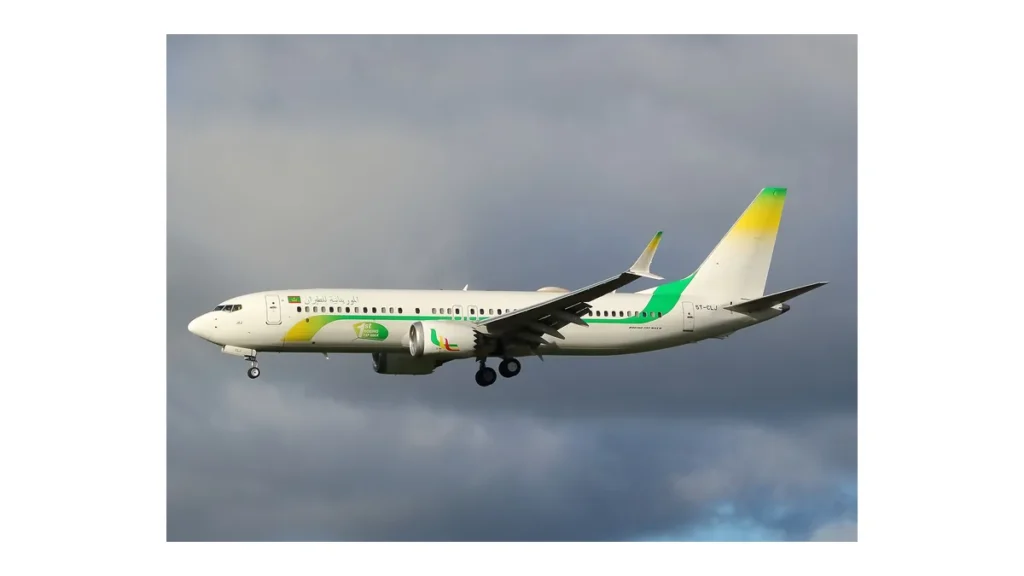
According to publicly disclosed fleet data and industry tracking sources, Mauritania Airlines operates a modest narrowbody fleet suited to the thin-route economics of its network. The carrier has historically relied on Boeing 737 family aircraft — variants within the Classic and Next Generation series — to serve both regional and medium-haul intercontinental sectors. Industry observers have noted the airline’s interest in fleet rationalisation, with a preference for standardising around a single aircraft type to reduce maintenance costs, a priority shared by many smaller African carriers operating under tight margin conditions. No confirmed widebody orders or major fleet expansion announcements had been publicly documented at the time of writing, though industry estimates suggest the operational fleet remains in the single-digit range of active airframes. Any prospective fleet renewal discussions would likely centre on the Boeing 737 MAX family or comparable Airbus A320neo-series aircraft, given their fuel efficiency advantages on the routes the airline serves.
Destinations
Mauritania Airlines operates a network that is primarily regional in character, with a meaningful intercontinental component anchored by services to Europe. The airline’s route map reflects Mauritania’s geopolitical and economic ties: westward to the Canary Islands and mainland Spain, northward to France — particularly Paris (CDG) — and eastward and southward into sub-Saharan West Africa. Key intra-African routes connect Nouakchott with Dakar (DSS) in Senegal, Bamako (BKO) in Mali, Casablanca (CMN) in Morocco, and Tunis (TUN) in Tunisia, forming a network that serves both business travellers and the significant diaspora communities that sustain demand on these corridors. The European services, notably to Paris and Las Palmas, represent the airline’s longest and commercially most significant sectors. Domestic services between NKC and NDB complete the network, providing essential air connectivity within a country where road infrastructure across desert terrain remains limited.
Codeshare and Alliance
Mauritania Airlines is not a member of any of the three major global airline alliances — Star Alliance, SkyTeam, or oneworld. The carrier operates independently, which is typical for smaller African flag carriers at its stage of development. Codeshare arrangements, where they exist, have been limited and bilateral in nature rather than part of a broad interline strategy. The airline has historically maintained working relationships with carriers serving overlapping markets in West and North Africa, though no major codeshare partnership with a large network carrier had been formally and publicly confirmed at the time of writing. Expanding interline and codeshare coverage remains an area of potential strategic development as the airline seeks to improve connectivity for transit passengers moving through NKC.
Notable Incidents
Mauritania Airlines does not have any major accidents or serious incidents prominently documented on its public safety record in recent years. The airline has operated within the regulatory oversight framework of Mauritania’s civil aviation authority, and no events meeting the threshold of a significant hull loss or fatal accident have been attributed to the current carrier entity in credible, publicly available aviation safety databases at the time of writing. Readers seeking comprehensive safety data are directed to the Aviation Safety Network and ICAO’s safety audit disclosures for the most current and authoritative information.
Financial and Operational Situation
Like the majority of smaller African flag carriers, Mauritania Airlines operates in a financially constrained environment shaped by thin passenger volumes, high fuel costs relative to revenue, and the structural challenges of serving a market with limited corporate travel demand. The airline benefits from its flag carrier status, which provides a degree of political support and, historically, some protection from open-skies competition on key routes. However, state support has not insulated it from the broader pressures facing the sector. Industry estimates suggest the carrier has faced recurring profitability challenges, a pattern consistent with peers of similar scale across the continent. Efforts to improve operational efficiency — including load factor optimisation and ancillary revenue development — are understood to be ongoing. The airline’s financial disclosures are not comprehensively public, making independent verification of specific figures difficult; analysts covering the West African aviation market tend to characterise its financial position as fragile but stable, contingent on continued government backing and steady diaspora travel demand.
Recent Developments
In the 24 months leading into 2026, Mauritania Airlines has focused on consolidating its core network rather than aggressive expansion, a posture that reflects both financial caution and the broader post-pandemic recalibration affecting African aviation. The airline has worked to restore and stabilise frequencies on its key European routes following the disruptions of the early 2020s, with the Paris and Las Palmas services remaining central to its commercial strategy. There has been reported interest in strengthening connectivity to Gulf hubs, which would serve the growing number of Mauritanian workers and pilgrims travelling to the Arabian Peninsula, though no confirmed new Gulf route had been publicly announced at the time of writing. Regulatory engagement with ICAO and the African Civil Aviation Commission (AFCAC) has continued as part of Mauritania’s broader commitment to the Single African Air Transport Market (SAATM) framework, which, if fully implemented, could reshape the competitive environment in which the airline operates. Fleet discussions and potential partnership talks with larger regional carriers are understood to be at exploratory stages.