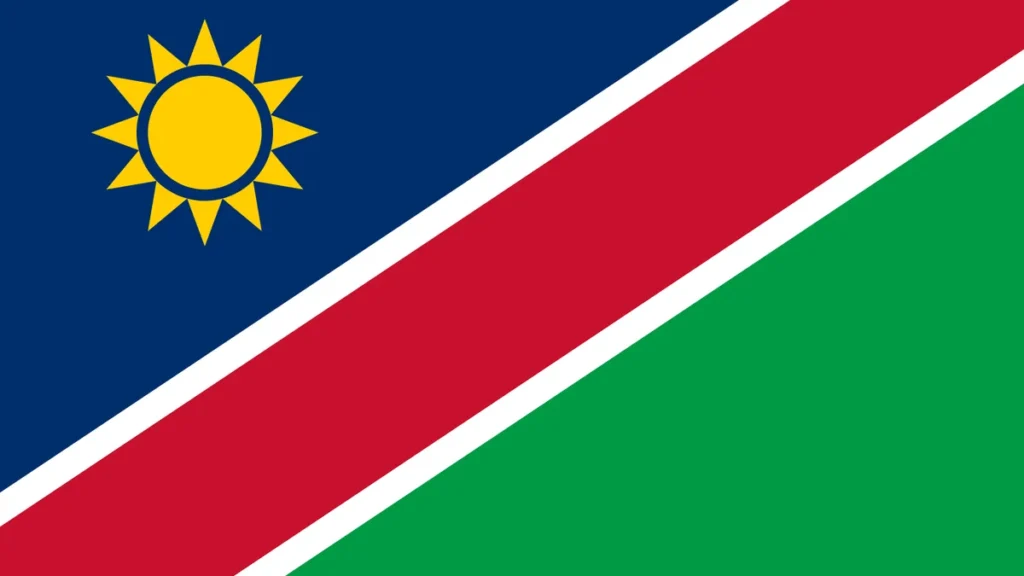
Namibia — Expert Briefing
Namibia at a glance: A sparsely populated, mineral-rich democracy on Africa’s south-western coast, Namibia is emerging as one of the continent’s most consequential energy and critical-minerals frontiers at a moment when global supply chains are being actively redrawn.
Overview
Capital: Windhoek. Population: approximately 2.8 million (World Bank, 2024 estimate), making Namibia one of the least densely populated countries on earth at roughly 3.5 persons per square kilometre. Official languages: English (sole official language since independence in 1990), alongside widely spoken national languages including Oshiwambo, Afrikaans, Otjiherero, Nama/Damara, and others. Currency: Namibian dollar (NAD), pegged at parity to the South African rand under the Common Monetary Area arrangement. GDP per capita: upper-middle-income band, estimated at approximately USD 5,200–5,600 (Atlas method, 2024), though this figure masks deep structural inequality — Namibia consistently records one of the highest Gini coefficients in the world. Namibia matters in 2026 for two intersecting reasons: the country sits atop what geologists and energy majors now describe as one of the most significant offshore oil and gas discoveries of the past decade, while simultaneously holding world-class deposits of green-hydrogen-relevant minerals including uranium, lithium, and rare earths. At a time when both the energy transition and resource nationalism are reshaping African political economies, Namibia’s choices over the next five years will carry consequences well beyond its borders.
Government and Politics
Namibia is a presidential republic. Executive power is vested in a directly elected president who serves as both head of state and head of government, with a constitutionally mandated two-term limit of five years each. The current head of state is President Netumbo Nandi-Ndaitwah, who was inaugurated in March 2025 following the November 2024 general election — making her Namibia’s first female president and the first woman to lead a Southern African Development Community (SADC) member state as an elected head of government. Nandi-Ndaitwah, a veteran of the liberation movement and former Deputy Prime Minister and Foreign Minister, ran on the ticket of the South West Africa People’s Organisation (SWAPO), the party that has governed Namibia without interruption since independence in 1990. The legislature is bicameral: the National Assembly (lower house, 96 elected seats plus up to 8 presidential appointees) and the National Council (upper house, 42 members drawn from regional councils). SWAPO retained its parliamentary majority in the 2024 elections, though its share of the vote continued a gradual decline observed since 2014, reflecting growing urban discontent and competition from the Independent Patriots for Change (IPC) and other opposition formations. The next general elections are scheduled for 2029. No major constitutional amendments have been enacted in the current parliamentary term, though debate continues around land reform provisions and the potential codification of economic rights.
Economy
Namibia’s GDP stood at approximately USD 12.5–13 billion in current prices in 2024 (IMF World Economic Outlook estimates), with real growth running at around 3.5–4 percent annually — a respectable performance for a small open economy exposed to commodity price volatility and the economic cycles of its dominant trading partner, South Africa. The economy rests on three primary pillars: mining (uranium, diamonds, zinc, gold, and increasingly lithium), fishing and fish processing, and services including tourism and financial intermediation. Beef and processed fish are significant agricultural exports. The Namibian dollar’s parity peg to the rand provides monetary stability but constrains independent monetary policy; the Bank of Namibia broadly mirrors South African Reserve Bank rate decisions. Public debt has risen to approximately 65–68 percent of GDP, elevated by post-pandemic fiscal stimulus and infrastructure investment, though the trajectory is considered manageable by regional standards provided hydrocarbon revenues materialise on schedule. The single most consequential economic story of the past 24 months is the accelerating development of the Orange Basin offshore oil and gas fields, where TotalEnergies and Shell hold significant stakes alongside the state-owned National Petroleum Corporation of Namibia (NAMCOR). The Venus and Graff discoveries — among the largest deepwater finds globally in recent years — have attracted intense international investor attention and prompted the government to fast-track a Petroleum Activities Bill and a sovereign wealth fund framework. First commercial production is not expected before the late 2020s, but the anticipation alone is already reshaping fiscal planning, infrastructure investment decisions, and Namibia’s negotiating position in international economic diplomacy. Separately, the Namibia Green Hydrogen project anchored at Lüderitz, backed by a consortium including Hyphen Hydrogen Energy, represents one of the most ambitious renewable energy export initiatives on the continent, though financing timelines have slipped and project viability remains subject to evolving European demand signals.
Demographics and Society
Namibia’s population of roughly 2.8 million is young — the median age is approximately 21 years — and growing at around 2 percent per annum. Urbanisation is accelerating: the United Nations estimates that approximately 55–57 percent of Namibians now live in urban areas, up from under 40 percent at independence, with Windhoek (population approximately 450,000–500,000 in the greater metropolitan area) and Walvis Bay as the principal urban centres. The country is ethnically and linguistically diverse: the Ovambo peoples, predominantly in the north, constitute the largest group at roughly 50 percent of the population and form the core electoral base of SWAPO. Other significant groups include the Kavango, Herero, Damara, Nama, Caprivian (Lozi-speaking), San, Baster, and white Namibians of Afrikaner and German descent — the latter a community whose cultural footprint, particularly in Lüderitz and Swakopmund, remains visible and occasionally politically contentious. Christianity is the dominant religion, practised by an estimated 80–90 percent of the population across a range of denominations, with Lutheran and Catholic traditions particularly strong. The defining social trend of the current moment is the intensifying urban youth unemployment crisis: official youth unemployment (ages 15–34) exceeds 40 percent by most credible estimates, driving both internal rural-to-urban migration and a growing discourse around emigration — sometimes called “Jozi dreams” in reference to Johannesburg — that is generating political pressure on the new Nandi-Ndaitwah administration to demonstrate tangible economic inclusion alongside the macro-level resource boom narrative.
Key Issues Right Now
The hydrocarbon governance challenge. The scale of Namibia’s offshore oil and gas potential has triggered an urgent and unresolved debate about institutional readiness. Civil society organisations, the Namibia Institute of Public Administration and Management, and international watchdogs including the Natural Resource Governance Institute have all flagged gaps in the legislative framework, NAMCOR’s technical and financial capacity, and the risk of elite capture of resource rents before a credible sovereign wealth fund architecture is in place. President Nandi-Ndaitwah has signalled that resource governance reform is a priority, but translating political will into durable institutional design — against a backdrop of fiscal pressure and commercial urgency from international partners — is the central governance test of her first term.
Climate stress and water security. Namibia is the driest country in sub-Saharan Africa and is experiencing measurably worsening drought cycles consistent with regional climate projections. The 2023–2024 El Niño event caused severe agricultural losses in the north and centre of the country, exacerbating food insecurity among subsistence farming communities. The Namibia Meteorological Service and regional bodies including the SADC Climate Services Centre have documented a trend toward more frequent and intense dry spells. Water infrastructure — particularly the Windhoek aquifer system and the Namibia Water Corporation’s (NamWater) distribution network — is under growing strain. The government’s National Adaptation Plan acknowledges these risks, but funding gaps and implementation delays mean that climate vulnerability remains a structural drag on rural livelihoods and agricultural productivity.
The unresolved Herero and Nama genocide reparations question. Germany’s 2021 formal acknowledgement of the 1904–1908 colonial-era genocide against the Herero and Nama peoples, and the accompanying offer of EUR 1.1 billion in development assistance over 30 years, was rejected by many Herero and Nama community leaders and diaspora organisations as inadequate and procedurally flawed — notably because affected communities were not meaningfully consulted in the bilateral negotiations. The issue remains politically live in 2026: community representatives continue to pursue legal avenues in German and international courts, the Namibian government faces domestic pressure to renegotiate terms, and the episode has broader implications for how African states and communities engage with European partners on historical justice questions. It also intersects with ongoing land reform debates, since much of the land at issue was alienated during the colonial period.
Travel and Connectivity
Namibia’s principal international gateway is Hosea Kutako International Airport (WDH), located approximately 45 kilometres east of Windhoek, which handles the majority of long-haul and regional traffic including connections to Frankfurt, London Heathrow, Johannesburg, Cape Town, Addis Ababa, and Nairobi. Walvis Bay Airport (WVB) serves the coastal industrial and tourism corridor and handles some regional charter and scheduled traffic. Principal cities beyond Windhoek include Walvis Bay (the country’s main commercial port and a growing logistics hub), Swakopmund (tourism and light industry), Oshakati (the largest town in the populous north), and Lüderitz (a focal point of the green hydrogen and offshore energy development). Tourism is a significant economic sector and a major source of foreign exchange: Namibia’s appeal rests on its extraordinary landscape diversity — the Namib Desert, Etosha National Park, the Skeleton Coast, Fish River Canyon — and a well-developed, relatively high-value safari and adventure tourism infrastructure. The country targets and largely attracts mid-to-high-spend visitors, particularly from Germany, the United Kingdom, South Africa, and increasingly China. Internet penetration stands at approximately 55–60 percent of the population (ITU estimates, 2024), with mobile broadband the dominant access mode; fixed-line infrastructure is limited outside Windhoek and Walvis Bay. Mobile money adoption is moderate by regional standards — MTC’s mobile financial services and Bank Windhoek’s digital platforms are the principal providers — and the Bank of Namibia has been actively developing a national payments modernisation framework, though Namibia has not yet achieved the mobile money saturation levels seen in Kenya or Tanzania.
Further Research
Analysts, journalists, and investors seeking to deepen their understanding of Namibia should consult the following institutions and resources as primary starting points. The Bank of Namibia publishes quarterly bulletins, annual reports, and monetary policy statements that provide the most authoritative data on macroeconomic conditions, financial sector performance, and the NAD/rand monetary arrangement. The Namibia Statistics Agency (NSA) — formerly the Central Bureau of Statistics — is the official source for census data, national accounts, labour force surveys, and trade statistics, and its publications are essential for any demographic or economic analysis. The Natural Resource Governance Institute (NRGI) has produced detailed assessments of Namibia’s extractive sector governance, particularly in relation to the emerging oil and gas framework, and its work is directly relevant to the hydrocarbon governance debate. The Africa Center for Strategic Studies (Washington, D.C.) provides security, governance, and political economy analysis covering Namibia within its broader Southern Africa coverage. The World Bank Namibia country page aggregates development indicators, project documentation, and country economic memoranda and is a reliable secondary source for cross-country benchmarking. Finally, the Institute for Public Policy Research (IPPR) Namibia, based in Windhoek, is the country’s leading independent think tank and produces policy briefs, election analyses, and research reports on governance, inequality, and economic policy that are indispensable for anyone seeking ground-level analytical perspective.