Ryanair (Morocco operations)
Ryanair (Morocco operations)
About
Ryanair’s Morocco operations represent one of the most consequential low-cost carrier presences on the African continent, connecting the Kingdom’s principal airports to a dense web of European destinations and positioning Morocco as a gateway between Africa and the European Union’s single aviation market. Operating under the IATA code FR and ICAO designator RYR, Ryanair brings its well-established ultra-low-cost model — high seat density, ancillary-revenue discipline, and rapid turnaround times — to a North African market that has grown significantly in strategic importance for both leisure and diaspora travel.
Ryanair, the Irish-registered parent carrier founded in 1984 and headquartered in Swords, County Dublin, began expanding systematically into the Moroccan market in the 2000s as the country liberalised its bilateral air service agreements, most notably through the Open Sky agreement signed between Morocco and the European Union in 2006. That accord was a watershed moment: it allowed EU-based carriers, including Ryanair, to operate freely between Morocco and any EU member state, unlocking a competitive dynamic that permanently altered the pricing environment on Morocco–Europe corridors.
Ryanair Holdings plc, the publicly listed parent company traded on the Euronext Dublin and Nasdaq exchanges, retains full ownership of the operating entity serving Moroccan routes. There is no Moroccan state equity in the operation. In recent years, Ryanair Holdings has reorganised its group structure to include subsidiary carriers such as Buzz, Lauda Europe, and Malta Air alongside the main Ryanair brand, though Morocco-facing services continue to be marketed and operated under the primary Ryanair brand rather than a subsidiary.
Bases and Hubs
Ryanair operates across multiple Moroccan airports rather than concentrating capacity at a single hub, a network architecture consistent with its broader European point-to-point model.
Mohammed V International Airport, Casablanca (CMN) — Morocco’s busiest airport and the primary commercial gateway, serving as Ryanair’s highest-volume Moroccan point of operation for both leisure and VFR (visiting friends and relatives) traffic.
Marrakech Menara Airport (RAK) — A critical leisure-focused base drawing significant UK, French, Spanish, and Italian tourist demand, and one of Ryanair’s most commercially active Moroccan stations.
Fès–Saïs Airport (FEZ) — A key diaspora corridor airport, particularly important for Moroccan communities resident in Belgium, the Netherlands, and France.
Agadir–Al Massira Airport (AGA) — Serves the Atlantic resort market and supports seasonal capacity surges aligned with northern European winter sun demand.
Nador International Airport (NDR) and Tangier Ibn Battuta Airport (TNG) — Smaller focus cities that nonetheless carry meaningful diaspora traffic, particularly to Spain and Belgium.
Fleet
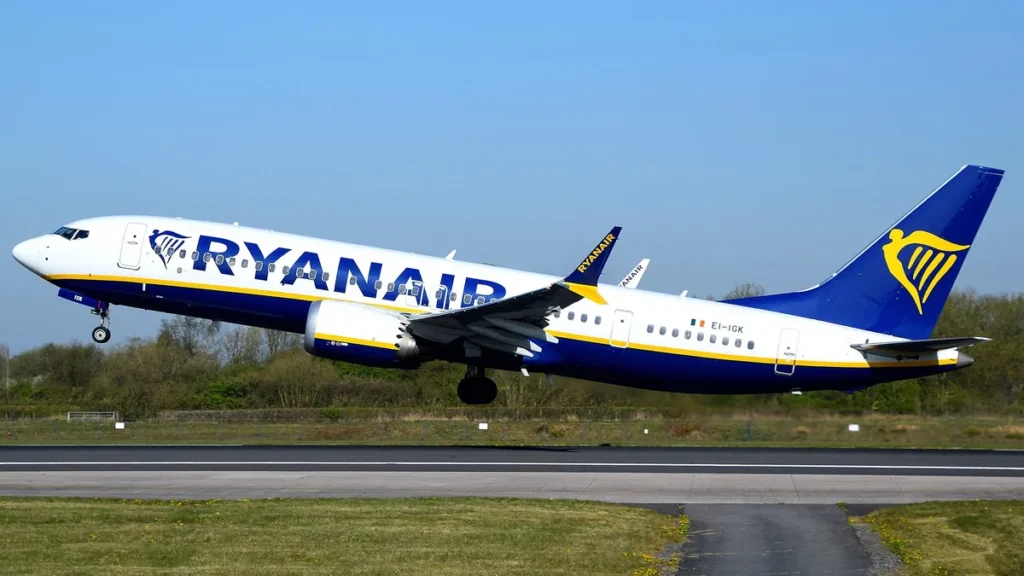
Ryanair’s Morocco-serving flights are operated exclusively with Boeing 737-family aircraft, consistent with the group’s single-fleet-type strategy. The workhorse across the network is the Boeing 737-800, a 189-seat, single-aisle narrowbody configured in a high-density, all-economy layout. According to publicly disclosed fleet data, Ryanair has been progressively introducing the Boeing 737 MAX 8-200 — marketed internally as the “Gamechanger” — across its European and North African network. The MAX 8-200 variant offers greater fuel efficiency and a modestly increased seat count compared with the 737-800, supporting Ryanair’s unit-cost reduction targets. No widebody or regional jet types are operated on Moroccan routes. Ryanair Holdings has placed substantial orders with Boeing for additional MAX aircraft, and industry observers expect the Moroccan network to see an increasing proportion of MAX-family operations as deliveries continue through the mid-2020s.
Destinations
Ryanair’s Moroccan network is overwhelmingly oriented toward Europe, reflecting both the Open Sky framework and the demographic reality of a large Moroccan diaspora across the continent. The carrier does not operate intra-African or intercontinental (transatlantic or Gulf) routes from Morocco; its network shape is firmly point-to-point, Morocco-to-Europe. Key route categories include leisure corridors to the United Kingdom (London Stansted, Manchester, Edinburgh), Spain (Madrid, Barcelona, Seville, Málaga), France (Paris Beauvais, Marseille, Lyon, Bordeaux), Italy (Rome Ciampino, Milan Bergamo, Bologna), Belgium (Brussels Charleroi), and the Netherlands (Eindhoven). The Spain–Morocco and France–Morocco corridors are among the highest-frequency operations, reflecting both tourist flows and the density of Moroccan communities in those countries. Seasonal capacity adjustments are common, with summer schedules typically expanding to serve additional UK and Scandinavian leisure demand into Marrakech and Agadir.
Codeshare and Alliance
Ryanair is not a member of any of the three major global airline alliances — Star Alliance, SkyTeam, or oneworld — and has historically positioned itself explicitly outside the interline and codeshare ecosystem as a matter of commercial philosophy. The carrier does not maintain traditional codeshare agreements with partner airlines on its Moroccan routes. Ryanair has, however, developed its own connectivity product, “Ryanair Rooms” and ancillary partnerships with ground transport and accommodation providers, and has at various points explored limited interoperability with online travel agencies. Travellers connecting beyond Ryanair’s network to onward African destinations must self-connect and rebook independently.
Notable Incidents
No major safety incidents involving Ryanair aircraft operating on Moroccan routes appear on the carrier’s public safety record in recent years. Ryanair as a group holds a strong operational safety reputation and is a certified operator under European Union Aviation Safety Agency (EASA) oversight. Travellers and researchers seeking comprehensive safety data are directed to the Aviation Safety Network database and EASA’s published records.
Financial and Operational Situation
Ryanair Holdings has returned to robust profitability in the post-pandemic period, driven by strong leisure demand recovery across its European and North African network. Industry estimates suggest that Morocco-facing routes contribute meaningfully to the group’s southern European and Mediterranean revenue pool, benefiting from high load factors on diaspora corridors and growing leisure demand from northern Europe. The carrier’s ultra-low-cost structure — characterised by aggressive ancillary revenue generation from baggage fees, priority boarding, and onboard sales — means that headline fares on Morocco routes are frequently among the lowest available in the market, while per-passenger ancillary yields help sustain margins. There is no state ownership or public subsidy involved in Ryanair’s Moroccan operations; the carrier operates on a fully commercial basis. Airport incentive agreements with Moroccan airport operator ONDA (Office National Des Aéroports) have historically supported route development, a common practice in the low-cost carrier sector globally.
Recent Developments
Over the past 24 months, Ryanair has continued to expand its Moroccan footprint incrementally, adding frequencies on established high-demand corridors and selectively launching new city-pair routes in response to competitive dynamics and demand signals. The progressive introduction of Boeing 737 MAX 8-200 aircraft on Moroccan services has been a notable operational development, offering improved fuel economics that support lower base fares. Ryanair has also navigated ongoing regulatory and consumer-rights scrutiny from European authorities regarding refund practices and passenger rights compliance — issues that affect its Morocco-originating passengers as much as its European base. Morocco’s broader aviation ambitions, including infrastructure investment at Mohammed V and the development of a new airport serving the Casablanca region, are expected to create additional capacity opportunities that Ryanair is well-positioned to exploit. The carrier has also faced competitive pressure from Royal Air Maroc’s low-cost subsidiary and from easyJet on select leisure routes, keeping the pricing environment on key corridors highly competitive.