Nouakchott–Oumtounsy International Airport
Nouakchott–Oumtounsy International Airport
Nouakchott–Oumtounsy International Airport (NKC)
Nouakchott–Oumtounsy International Airport (IATA: NKC | ICAO: GQNO) is the principal international gateway to Mauritania and the primary aviation hub serving the country’s capital, Nouakchott. Positioned at the western edge of the Sahara and facing the Atlantic coast, the airport occupies a strategically significant location on the air-bridge between North Africa, West Africa, and Europe — making it a quietly important node in the continent’s evolving aviation network.
About
Nouakchott–Oumtounsy International Airport replaced the older Nouakchott Airport (also known as Nouakchott Civil Airport) as the city’s main international facility. The new airport, located at Oumtounsy approximately 25 kilometres north-east of the city centre, was inaugurated in 2016 and represented a generational upgrade in Mauritania’s civil aviation infrastructure. Developed with financial and technical support from international partners, the facility was designed from the outset to handle significantly greater passenger volumes than its predecessor and to meet contemporary international safety and operational standards set by ICAO.
The airport is operated under the authority of the Mauritanian state, with oversight from the Agence Nationale de l’Aviation Civile (ANAC Mauritanie), the country’s civil aviation regulatory body. Since opening, the facility has undergone phased works to expand its operational capacity and improve landside services, reflecting Mauritania’s broader ambitions to position Nouakchott as a credible transit and business destination in the Sahel-Atlantic corridor.
The airport’s runway infrastructure includes a primary instrument runway capable of accommodating wide-body jet aircraft, enabling direct long-haul services to European capitals — a critical feature for a country whose economy depends on mining exports, fishing, and growing diplomatic engagement. The airfield’s design and approach procedures comply with ICAO Annex 14 standards, and the facility holds the certifications required to receive Category C and D aircraft types.
Country
Mauritania is a vast, sparsely populated republic in north-west Africa, bordered by Western Sahara, Algeria, Mali, Senegal, and the Atlantic Ocean. Its capital, Nouakchott, is home to a substantial share of the country’s population — estimated in the low millions — in a nation whose total population numbers several million people spread across one of the largest land areas on the continent. Mauritania occupies a pivotal geographic position bridging the Arab Maghreb and sub-Saharan West Africa, and its political and economic relationships span both regions. The country is a member of the Arab League, the African Union, and the Economic Community of West African States (ECOWAS) observer framework, giving it relevance to analysts tracking Sahelian security, resource extraction, and regional migration patterns.
→ Read the Mauritania expert briefing
Airlines based here
Mauritania Airlines International (MAI) is the flag carrier of Mauritania and uses Nouakchott–Oumtounsy as its primary hub and operational base. The airline operates a modest fleet on both regional African routes and intercontinental services to Europe, functioning as the country’s principal scheduled carrier. Mauritania Airlines International has historically maintained codeshare and interline arrangements with larger network carriers to extend its passengers’ reach beyond its own network.
Beyond the national carrier, the airport attracts a range of visiting international airlines that operate scheduled services into Nouakchott without basing aircraft there. These include Royal Air Maroc, which connects Nouakchott to Casablanca and onward to its extensive intercontinental network; Air France, which has maintained a Paris–Nouakchott service reflecting longstanding Franco-Mauritanian ties; Turkish Airlines, which serves the airport as part of its expanding African network out of Istanbul; and Air Senegal, which links Nouakchott to Dakar on a short but commercially important regional route. Tunisair has also operated services connecting Nouakchott to Tunis. The precise frequency and scheduling of these carriers is subject to seasonal adjustment and commercial review.
Flights and destinations
The route network at Nouakchott–Oumtounsy reflects the airport’s dual role as a national gateway and a regional connector. Intercontinental services link Nouakchott directly to Paris (Charles de Gaulle) and Istanbul, providing access to two of the world’s largest aviation hubs and, by extension, onward connectivity to the Americas, Asia, and the Gulf. Within Africa, the airport supports scheduled services to Casablanca, Dakar, Bamako, Abidjan, Las Palmas (Canary Islands, Spain — a route of significance given proximity and diaspora ties), and Tunis. Domestic connectivity within Mauritania, serving cities such as Nouadhibou in the north, is also facilitated through the airport, though domestic aviation in Mauritania remains limited in scale. The overall network, while not large by continental standards, is well-calibrated to the country’s trade, diplomatic, and migration flows.
Facilities and capacity
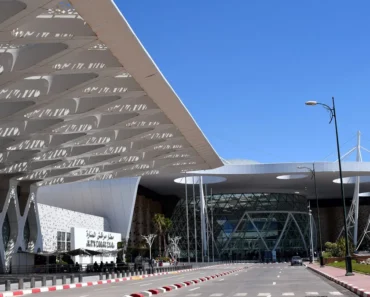
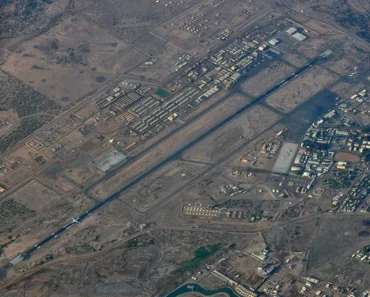
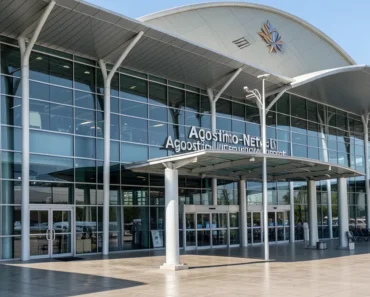
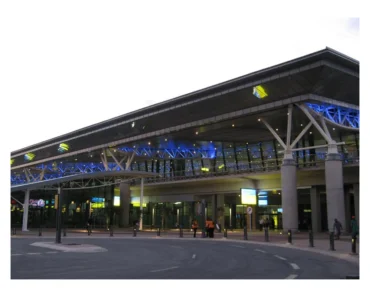
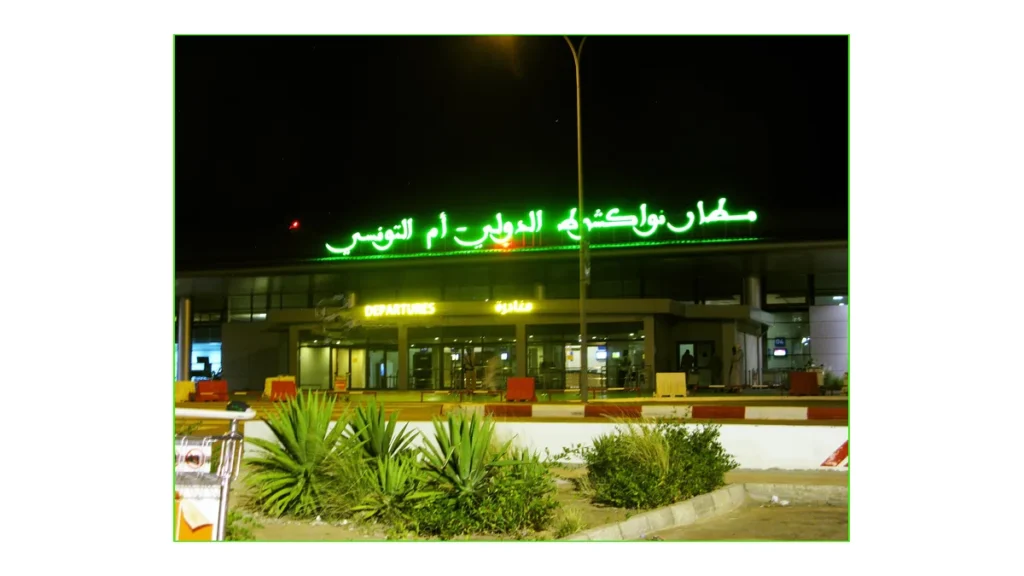
The passenger terminal at Nouakchott–Oumtounsy is a single integrated structure designed to handle both international and domestic traffic, with separate processing zones for arriving and departing passengers. The terminal incorporates modern check-in halls, immigration and customs facilities, a departure lounge with retail and food-and-beverage concessions, and airside gates served by both jet bridges and remote stands with bus transfers. The airport operates one primary runway, oriented to accommodate the prevailing wind conditions of the coastal Saharan environment, and is equipped with instrument landing system (ILS) infrastructure to support operations in reduced-visibility conditions.
Cargo handling facilities are present at the airport, supporting Mauritania’s export economy — particularly fish products from the Atlantic coast and goods related to the mining sector. The cargo apron and warehousing capacity are modest relative to major African freight hubs, but are adequate for current traffic levels. By continental classification, Nouakchott–Oumtounsy is best described as a small-to-medium international hub: larger and more capable than many secondary African airports, but operating well below the throughput of major African gateway airports such as Casablanca Mohammed V, Addis Ababa Bole, or Johannesburg O.R. Tambo. According to publicly disclosed traffic data and industry estimates, the airport handles passenger volumes in the range consistent with its network size, with growth potential tied to Mauritania’s economic trajectory and regional connectivity ambitions.
Visa regulations
Travellers arriving at Nouakchott–Oumtounsy International Airport are subject to Mauritania’s national visa regime, which has evolved in recent years toward greater accessibility. Citizens of many countries — including the United States, the United Kingdom, and European Union member states — have generally been eligible to obtain a visa on arrival at the airport, subject to payment of the applicable fee and presentation of a valid passport, onward travel documentation, and proof of accommodation. An eVisa system has also been available for pre-travel application, allowing eligible travellers to obtain authorisation before departure and streamline the arrival process. Citizens of a number of African countries, particularly those within the ECOWAS zone and neighbouring states, may benefit from simplified entry arrangements, though the precise terms vary by nationality. Visa policy is subject to change without notice, and travellers are strongly advised to verify current requirements with the nearest Mauritanian embassy or consulate before travel. For a live lookup of current visa requirements by passport nationality, see the visa requirements tool.
Recent developments
In the 24 months leading to mid-2026, Nouakchott–Oumtounsy has seen a number of operationally significant developments. Turkish Airlines consolidated and, by some industry reports, expanded its Nouakchott service, reflecting the carrier’s sustained strategic commitment to African market penetration. Air Senegal’s regional connectivity has been a subject of commercial attention as that carrier restructures its network following earlier financial pressures. On the infrastructure side, works to improve landside access roads and terminal forecourt facilities have been reported, addressing longstanding concerns about ground transport links between the airport and the city centre — a journey that can be complicated by road conditions and traffic. ANAC Mauritanie has continued engagement with ICAO’s regional office for Africa and the Indian Ocean (WACAF) on safety oversight and regulatory alignment. Discussions around potential new route development — particularly toward Gulf destinations and additional West African cities — have been reported in regional aviation trade media, though confirmed new service announcements should be verified against current airline schedules.
News and reports
Ongoing operational and regulatory news relating to Nouakchott–Oumtounsy International Airport can be tracked through several authoritative sources. The Agence Nationale de l’Aviation Civile (ANAC Mauritanie) publishes official notices, regulatory updates, and safety communications through its official channels. ICAO’s Western and Central African regional office (WACAF), based in Dakar, Senegal, covers Mauritania within its oversight remit and publishes regional safety and capacity-building reports. IATA’s Africa and Middle East regional team produces periodic market analysis and connectivity reports that include Mauritanian traffic data where available. For commercial aviation intelligence, subscription services such as OAG, Cirium, and ch-aviation track schedule data, fleet movements, and route changes for carriers serving NKC. Regional news outlets covering Mauritanian affairs — including Agence Mauritanienne d’Information (AMI), the state news agency — occasionally report on airport and aviation developments of national significance. Travellers and researchers should cross-reference multiple sources, as operational details can change rapidly in smaller aviation markets.