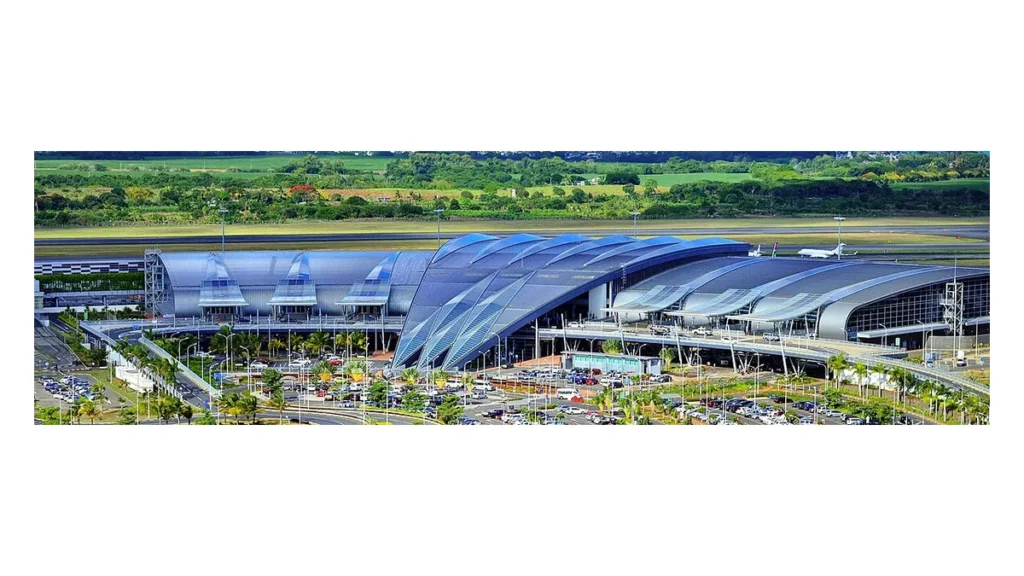
Sir Seewoosagur Ramgoolam International Airport
Sir Seewoosagur Ramgoolam International Airport
Sir Seewoosagur Ramgoolam International Airport (MRU) — Airport Profile
Sir Seewoosagur Ramgoolam International Airport (IATA: MRU / ICAO: FIMP) is the principal international gateway to the Republic of Mauritius, located near Plaine Magnien in the south-east of the island. As one of the busiest and best-connected airports in sub-Saharan Africa and the Indian Ocean region, MRU occupies a strategically significant position in African aviation — serving as a bridge between the African continent, Europe, Asia, and the Middle East. For travellers, journalists, and analysts tracking the development of African air transport infrastructure, this airport represents a compelling case study in how a small island economy can sustain a genuinely international aviation footprint.
About
Sir Seewoosagur Ramgoolam International Airport takes its name from the first Prime Minister of Mauritius, a figure of foundational national importance. The airport’s origins trace to the colonial-era Plaisance Airport, which was developed during the mid-twentieth century and formally upgraded to international standards as Mauritius pursued independence and economic diversification. The airport was renamed in honour of Sir Seewoosagur Ramgoolam following his death in 1985, cementing its symbolic as well as functional role in the nation’s identity.
Ownership and operational oversight of the airport rests with Airports of Mauritius Ltd (AML), a state-linked entity operating under the policy framework of the Mauritius government. AML has overseen successive rounds of infrastructure investment since the 1990s, with the most transformative being the construction and phased opening of a new terminal complex — commonly referred to as the New Terminal — which significantly expanded passenger handling capacity, introduced modern retail and lounge facilities, and improved airside efficiency. This development repositioned MRU from a functional but modest facility into a mid-sized hub capable of handling wide-body long-haul aircraft across multiple concurrent operations.
Subsequent expansion phases have addressed cargo handling, apron capacity, and ground transport connectivity. The airport’s elevation and coastal proximity require careful operational planning, and AML has worked alongside the Civil Aviation Department of Mauritius and ICAO’s regional structures to maintain safety and navigational standards consistent with international benchmarks.
Country
Mauritius is a small island nation in the south-western Indian Ocean, with Port Louis serving as its capital city. The country’s population is estimated at approximately 1.3 million, though its economic influence and international connectivity far exceed what that figure might suggest. Mauritius is widely regarded as one of Africa’s most stable and prosperous economies, consistently ranking highly on governance, ease of doing business, and financial services indices. Its geographic position — roughly 2,000 kilometres east of Madagascar — makes it a natural waypoint between southern and eastern Africa and the broader Indo-Pacific corridor. → Read the Mauritius expert briefing
Airlines Based Here
Air Mauritius (IATA: MK) is the flag carrier of the Republic of Mauritius and treats MRU as its primary hub. The airline operates long-haul services to Europe, Asia, and Australia, as well as regional routes across the Indian Ocean islands and eastern Africa. Air Mauritius has faced significant financial turbulence in recent years, including a period of administration during the COVID-19 pandemic, and has since restructured its network and fleet with a focus on sustainable route economics. Beyond the national carrier, MRU functions as a focus city for a substantial number of visiting international carriers. These include major European airlines such as Air France, British Airways, Condor, TUI fly, and Corsair, which operate seasonal and year-round leisure-oriented services primarily from Western Europe. Middle Eastern carriers including Emirates and Air Arabia provide connectivity to Gulf hubs, enabling onward connections across Asia and beyond. From the African continent, Kenya Airways and other regional operators maintain scheduled services linking MRU to Nairobi and other eastern African cities.
Flights and Destinations
MRU supports a network that spans four continents, anchored by strong leisure demand from Europe and growing business and diaspora traffic from the Middle East and Asia. Representative intercontinental destinations served from MRU include Paris (Charles de Gaulle), London (Heathrow), Frankfurt, Dubai, and Mumbai. Within the African continent and the Indian Ocean region, scheduled services connect Mauritius to Nairobi, Antananarivo (Madagascar), Réunion (Roland Garros Airport), the Seychelles (Mahé), and Johannesburg. The Johannesburg route, operated by both Air Mauritius and South African carriers at various points, is among the highest-frequency connections on the airport’s schedule and reflects the depth of economic and tourism ties between Mauritius and South Africa. Seasonal charter traffic from Germany, Scandinavia, and Switzerland adds further volume during European winter months, when Mauritius’s summer climate draws significant leisure demand.
Facilities and Capacity
MRU operates a single primary passenger terminal, the New Terminal building, which consolidated and replaced older facilities and brought the airport’s retail, check-in, immigration, and lounge infrastructure to a standard broadly comparable with mid-tier regional hubs elsewhere in the world. The terminal accommodates both departing and arriving international passengers and includes dedicated areas for premium travellers, consistent with the expectations of the long-haul leisure market the airport primarily serves. The airport operates a single main runway — Runway 14/32 — which is of sufficient length to accommodate wide-body aircraft including the Airbus A350, Boeing 787, and Boeing 777, all of which operate regular services into MRU. Cargo facilities are managed separately from the passenger terminal and support Mauritius’s export economy, particularly the movement of fresh produce, cut flowers, and high-value manufactured goods. According to publicly disclosed traffic data from Airports of Mauritius Ltd, MRU handles several million passengers annually, placing it in the medium-hub category by African standards — smaller than the major hubs of Johannesburg, Cairo, or Nairobi, but significantly larger than most other Indian Ocean island airports. Industry estimates suggest that tourism-related traffic accounts for the substantial majority of passenger movements.
Visa Regulations
Mauritius operates one of the more open visa regimes in Africa, which is a deliberate policy choice aligned with the country’s tourism and investment priorities. Travellers holding passports from the United States, the United Kingdom, and European Union member states are generally admitted without a prior visa for stays up to a specified period — commonly cited as 90 days for many of these nationalities — subject to proof of onward travel and sufficient funds. Many African Union passport holders also benefit from visa-free or visa-on-arrival arrangements under bilateral agreements and the broader African Union free movement agenda, though the precise terms vary by nationality. An eVisa system has been available for certain nationalities, providing an online pre-clearance option before travel. It is important to note that visa regulations are subject to change and travellers should verify current requirements before booking. → Check the live visa requirements lookup
Recent Developments
In the 24 months leading into 2026, MRU has seen a gradual but meaningful recovery and expansion of its route network following the disruptions of the pandemic era. Air Mauritius has worked to restore and in some cases extend its pre-pandemic schedule, with particular attention to European leisure routes where demand has rebounded strongly. New or resumed services from European leisure carriers have added seat capacity on key corridors, and the airport authority has reported increased interest from carriers seeking to add Mauritius as a destination amid growing global appetite for Indian Ocean travel. Infrastructure works at the terminal have focused on improving passenger flow and digital processing, including enhanced e-gate technology at immigration. On the regulatory side, the Civil Aviation Department of Mauritius has continued its engagement with ICAO safety oversight programmes, and the airport has maintained its operational certifications without publicly reported significant incidents. Cargo volumes have also attracted attention, with logistics operators exploring MRU as a potential transhipment point for Indian Ocean freight flows, though this remains at an early strategic stage according to industry commentary.
News and Reports
Researchers, journalists, and analysts tracking developments at MRU and in Mauritian aviation more broadly should consult several authoritative sources. Airports of Mauritius Ltd publishes operational updates and press releases through its official communications channels. The Civil Aviation Department of Mauritius, operating under the relevant ministry, issues regulatory notices and safety-related publications. At the regional and global level, IATA’s Africa and Indian Ocean regional reports provide comparative context for MRU’s performance within the broader African aviation market. ICAO’s Eastern and Southern African Regional Office (ESAF) covers Mauritius within its oversight remit and publishes relevant safety and infrastructure assessments. Aviation trade publications including ch-aviation, Anna.aero, and The Air Current provide ongoing commercial route analysis and airline strategy coverage that frequently references MRU in the context of Indian Ocean connectivity. Travellers seeking real-time operational information — delays, terminal notices, ground transport — should refer directly to the Airports of Mauritius Ltd official platform.
Related Research
- Mauritius Expert Briefing — in-depth country analysis for investors, journalists, and researchers
- Mauritius Statistics — key economic, demographic, and trade data
- African Airports — comparative profiles across the continent
- African Airlines — carrier profiles, routes, and fleet data
- Visa Requirements — live lookup tool for entry requirements by nationality
- Country Comparison — benchmark Mauritius against regional peers