Fastjet Zimbabwe
Fastjet Zimbabwe
About
Fastjet Zimbabwe occupies a distinctive position in southern African aviation: a low-cost carrier operating under the IATA code FN and ICAO designator FJZ, registered in Zimbabwe and headquartered at Robert Gabriel Mugabe International Airport in Harare (HRE). In a region where full-service legacy carriers have long dominated thin, high-fare routes, Fastjet Zimbabwe represents a sustained attempt to bring the low-cost model to one of sub-Saharan Africa’s more challenging operating environments — characterised by foreign-currency constraints, fluctuating demand, and a regulatory landscape that has historically favoured incumbents.
The airline traces its origins to the broader Fastjet group, a pan-African low-cost concept that launched with considerable ambition in the early 2010s, backed in part by the founders of easyJet and listed on the London Stock Exchange’s AIM market. The Zimbabwean operation was established as a locally registered entity to comply with the country’s aviation ownership rules, and it has undergone several rounds of restructuring as the parent group navigated the turbulence common to pioneer low-cost carriers on the continent.
Ownership of Fastjet Zimbabwe has evolved over the years through a combination of local Zimbabwean shareholders and the wider Fastjet group structure. The airline has at various points sought strategic investors and entered discussions with regional aviation bodies as it works to stabilise its balance sheet and expand its network. As of 2026, the carrier continues to operate as an independent low-cost entity, positioning itself as an accessible alternative to road and rail travel for both business and leisure passengers across the region.
Bases and Hubs
Harare (HRE) — Primary Hub. Robert Gabriel Mugabe International Airport serves as Fastjet Zimbabwe’s principal base of operations, handling the majority of the airline’s departures and arrivals and serving as its crew and maintenance centre.
Bulawayo (BUQ) — Secondary Focus City. Joshua Mqabuko Nkomo International Airport in Bulawayo, Zimbabwe’s second-largest city, functions as a domestic focus point, connecting the country’s commercial heartland in Matabeleland to the capital and onward regional destinations.
Victoria Falls (VFA) — Leisure Gateway. Victoria Falls Airport is a strategically important leisure-traffic node for the airline, feeding tourism demand from the broader southern African region and serving as a natural connection point for travellers visiting one of Africa’s most visited natural landmarks.
Fleet
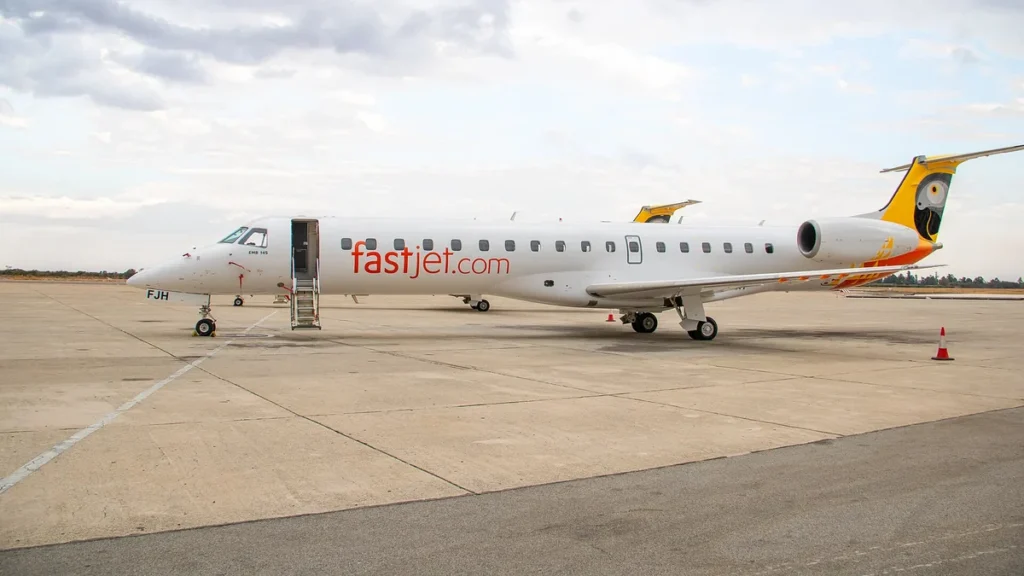
Fastjet Zimbabwe has historically operated narrowbody jet equipment consistent with the low-cost short-to-medium-haul model. According to publicly disclosed fleet data, the airline has operated variants of the Embraer E190 family, a regional jet well suited to the thinner route densities characteristic of the Zimbabwean and broader southern African market. The E190’s economics allow the carrier to maintain viable load factors on routes that would be difficult to sustain with larger narrowbody types such as the Boeing 737 or Airbus A320 family. Industry observers have noted that fleet renewal and right-sizing remain ongoing priorities for the airline as it balances capacity with demand, and any future fleet decisions are expected to reflect the continued dominance of fuel-efficient narrowbody and regional jet types in African low-cost operations.
Destinations
Fastjet Zimbabwe’s network is primarily intra-African in character, with a focus on connecting Zimbabwe’s main population and tourism centres to key regional hubs. Domestically, the airline links Harare, Bulawayo, and Victoria Falls, providing an alternative to long overland journeys on routes where road infrastructure can be unreliable. Regionally, the carrier has operated or sought to develop routes connecting Harare to destinations including Johannesburg (OR Tambo International, JNB) in South Africa — a commercially critical corridor given the volume of business and diaspora traffic — as well as connections into other southern and eastern African markets. The Victoria Falls–Johannesburg pairing is a particularly important leisure route, attracting both inbound tourists and regional travellers. The airline’s intercontinental network is limited, consistent with its low-cost regional positioning, and long-haul flying is not a stated strategic priority.
Codeshare and Alliance
Fastjet Zimbabwe is not a member of any of the three major global airline alliances — Star Alliance, SkyTeam, or oneworld. As a low-cost carrier focused on point-to-point travel, formal alliance membership is not consistent with its business model. The airline has at various times explored interline and codeshare arrangements with regional partners to improve connectivity for passengers transiting through its hubs, though the depth and current status of any such agreements should be verified directly with the carrier or through current IATA documentation. Investors and travel buyers seeking connectivity data are advised to consult the airline’s current published interline directory.
Notable Incidents
Fastjet Zimbabwe does not have any major accidents or serious safety incidents on its publicly available safety record in recent years. The airline operates under the oversight of the Civil Aviation Authority of Zimbabwe (CAAZ) and is subject to regional safety frameworks applicable to carriers operating within southern African airspace. Journalists and researchers requiring a comprehensive safety audit trail are directed to the Aviation Safety Network database and CAAZ published records.
Financial and Operational Situation
Fastjet Zimbabwe’s financial profile reflects the broader challenges facing low-cost aviation in sub-Saharan Africa. The airline has operated in an environment defined by Zimbabwe’s well-documented macroeconomic difficulties, including currency instability, restricted access to foreign exchange for aircraft leasing and fuel procurement, and subdued consumer purchasing power. Industry estimates suggest that the carrier, like many African low-cost operators, has faced sustained pressure on yields and load factors, particularly during and after the COVID-19 pandemic period, which devastated aviation demand across the continent. The airline’s path to sustained profitability is understood to depend on network rationalisation, fleet efficiency, and the broader recovery of Zimbabwean and regional travel demand. Any specific financial disclosures should be sourced from the airline’s official filings or statements to the relevant stock exchange or regulatory authority.
Recent Developments
In the 24 months to early 2026, Fastjet Zimbabwe has continued to navigate a post-pandemic recovery environment while managing the structural constraints of operating in Zimbabwe’s economy. The airline has focused on consolidating its core domestic network and maintaining its key regional routes, particularly the Harare–Johannesburg corridor, which remains its most commercially significant international link. Discussions around fleet renewal and potential new route launches have been reported in regional aviation media, reflecting the carrier’s ambition to grow cautiously as demand recovers. Regulatory engagement with the Civil Aviation Authority of Zimbabwe and bilateral air services agreement developments between Zimbabwe and its neighbours remain important variables for the airline’s near-term network planning. Stakeholders are encouraged to monitor official announcements from the airline and CAAZ for the most current operational and commercial updates.
Related Research
- Zimbabwe Expert Briefing — full country profile, economic context, and aviation regulatory environment
- African Airlines — the complete pillar covering carriers across the continent
- African Airports — infrastructure profiles including HRE, BUQ, and VFA
- Country Comparison Tool — benchmark Zimbabwe’s aviation market against regional peers