Bangui M’Poko International Airport
Bangui M’Poko International Airport
About
Bangui M’Poko International Airport (IATA: BGF; ICAO: FEFF) is the principal gateway to the Central African Republic and one of the more strategically significant — if chronically under-resourced — airports in the heart of the African continent. Sitting at the crossroads of Central and West African air corridors, BGF serves as the sole international commercial airport in a landlocked nation that depends heavily on air connectivity for humanitarian logistics, diplomatic traffic, and what commercial passenger demand exists. For travellers, journalists, and aviation analysts, understanding BGF means understanding the intersection of fragile-state governance, humanitarian aviation, and the slow, uneven modernisation of African airport infrastructure.
The airport takes its name from the M’Poko River, which runs close to its perimeter on the western edge of Bangui. It was established during the French colonial era and has operated in its current general configuration since the mid-twentieth century, with its origins traceable to airfield infrastructure developed in the 1950s. Ownership and operational oversight rest with the Central African Republic’s government, with the national civil aviation authority — the Agence Nationale de l’Aviation Civile et de la Météorologie (ANACIM-RCA, or its equivalent successor body) — holding regulatory responsibility. Day-to-day airport management has at various points involved technical assistance from French civil aviation bodies, reflecting the country’s continued administrative ties with France.
Major capital investment at BGF has been episodic rather than systematic. The airport has benefited from periodic rehabilitation works supported by international partners, including the African Development Bank and bilateral donors, though the security environment in the Central African Republic has complicated sustained infrastructure programmes. The terminal building, while functional, reflects decades of deferred maintenance punctuated by targeted upgrades. Runway resurfacing and navigational aid improvements have been undertaken at intervals, often tied to the operational requirements of United Nations and humanitarian flight operators who constitute a significant share of movements at the airport.
Country
The Central African Republic (CAR) is a landlocked nation in the heart of sub-Saharan Africa, bordered by Chad, Sudan, South Sudan, the Democratic Republic of Congo, the Republic of Congo, and Cameroon. Bangui, situated on the Ubangi River along the border with the DRC, serves as the national capital and is home to a significant share of the country’s population, which numbers in the range of several million people across a territory roughly the size of France. The CAR is consistently ranked among the world’s least-developed countries, and its political and security landscape — marked by prolonged conflict and the presence of UN peacekeeping forces (MINUSCA) — shapes virtually every dimension of life in Bangui, including the operation of its international airport.
→ Read the Central African Republic expert briefing
Airlines based here
BGF does not currently host a full-service national carrier in the conventional sense. The Central African Republic has historically struggled to sustain a flag carrier, and as of 2026, no domestically based airline operates scheduled international services at the scale that would qualify it as a hub carrier. Aero Service, a long-standing Central African operator, has provided domestic and sub-regional charter and scheduled services and maintains a presence at BGF, but its network is limited in scope. The airport’s scheduled international traffic is therefore dominated by visiting carriers — foreign airlines that include Bangui as a point on their regional networks rather than as a home base.
Air France has historically been the most prominent full-service carrier serving BGF, operating connections via Paris Charles de Gaulle that provide the airport’s primary intercontinental link. Ethiopian Airlines, which has aggressively expanded its pan-African network from its Addis Ababa hub, serves Bangui as part of its Central African routing. Kenya Airways has at various points included BGF within its African network. Regional operators including Camair-Co (Cameroon) and, intermittently, carriers based in neighbouring states have provided sub-regional connectivity, though schedules on these thinner routes are subject to suspension and resumption depending on commercial viability and the broader security environment.
Flights and destinations
The route network at Bangui M’Poko is modest by continental standards but covers the key corridors that matter most to the airport’s primary user groups. Intercontinentally, Paris (Charles de Gaulle) represents the single most important long-haul destination, serving the large diaspora community, government and diplomatic travellers, and French institutional actors with interests in the CAR. Within Africa, Addis Ababa (Bole International) is a critical hub connection, giving BGF passengers onward access to Ethiopian Airlines’ extensive global network. Nairobi (Jomo Kenyatta International) has featured as a destination, providing connectivity into East Africa’s commercial and humanitarian hub. Douala and Yaoundé in Cameroon serve as the most important sub-regional links, reflecting the deep economic and logistical ties between the CAR and its western neighbour. N’Djamena in Chad, Kinshasa in the DRC, and Brazzaville in the Republic of Congo round out the core regional network, connecting Bangui to the capitals of its immediate neighbours. Humanitarian and UN-operated flights — managed through organisations such as the World Food Programme’s UNHAS service — add a further layer of operational traffic to destinations within the CAR and across the broader humanitarian corridor, though these are not commercial scheduled services in the standard sense.
Facilities and capacity
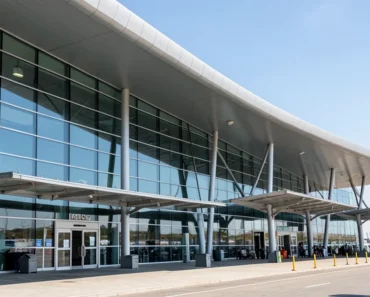
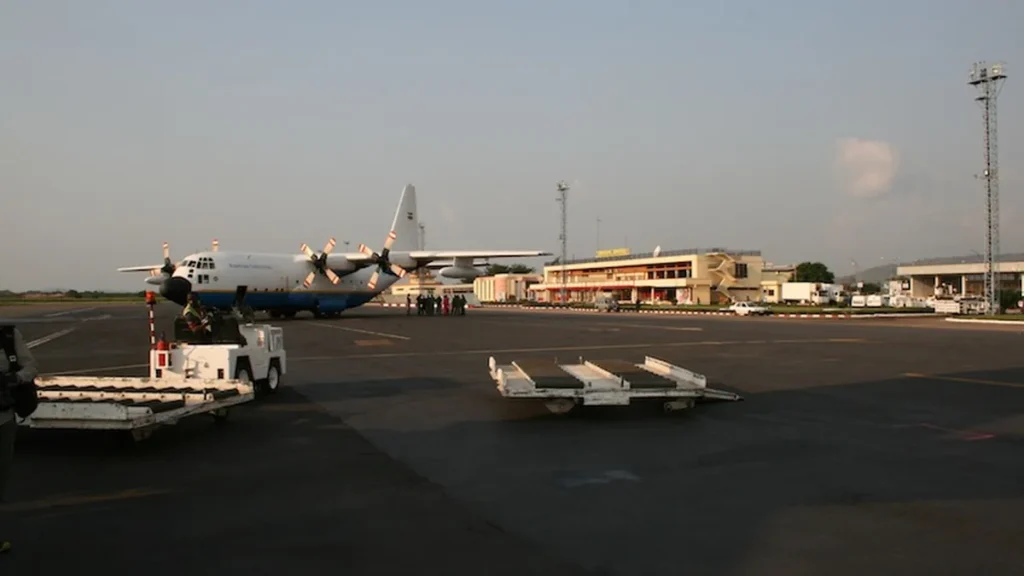
Bangui M’Poko operates a single passenger terminal building that handles both international and domestic traffic. The terminal is functional but compact, and industry observers classify BGF as a small regional hub by African standards — capable of processing the current volume of traffic but with limited redundancy and modest passenger amenity. The airport has a single primary runway, oriented to accommodate the prevailing wind patterns of the region, with a published length sufficient to handle narrow-body jet operations including the Boeing 737 family and Airbus A320 family aircraft that constitute the workhorses of African aviation. Wide-body operations, including Air France’s long-haul services, are technically accommodated, though infrastructure constraints limit the frequency and scale of such movements.
Cargo facilities at BGF are basic but operationally important, given the airport’s role as the primary entry point for humanitarian aid, medical supplies, and relief goods. A dedicated cargo apron area handles freight movements, with ground handling services provided by a small number of contracted operators. Fuel supply infrastructure, always a logistical consideration at airports in fragile states, has been a periodic operational concern. Planned expansion works — including terminal upgrades and apron extensions — have been discussed within the framework of international development assistance, though the timeline and funding status of specific projects should be verified against current disclosures from the CAR government and its development partners, as announced commitments in this environment do not always translate to completed works on schedule.
Visa regulations
Travellers arriving at Bangui M’Poko International Airport are subject to the Central African Republic’s visa regime, which as of 2026 requires most foreign nationals to obtain a visa prior to travel. The CAR does not operate a widely accessible eVisa system comparable to those of more digitally advanced African states, and visa-on-arrival availability is limited and subject to change based on diplomatic relations and administrative capacity at the port of entry. Nationals of the United States, United Kingdom, and European Union member states are generally required to obtain a visa in advance through a CAR embassy or consulate. Citizens of some CEMAC (Economic and Monetary Community of Central Africa) member states — including Cameroon, Chad, the Republic of Congo, Gabon, and Equatorial Guinea — may benefit from preferential entry arrangements under regional agreements, though travellers should verify current conditions before departure. All visa rules are subject to change at short notice, particularly in a country with a dynamic political and security environment. For the most current and source-verified visa requirements applicable to your nationality, use the live lookup tool: → Check visa requirements for the Central African Republic.
Recent developments
In the twenty-four months leading into 2026, Bangui M’Poko has seen a number of operationally significant developments, though the pace of change remains constrained by the country’s broader political and economic circumstances. Ethiopian Airlines has maintained and in some periods strengthened its Addis Ababa–Bangui service, reflecting the carrier’s strategic commitment to comprehensive African coverage even in challenging markets. Discussions around improving ground handling standards and aligning BGF’s operational procedures more closely with ICAO safety oversight recommendations have been reported in civil aviation circles, consistent with the ICAO’s ongoing Universal Safety Oversight Audit Programme engagement across the region.
The humanitarian aviation dimension of BGF’s operations has remained prominent, with MINUSCA and UNHAS continuing to generate significant non-commercial traffic. Security conditions in and around Bangui — which have fluctuated in recent years — have had direct operational implications for the airport, including periods of heightened access restrictions and changes to ground movement protocols. Any traveller or journalist planning to use BGF is strongly advised to consult current security advisories from their government’s foreign affairs ministry, as conditions can shift rapidly and affect airport accessibility and flight operations.
News and reports
Ongoing operational and regulatory news relating to Bangui M’Poko International Airport can be tracked through several authoritative channels. The Central African Republic’s civil aviation authority issues periodic operational notices and regulatory communications that represent the primary official source for airport-specific announcements. IATA’s Africa regional office publishes market intelligence and safety-related reporting that covers BGF within its broader Central African coverage. The ICAO’s Dakar and Nairobi regional offices — which hold oversight responsibility for the CAR — are sources for safety audit findings and corrective action plans. For humanitarian aviation specifically, the UN Office for the Coordination of Humanitarian Affairs (OCHA) and WFP’s UNHAS programme publish operational updates that frequently reference BGF’s role in relief logistics. Aviation trade publications including ch-aviation, The Air Current, and African Business Aviation Association communications provide commercial route and fleet intelligence. Researchers and journalists are advised to cross-reference multiple sources, as information from any single channel may be incomplete given the reporting environment in the Central African Republic.
Related research
- Central African Republic Expert Briefing
- Central African Republic Statistics and Data
- African Airports Directory
- African Airlines Guide
- Visa Requirements Lookup Tool
- African Country Comparison Tool