Sierra Leone — Expert Briefing
Sierra Leone at a glance: A small but strategically positioned West African state navigating post-conflict recovery, democratic fragility, and significant mineral wealth against a backdrop of persistent poverty and climate vulnerability.
Overview
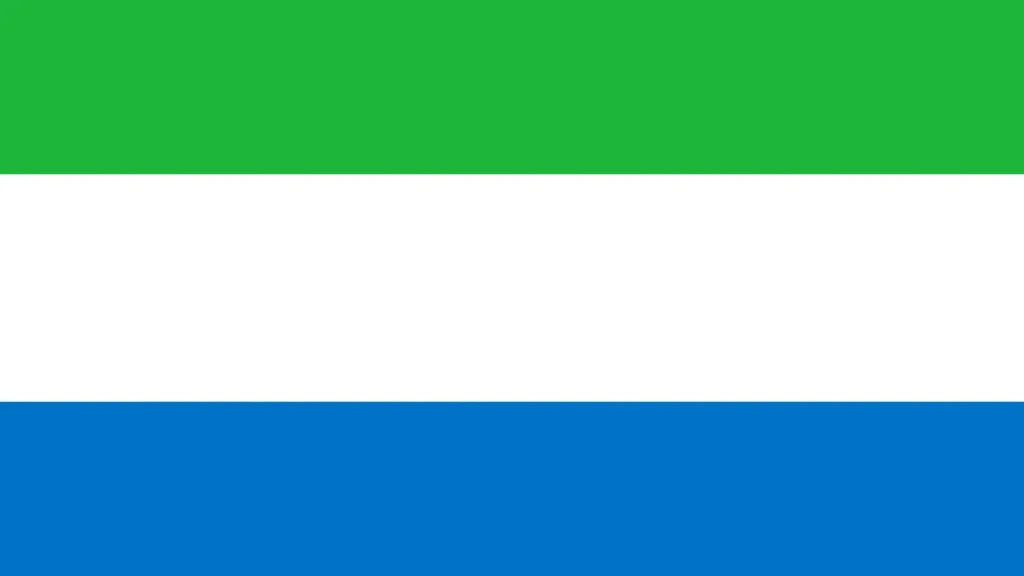
Sierra Leone is a presidential republic located on the Atlantic coast of West Africa, bordered by Guinea to the north and east and Liberia to the southeast. Its capital is Freetown, a port city of approximately 1.2 million people that accounts for a disproportionate share of national economic activity. The country’s total population is estimated at around 8.8 million as of 2025, according to UN projections. The official language is English, though Krio — a creole language rooted in the era of freed-slave resettlement — functions as the de facto lingua franca across ethnic and regional lines. The currency is the Leone (SLL), redenominated in 2022 when the Bank of Sierra Leone introduced the new Leone (NLE) at a rate of 1,000 old Leones to one new Leone. GDP per capita sits in the low-income band, estimated at approximately USD 550–600 in nominal terms, placing Sierra Leone consistently among the lower quartile of global income rankings. Sierra Leone matters in 2026 for two intersecting reasons: its substantial deposits of iron ore, rutile, bauxite, and diamonds position it as a target for intensifying great-power and Gulf-state resource competition, while its fragile democratic institutions — tested by disputed elections in 2023 — remain a bellwether for governance trajectories across the Mano River Union region.
Government and Politics
Sierra Leone is a unitary presidential republic. Executive power is vested in a directly elected president who serves as both head of state and head of government. The current president is Julius Maada Bio, a former military head of state turned civilian politician who leads the Sierra Leone People’s Party (SLPP). Bio was first elected in 2018 and re-elected in the June 2023 general election — a contest that was immediately disputed by the main opposition All People’s Congress (APC), which alleged widespread irregularities in the vote-counting process and refused to accept the results. The APC’s boycott of parliament following the election created a prolonged constitutional and political crisis that drew condemnation from civil society groups and cautious concern from international partners including ECOWAS and the United Nations. The legislature is the unicameral Parliament of Sierra Leone, which ordinarily comprises 146 members — 132 directly elected and 14 Paramount Chief representatives — though its functioning was severely disrupted by the post-election standoff. A National Dialogue process brokered by the Commonwealth and facilitated by former Nigerian president Ernest Shonekan produced a framework agreement in late 2023 aimed at resolving the impasse, though implementation has been uneven. No significant constitutional amendments have been enacted since the 2023 election, though proposals around electoral reform and the composition of the Electoral Commission for Sierra Leone (ECSL) remain live political issues. The next scheduled general election is due in 2028.
Economy
Sierra Leone’s GDP is estimated at approximately USD 4.5–5 billion in purchasing power parity terms, with nominal GDP closer to USD 4 billion. The economy is heavily dependent on three primary sectors: mining and extractives, subsistence and smallholder agriculture (which employs the majority of the rural population), and a growing but still nascent services sector. Key exports include iron ore, rutile (titanium dioxide ore, of which Sierra Leone is among the world’s leading producers), diamonds, cocoa, and coffee. The Leone has faced sustained depreciation pressure, with inflation running at elevated double-digit levels through 2023 and into 2024, eroding household purchasing power and complicating monetary policy for the Bank of Sierra Leone. The country carries a significant external debt burden, with the IMF and World Bank both classifying it at high risk of debt distress. Sierra Leone has maintained an Extended Credit Facility arrangement with the IMF, which has provided a degree of fiscal anchor but also required difficult expenditure adjustments. The single most consequential economic story of the past 24 months has been the collapse and subsequent partial recovery of iron ore production following the suspension of operations by Marampa Mines — a Chinese-backed iron ore operation in the Port Loko district — due to financing difficulties and contractual disputes. The episode exposed the degree to which Sierra Leone’s export revenue and fiscal receipts remain hostage to the operational decisions of a small number of large foreign mining concessionaires, reigniting debate about contract transparency, revenue management, and the terms of resource nationalism.
Demographics and Society
Sierra Leone’s population of approximately 8.8 million is young and growing rapidly, with a median age estimated below 20 years and a total fertility rate that, while declining, remains among the higher rates in sub-Saharan Africa. Urbanisation is accelerating: Freetown and its peri-urban periphery now account for roughly 45 percent of the urban population, with secondary towns including Bo, Kenema, Makeni, and Koidu growing steadily. The country is ethnically diverse, with the Temne (concentrated in the north and northwest) and the Mende (dominant in the south and east) together comprising over half the population. Other significant groups include the Limba, Kono, Mandingo, and Krio — the latter a historically influential community descended from freed slaves and recaptives who shaped Freetown’s professional and administrative class. Religiously, Sierra Leone is roughly 78 percent Muslim and 20 percent Christian, with the remainder practising indigenous religions; notably, interfaith relations have historically been relatively harmonious by regional standards, with significant intermarriage and shared ritual participation across communities. The defining social trend of the current moment is the acute crisis in maternal and child health: Sierra Leone consistently records among the world’s highest maternal mortality ratios — estimated at over 400 deaths per 100,000 live births — and the government’s flagship Free Health Care Initiative, launched in 2010, has struggled to deliver consistent results due to chronic underfunding, drug supply chain failures, and shortages of trained health workers, particularly midwives and anaesthetists in rural districts.
Key Issues Right Now
Political reconciliation and institutional trust. The aftermath of the disputed 2023 election continues to cast a shadow over Sierra Leone’s democratic institutions. The APC’s partial re-engagement with parliament — following the Shonekan-mediated dialogue — has not fully resolved underlying grievances about the independence of the Electoral Commission, the conduct of the proportional representation counting system introduced in 2023, or the neutrality of the judiciary. Civil society organisations and international observers have called for structural reforms to the ECSL before the next electoral cycle, but progress has been slow. The risk of renewed political polarisation along regional and ethnic lines — SLPP’s southern Mende base versus the APC’s northern Temne constituency — remains a structural vulnerability that analysts continue to monitor closely.
Climate vulnerability and food security. Sierra Leone is ranked among the most climate-vulnerable countries in the world by multiple indices, and the practical consequences are increasingly visible. Erratic rainfall patterns are disrupting the planting and harvest cycles of smallholder rice farmers — rice being both the staple crop and a cultural cornerstone. Coastal erosion is accelerating around Freetown and the Western Area peninsula, threatening informal settlements built on reclaimed or marginal land. The 2017 mudslide disaster at Regent, which killed over 1,000 people, remains a reference point for the intersection of deforestation, unplanned urbanisation, and extreme weather events. The government has articulated climate adaptation commitments under its Nationally Determined Contribution to the Paris Agreement, but implementation capacity and financing remain severely constrained.
Security and regional spillover. Sierra Leone is not currently experiencing active armed conflict, but its security environment is shaped by regional dynamics that demand attention. The instability in Guinea — which has been under military rule since the 2021 coup — creates a porous northern border and complicates trade and movement. More broadly, the spread of jihadist-linked violence from the Sahel into coastal West African states, including the documented expansion of JNIM-affiliated networks into northern Côte d’Ivoire and parts of Guinea, has prompted Sierra Leone’s security services and international partners to reassess threat vectors. Domestically, youth unemployment — estimated above 60 percent in some urban surveys — and the grievances of ex-combatants from the 1991–2002 civil war who feel inadequately reintegrated remain latent social pressures that security planners treat as risk factors for mobilisation.
Travel and Connectivity
The principal international gateway is Lungi International Airport, located across the Sierra Leone River estuary from Freetown. The disconnect between the airport and the capital — historically bridged by ferry, water taxi, or a lengthy road detour — has long been identified as a critical infrastructure bottleneck and a deterrent to tourism and business travel. A long-discussed bridge or tunnel project connecting Lungi to the Western Area peninsula has been the subject of successive feasibility studies and financing negotiations, most recently involving Chinese and Gulf-state partners, but has not yet broken ground as of early 2026. Freetown is the dominant urban hub; Bo is the largest interior city and a commercial centre for the south; Kenema is significant for diamond trading; and Koidu (Kono District) is the heart of alluvial and kimberlite diamond mining. Tourism remains underdeveloped relative to the country’s natural assets — white-sand beaches along the Freetown Peninsula, the Outamba-Kilimi National Park, and Tiwai Island Wildlife Sanctuary among them — though the sector has shown modest growth driven by diaspora visitors and niche eco-tourism. Internet penetration stands at approximately 25–35 percent of the population, with mobile internet via 3G and 4G networks the dominant access mode; fixed broadband infrastructure is minimal outside Freetown. Mobile money adoption has expanded significantly, with services such as Orange Money and Africell Money providing financial access to populations outside the formal banking system, consistent with broader West African trends.
Further Research
Analysts, journalists, and investors seeking to deepen their understanding of Sierra Leone should consult the following institutions and resources. The Bank of Sierra Leone publishes monetary policy statements, inflation data, and financial sector reports that provide the most authoritative picture of macroeconomic conditions. The Statistics Sierra Leone (formerly the Sierra Leone National Bureau of Statistics) is the primary source for census data, household surveys, and national accounts. The World Bank Sierra Leone country page aggregates development indicators, project documentation, and country economic memoranda that are essential for tracking aid flows and structural reform progress. The Africa Center for Strategic Studies (Washington, D.C.) produces security-focused analysis on West Africa, including periodic assessments of Mano River Union dynamics relevant to Sierra Leone’s regional context. The Concord Times and Awoko newspapers, both Freetown-based, provide daily domestic political and economic reporting that is indispensable for tracking fast-moving developments on the ground. Finally, the Overseas Development Institute (ODI) and the Africa Research Institute have both produced substantive work on Sierra Leone’s post-conflict development trajectory, governance challenges, and extractive industry governance that remains analytically valuable for contextual background.