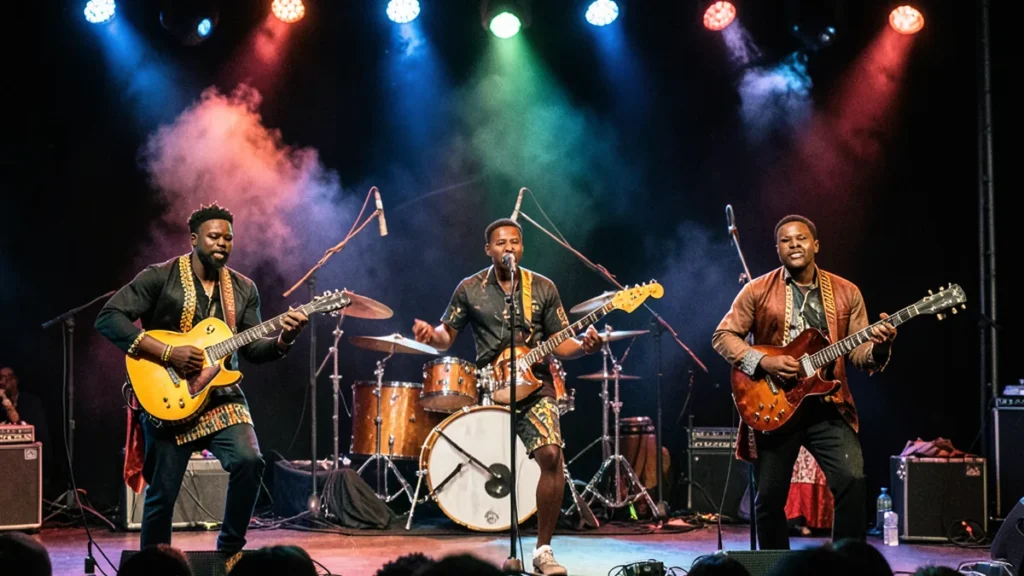
The African music industry — Afrobeats, Amapiano, and the global rise of African sound
Africa’s music industry has undergone one of the most dramatic commercial transformations of any creative sector in the world over the past decade. What was once dismissed by global label executives as a fragmented, piracy-riddled market has become a strategic priority for Sony, Universal, and a growing constellation of independent operators. Driven by a youthful population, accelerating smartphone penetration, and a generation of artists who refused to dilute their sound for Western audiences, African music is now a genuine export industry — generating revenue, shaping global pop culture, and attracting serious institutional capital.
Afrobeats: From Lagos to the Global Charts
No single genre has done more to announce Africa’s musical ambitions to the world than Afrobeats — a broad, Lagos-centred umbrella that fuses Yoruba rhythms, highlife, dancehall, and R&B into something immediately recognisable and stubbornly infectious. Burna Boy’s 2020 Grammy win for Twice as Tall in the Best Global Music Album category was a symbolic inflection point, but the commercial groundwork had been laid years earlier. Wizkid’s 2016 collaboration with Drake on “One Dance” — which spent fifteen weeks at number one on the Billboard Hot 100 — demonstrated that Nigerian artists could anchor mainstream Western hits rather than merely feature on them. Davido’s consistent arena touring across Europe and North America through the early 2020s further normalised Afrobeats as a live-event proposition for promoters outside the continent.
The generation that followed has, if anything, accelerated the pace. Tems became the first Nigerian woman to appear on the Billboard Hot 100, and her feature on Future’s “Wait for U” — which also sampled Beyoncé — reached number one in the United States in 2022. Rema’s “Calm Down,” released in 2022 and subsequently remixed with Selena Gomez, became one of the most-streamed African songs in Spotify history. Ayra Starr, signed to Mavin Records, and Asake, whose Afrobeats-meets-Fuji sound earned him a deal with EMPIRE Distribution, represent a cohort of artists now entering their commercial prime. By 2026, industry estimates suggest Afrobeats-adjacent music accounts for a measurable share of global streaming consumption in markets as varied as the United Kingdom, Brazil, and Indonesia — a geographic spread that would have been implausible a decade ago.
Amapiano and the South African Sound Going Global
South Africa’s contribution to the current moment is Amapiano — a genre that emerged from the townships of Gauteng in the mid-2010s and is built around log drum bass lines, jazzy piano chords, and a distinctively unhurried tempo. Kabza De Small and DJ Maphorisa, operating as a production partnership, are widely credited with industrialising the sound and giving it commercial coherence. Their prolific output through labels and distribution arrangements helped Amapiano transition from informal street parties to international festival stages with remarkable speed. By the early 2020s, Amapiano sets were appearing at Coachella, Glastonbury, and ADE in Amsterdam, and the genre had accumulated billions of streams across platforms.
Two artists have been particularly instrumental in translating Amapiano for global audiences. Uncle Waffles — a South African DJ and dancer whose viral 2021 performance footage spread across social media — brought the genre’s performative energy to international attention in a way that pure audio could not. Tyla, the Johannesburg-born singer whose song “Water” won the inaugural Grammy Award for Best African Music Performance in 2024, demonstrated that Amapiano-influenced pop could compete at the highest level of the American music industry. Sony Music’s decision to sign Tyla is itself a data point: major labels are now making calculated bets on South African artists as global crossover propositions, not merely regional acquisitions.
Regional Genres Building Their Own Gravity
The Afrobeats and Amapiano narratives dominate international coverage, but Africa’s musical geography is considerably richer. Tanzania’s Bongo Flava — a Swahili-language genre blending hip-hop, R&B, and taarab — has sustained a loyal East African audience for three decades and continues to produce commercially significant artists. Diamond Platnumz, whose WCB Wasafi label operates as one of the most professionally run independent music businesses on the continent, has collaborated with Rayvanny, Zuchu, and international acts including Alicia Keys and Ne-Yo, demonstrating that Bongo Flava can operate as a platform for regional soft power as much as a genre.
Kenya’s Genge — an energetic, Sheng-language rap and dancehall hybrid that emerged in Nairobi in the early 2000s — laid the cultural groundwork for a Kenyan music industry that now includes Gengetone and a growing Afro-pop scene with artists gaining traction on regional streaming charts. In Côte d’Ivoire, Coupé-Décalé remains a defining cultural export. Originating in the Ivorian diaspora in Paris in the early 2000s before returning to Abidjan with enormous commercial force, the genre’s emphasis on ostentatious performance and call-and-response crowd engagement has influenced club culture across Francophone West Africa. These regional scenes matter not only culturally but economically: they sustain local studios, promoters, session musicians, and an informal economy of creative labour that aggregate industry valuations frequently undercount.
The Streaming Economy: Platforms, Penetration, and the Revenue Question
The structural story of African music’s commercial maturation is inseparable from the growth of digital streaming on the continent. Boomplay, the music streaming and download service launched in 2015 through a joint venture involving Transsnet Music and NetEase, has grown into one of the most-used music platforms in sub-Saharan Africa, with a catalogue that prioritises African content and a freemium model calibrated to local price sensitivities. Audiomack, the New York-based platform, has invested heavily in African artist partnerships and has become a significant discovery engine for Afrobeats and Amapiano acts seeking to build streaming numbers before major-label conversations. Mdundo, a Nairobi-headquartered platform focused on East and West Africa, has pursued a mobile-first, data-light approach that reflects the realities of connectivity in markets where Wi-Fi penetration remains uneven.
Spotify’s African growth trajectory has been closely watched since the platform launched in South Africa in 2018 and subsequently expanded across the continent. According to the latest sector reports, African markets now represent one of Spotify’s faster-growing regional cohorts by monthly active user growth, even as average revenue per user remains lower than in North America or Western Europe — a tension that the platform has attempted to address through localised pricing tiers. The fundamental challenge for the streaming economy in Africa remains converting listenership into monetisable streams at a scale that meaningfully compensates artists and rights holders. Piracy, while reduced from its peak, has not been eliminated, and the informal distribution of music via WhatsApp and Bluetooth file-sharing continues to complicate royalty tracking in several markets.
Labels, Infrastructure, and the Business Architecture of African Music
The label landscape in Africa has matured considerably. Mavin Records, founded by producer Don Jazzy in Lagos in 2012, has operated as something close to a talent factory — its roster has included Tiwa Savage, Korede Bello, Di’ja, Johnny Drille, Rema, and Ayra Starr, among others. In 2022, Universal Music Group acquired a majority stake in Mavin Records in a deal that represented one of the most significant foreign investments in an African music company to date, though the precise valuation was not publicly disclosed. Chocolate City, another Lagos-based independent, has maintained a reputation for artist development and has expanded its operations into East Africa. These homegrown labels matter because they retain institutional knowledge of local markets, artist management norms, and the cultural context that multinational operations frequently lack.
Sony Music Africa and Universal Music Africa have both deepened their continental footprints through a combination of acquisitions, licensing arrangements, and local signings. The competition between the two majors for African talent has, on balance, been beneficial for artists in terms of advance values and marketing budgets, though critics note that standard major-label contract structures — particularly around rights ownership — remain unfavourable to artists relative to what independent deals can offer. Industry estimates suggest Africa’s recorded music market, when combined with live performance revenue, publishing, and sync licensing, could reach a valuation of several billion dollars by 2026, though the precise figure varies significantly depending on methodology and which markets are included in the calculation.
Trajectory: What the Next Phase Looks Like
Africa’s music industry in 2026 is not a story of potential — it is a story of realised momentum encountering structural constraints. The artists are world-class, the audiences are vast and growing, and the global appetite for African sound is demonstrably not a passing trend. What the industry now requires is commensurate investment in music publishing infrastructure, transparent royalty collection mechanisms, live venue development, and music education pipelines that can sustain the next generation of producers, engineers, and business executives. The continent’s music economy will not reach its ceiling through streaming alone; it will require the full stack of industry infrastructure that has taken decades to build in Nashville, London, and Seoul. The direction of travel is clear. The pace of construction is the open question.