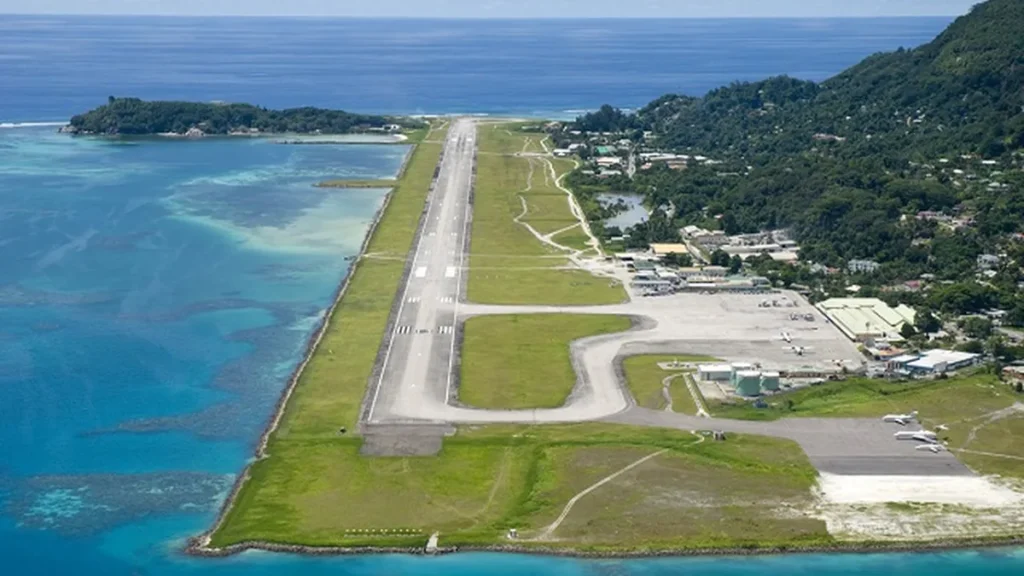
Seychelles International Airport
Seychelles International Airport
About
Seychelles International Airport (IATA: SEZ / ICAO: FSIA) is the principal gateway to the Seychelles archipelago and one of the Indian Ocean’s most strategically positioned aviation nodes. Situated on the northeastern coast of Mahé — the largest island in the 115-island chain — the airport functions as the country’s sole international point of entry by air and as a critical link between East Africa, the Gulf, South Asia, and Europe. For a small-island developing state whose economy is built almost entirely on high-value tourism and blue-economy industries, SEZ is not merely an infrastructure asset; it is the economic lifeline of the nation.
The airport’s origins trace to the colonial era, when a basic airstrip was established on reclaimed land on Mahé’s northeastern tip. Commercial international operations expanded significantly following Seychelles independence in 1976, and the facility was progressively upgraded to accommodate wide-body jet aircraft. The airport is owned by the Government of Seychelles and operated under the oversight of the Seychelles Civil Aviation Authority (SCAA), which is responsible for safety regulation, air traffic management, and aerodrome licensing.
A major infrastructure programme undertaken in the 2000s and extended into the 2010s modernised the terminal building, expanded apron capacity, and improved ground-handling services to meet the demands of a growing long-haul leisure market. The single runway — oriented roughly northeast-to-southwest and designated 13/31 — measures approximately 2,740 metres in length, sufficient to accommodate Airbus A330, Boeing 787, and Boeing 777 class aircraft that form the backbone of long-haul tourist traffic to the islands. Ongoing investment in airside and landside infrastructure reflects the government’s stated ambition to position Seychelles as a premium destination capable of handling sustained growth in visitor arrivals.
Country
The Republic of Seychelles is an archipelagic state located in the western Indian Ocean, northeast of Madagascar and east of the East African mainland. Victoria, situated on Mahé, serves as the capital and is among the smallest capital cities in the world by population. The country’s total population is modest — broadly estimated in the low hundreds of thousands — yet it punches well above its demographic weight in terms of GDP per capita, driven by tourism and financial services. Within the African Union and the broader Indian Ocean Commission framework, Seychelles occupies a distinctive niche: a high-income small-island economy with deep trade and transport ties to both the African continent and the Gulf Cooperation Council states. → Read the Seychelles expert briefing
Airlines based here
Air Seychelles (IATA: HM) is the national carrier and the only airline that treats SEZ as a home base and operational hub. The airline has historically operated both regional and long-haul routes, though its network has been subject to periodic restructuring in response to commercial pressures; in recent years it has concentrated on regional connectivity within the Indian Ocean island group, including inter-island services to Praslin (served by the domestic terminal at SEZ) and select East African points. Beyond Air Seychelles, SEZ functions as a focus city — rather than a hub — for a range of visiting international carriers that operate scheduled seasonal or year-round services. Emirates, Ethiopian Airlines, Air Mauritius, Kenya Airways, Condor, Corsair, and Edelweiss Air have all maintained or recently operated scheduled services to SEZ, reflecting the airport’s role as a destination rather than a connecting hub for transit traffic.
Flights and destinations
The route network at SEZ is shaped almost entirely by leisure demand, with the vast majority of seats sold as part of package holidays or premium independent travel itineraries. Intercontinental services connect Mahé to major European source markets, with Paris (CDG), Frankfurt, Zurich, London (Heathrow and Gatwick, depending on season and carrier), and Rome among the European cities that have featured on published schedules. Gulf connectivity is anchored by Emirates’ Dubai (DXB) service, which provides onward connections across the Emirates global network and serves as a critical feeder for travellers from South Asia and Australia. Within Africa and the Indian Ocean region, Nairobi (NBO), Addis Ababa (ADD), Johannesburg (JNB), and Mauritius (MRU) represent key regional nodes. Réunion and the Maldives have also featured in Air Seychelles’ regional network at various points. The airport does not currently support significant cargo-only scheduled operations, though belly-hold freight on passenger wide-bodies contributes meaningfully to the island’s import supply chain.
Facilities and capacity
Seychelles International Airport operates a single integrated passenger terminal that handles both international arrivals and departures, with a separate domestic facility serving inter-island Air Seychelles flights to Praslin and Bird Island. The international terminal features a modest but functional suite of retail, food and beverage, and lounge facilities appropriate to its premium leisure positioning; the Seychelles Tourism Board and several duty-free concessions maintain a presence airside. The apron can accommodate multiple wide-body aircraft simultaneously, though the airport is classified broadly as a small-to-medium international hub when measured against continental African peers. The single runway configuration means that any maintenance closure requires careful scheduling coordination with the SCAA and airlines. Cargo handling is managed through a dedicated freight facility on the airport campus. According to publicly disclosed traffic data reviewed by industry analysts, annual passenger throughput at SEZ places it in a tier consistent with other high-value Indian Ocean leisure gateways rather than the large-volume hubs of Nairobi, Johannesburg, or Addis Ababa. Expansion planning, as referenced in government and SCAA communications, has addressed apron capacity, terminal passenger processing, and airfield lighting and navigation aids.
Visa regulations
Seychelles operates one of the most open visa regimes in Africa, a policy that directly supports its tourism-dependent economy. As of the time of writing, nationals of the vast majority of countries — including the United States, the United Kingdom, all European Union member states, and most African Union member states — do not require a visa obtained in advance to enter Seychelles. Instead, all visitors are issued a Visitor’s Permit on arrival, provided they hold a valid passport, a confirmed onward or return ticket, proof of sufficient funds, and confirmed accommodation. The standard initial permit is typically granted for one month and can be extended in-country. There is no traditional visa-on-arrival fee structure in the conventional sense; the permit is issued as a matter of routine for qualifying travellers. Seychelles does not currently operate a formal eVisa portal in the same manner as some regional neighbours, though travellers are advised to verify current entry requirements before travel, as immigration policy can be updated at short notice. → Check the live visa requirements lookup
Recent developments
In the 24 months leading to mid-2026, Seychelles International Airport has seen a number of operationally significant developments. Air Seychelles has continued its network rationalisation, focusing resources on routes where it holds a competitive or strategic advantage, while international carriers have progressively restored and in some cases expanded services that were curtailed during the post-pandemic recovery period. Industry estimates suggest that visitor arrival volumes have trended positively, supported by strong demand from European and Gulf-based travellers. On the infrastructure side, the SCAA has publicly referenced ongoing works related to airfield safety systems and terminal passenger flow improvements. New or reinstated route announcements — a recurring feature of the Seychelles tourism calendar — have included additional seasonal European services ahead of the northern winter peak season. The airport has also been the subject of broader discussions within the Indian Ocean Commission’s regional aviation connectivity agenda, reflecting Seychelles’ interest in strengthening air links with neighbouring island economies.
News and reports
Researchers, journalists, and aviation analysts tracking developments at SEZ should consult several authoritative primary and secondary sources. The Seychelles Civil Aviation Authority publishes regulatory notices, aeronautical information publications (AIPs), and periodic operational updates through its official channels. The Seychelles Tourism Board issues arrival statistics and market intelligence reports that provide context for understanding passenger demand at the airport. At the regional level, the IATA Africa and Middle East regional office produces periodic reports on African aviation market trends that situate SEZ within the broader continental picture. The ICAO Eastern and Southern African Regional Office (ESAF), based in Nairobi, is the relevant ICAO regional body for regulatory and safety oversight matters affecting Seychelles. For commercial route and capacity data, industry platforms such as OAG and Cirium track scheduled seat capacity and airline operations at SEZ on an ongoing basis. Local English-language media, including the Seychelles Nation and Today in Seychelles, provide timely coverage of airport-related announcements and tourism policy developments.