Djibouti–Ambouli International Airport
Djibouti–Ambouli International Airport
About
Djibouti–Ambouli International Airport (IATA: JIB / ICAO: HDAM) occupies a position in African aviation that is disproportionate to the small size of the country it serves. Situated on the Horn of Africa at the southern entrance to the Red Sea — one of the world’s most strategically contested maritime corridors — the airport functions simultaneously as a commercial gateway, a military logistics hub, and a critical node in the air-freight supply chains that connect East Africa, the Gulf, and South Asia. For travellers, journalists, and aviation analysts alike, understanding Ambouli means understanding how geography, geopolitics, and commerce converge in a single set of runways.
The airport traces its origins to the French colonial period, when the territory was known as French Somaliland and later the French Territory of the Afars and Issas. The facility was developed and expanded under French military and civil administration, and it continued to serve both functions after Djibouti’s independence in 1977. Ownership and operational oversight rests with the Government of Djibouti, with the Djibouti Airports Authority responsible for day-to-day management under the broader regulatory framework of the Djibouti Civil Aviation Authority (ADAC — Autorité de l’Aviation Civile).
Over the decades, Ambouli has undergone several rounds of infrastructure improvement, driven largely by the country’s ambitions to position Djibouti City as a regional logistics and transshipment capital. Expansion works have focused on passenger terminal capacity, cargo handling facilities, and airside infrastructure. The airport remains the country’s sole international commercial airport, meaning all inbound and outbound international traffic is concentrated at a single point — a fact that sharpens both its strategic importance and its vulnerability to disruption.
Country
Djibouti is a small but strategically vital republic located at the junction of the Gulf of Aden and the Red Sea, bordered by Eritrea, Ethiopia, and Somalia. Djibouti City serves as both the national capital and the country’s dominant urban centre, home to the large majority of a national population estimated in the low millions. Despite its modest size, Djibouti hosts military bases operated by France, the United States, China, Japan, and other powers, and its port complex is among the busiest in East Africa, serving as the principal maritime outlet for landlocked Ethiopia. This combination of military presence, port activity, and free-trade zone development gives the country an economic and diplomatic footprint well beyond what its population figures alone would suggest.
→ Read the Djibouti expert briefing
Airlines based here
Air Djibouti, the national flag carrier, uses Ambouli as its home base and primary operating hub. The airline has historically operated a regional network connecting Djibouti City to destinations across East Africa and the Arabian Peninsula, though its fleet size and route network have fluctuated over the years in line with the financial pressures common to small African flag carriers. Ethiopian Airlines, one of the continent’s dominant network carriers, maintains a significant presence at Ambouli and provides one of the most reliable connections between Djibouti and the wider African continent via its Addis Ababa hub at Bole International Airport. Gulf carriers including flydubai have operated services into JIB, reflecting the strong commercial and labour-migration flows between Djibouti and the Gulf Cooperation Council states. Turkish Airlines has also served the route, connecting Djibouti to its Istanbul hub and, by extension, to a broad intercontinental network. The airport’s military dimension means that, alongside commercial operators, various national air forces and charter freight operators maintain a parallel operational presence that is not reflected in standard commercial airline schedules.
Flights and destinations
The commercial network at Ambouli is compact but strategically well-positioned. Within the African continent, Addis Ababa (Ethiopia) is by far the most heavily served destination, functioning as the primary connecting hub for onward travel across Africa and beyond. Nairobi (Kenya) appears on the network as a secondary African hub connection. On the Arabian Peninsula, Dubai (United Arab Emirates) is a key destination, serving both business travellers and the large diaspora and migrant-worker communities that move between Djibouti and the Gulf. Doha (Qatar) and Istanbul (Turkey) provide intercontinental connectivity for passengers routing through those major hub airports. Within the immediate Horn of Africa sub-region, connections to Hargeisa (Somaliland) and Mogadishu (Somalia) reflect the airport’s role as a regional access point for one of Africa’s most underserved aviation markets. Cargo and charter operations extend the airport’s effective reach considerably beyond the scheduled passenger network, particularly in support of humanitarian logistics for the broader Horn of Africa region.
Facilities and capacity
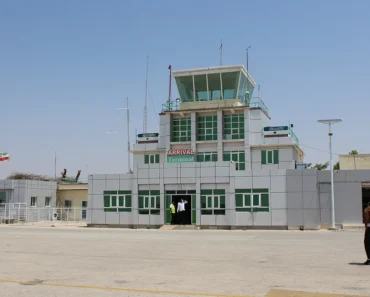
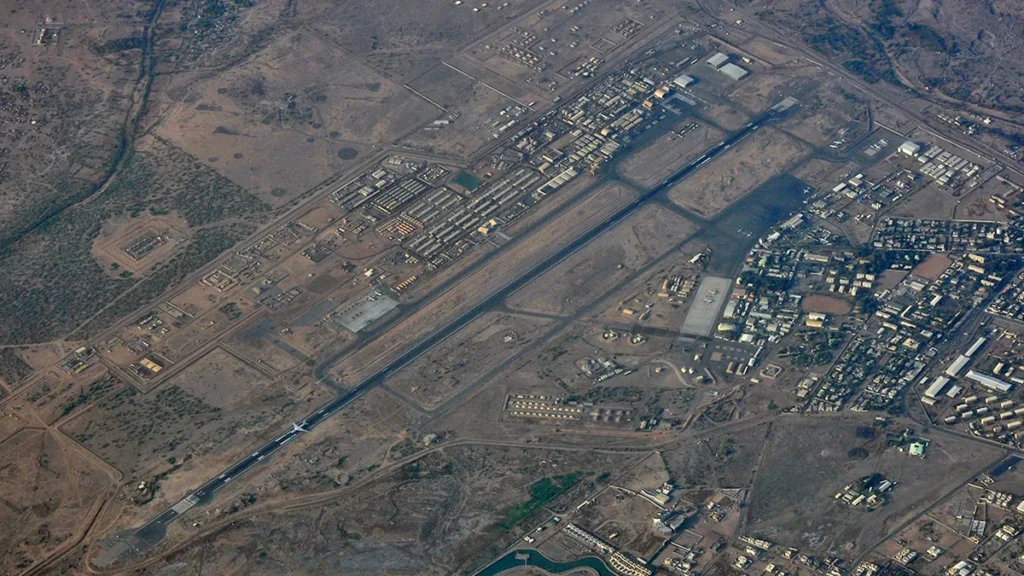
Ambouli operates a single passenger terminal building that handles both departures and arrivals. The terminal is functional rather than expansive, reflecting the airport’s classification as a small-to-medium international hub by African standards. The airport is served by a single primary runway — Runway 09/27 — which, at approximately 3,000 metres in length, is capable of accommodating wide-body jet aircraft including the Boeing 737 family, the Airbus A320 family, and larger long-haul types when required. A parallel taxiway system supports airside movements. Cargo facilities are present and have been developed in line with Djibouti’s broader ambitions as a logistics hub, with dedicated freight apron space serving both commercial cargo operators and humanitarian supply chains. According to publicly disclosed information, the Djiboutian government has at various points announced intentions to expand and modernise the airport’s terminal and cargo infrastructure; the precise scope, timeline, and financing of any ongoing or planned works should be verified against current official sources, as project details are subject to revision. The airport also accommodates the military flight operations associated with the foreign bases in the country, which are managed through separate airside arrangements.
Visa regulations
Travellers arriving at Djibouti–Ambouli International Airport are subject to Djibouti’s national visa regime, which as of 2026 is broadly accessible through multiple entry pathways. Citizens of many countries — including the United States, the United Kingdom, and European Union member states — are generally eligible to obtain a visa on arrival at the airport, making Ambouli one of the more straightforward entry points in the Horn of Africa for Western passport holders. An eVisa system has also been made available, allowing eligible travellers to apply and receive authorisation before departure, which is advisable during peak travel periods or when itinerary certainty is important. For regional African passport holders, entry conditions vary significantly by nationality, and travellers from neighbouring countries including Ethiopia, Somalia, and Eritrea should verify their specific requirements in advance. Visa fees, permitted durations of stay, and eligible nationalities are subject to change without extended notice, and the information above is provided as general orientation only. For a current, country-by-country visa lookup, consult the live tool at /visa-requirements/ and cross-reference with the official Djibouti immigration authorities before travel.
Recent developments
In the 24 months leading into 2026, Ambouli has seen a modest but meaningful evolution in its commercial profile. Industry observers have noted renewed efforts by the Djiboutian government to attract additional airline partners, consistent with the country’s broader economic diversification agenda. Discussions around terminal modernisation and cargo facility upgrades have continued, with Djibouti’s position as a logistics hub for East Africa providing a commercial rationale for investment. The airport has also remained operationally significant in the context of regional humanitarian responses, with the Horn of Africa’s recurring food security crises generating sustained demand for air-freight capacity through JIB. On the regulatory side, Djibouti has continued its engagement with ICAO and IATA frameworks aimed at improving safety oversight and operational standards across its civil aviation sector. Specific new route announcements, carrier agreements, or capital project milestones that have emerged in this period should be verified against current press releases from the Djibouti Airports Authority and ADAC, as the pace of commercial developments at smaller African hubs can shift rapidly.
News and reports
Researchers and journalists tracking developments at Djibouti–Ambouli International Airport have several authoritative source categories to draw on. The Djibouti Civil Aviation Authority (ADAC) is the primary regulatory body and periodically publishes operational notices, safety directives, and policy updates through official government channels. The Djibouti Airports Authority issues press communications on infrastructure and commercial developments. At the continental level, IATA’s Africa and Middle East regional office produces periodic market analysis and traffic trend reports that situate Djibouti within the broader East African aviation market; these are available through IATA’s official publications portal. ICAO’s Eastern and Southern African Regional Office (ESAF), based in Nairobi, covers Djibouti within its safety oversight and implementation monitoring work, and its audit findings and regional reports are publicly accessible through ICAO’s official documentation system. Specialist aviation trade media — including ch-aviation, Cirium, and Aviation Week — provide ongoing commercial route and fleet tracking that covers JIB within their African market coverage. For humanitarian logistics intelligence, the UN Office for the Coordination of Humanitarian Affairs (OCHA) and the World Food Programme publish air-transport operational updates that frequently reference Ambouli’s role in regional relief operations.