Air Seychelles
Air Seychelles
About
Air Seychelles occupies a distinctive position in African aviation: a small-island flag carrier operating at the intersection of the Indian Ocean leisure market and the continent’s broader connectivity ambitions. With IATA code HM and ICAO designator SEY, the airline serves as the primary international gateway for an archipelago nation whose economy is built almost entirely on tourism and financial services — making reliable, well-connected air access not merely a commercial matter but a strategic national interest.
The airline was founded in 1978, initially operating domestic inter-island services before expanding into international scheduled operations during the 1980s. For much of its history it has been majority state-owned, with the Government of Seychelles holding a controlling stake through successive restructuring cycles. A significant chapter in its corporate history came when Etihad Airways acquired a 40 percent shareholding in 2012 as part of the Abu Dhabi carrier’s then-aggressive equity alliance strategy. That partnership brought capital, codeshare traffic, and operational expertise, but was wound down as Etihad retrenched from its global equity portfolio in the late 2010s, leaving the Seychellois government once again as the dominant shareholder.
The post-Etihad period has been one of deliberate consolidation. Management has focused on right-sizing the network, reducing exposure to loss-making long-haul routes, and rebuilding the airline’s balance sheet following the severe disruption to Indian Ocean tourism caused by the COVID-19 pandemic. As of 2026, Air Seychelles operates as a lean, regionally focused carrier with selective intercontinental reach, positioning itself as a premium connector for the high-yield leisure and business traveller rather than a volume carrier competing on price.
Bases and Hubs
Mahé / Seychelles International Airport (SEZ) — The airline’s sole principal hub and the point through which all international scheduled operations are coordinated; SEZ handles the overwhelming majority of Air Seychelles passenger throughput and serves as the operational, maintenance, and administrative base for the carrier.
Praslin Island Airport (PRI) — A secondary domestic focus point serving the second-largest inhabited island in the Seychelles archipelago; Air Seychelles operates scheduled inter-island turboprop or light aircraft services linking Praslin to Mahé, supporting resort connectivity for high-end properties on the island.
Fleet
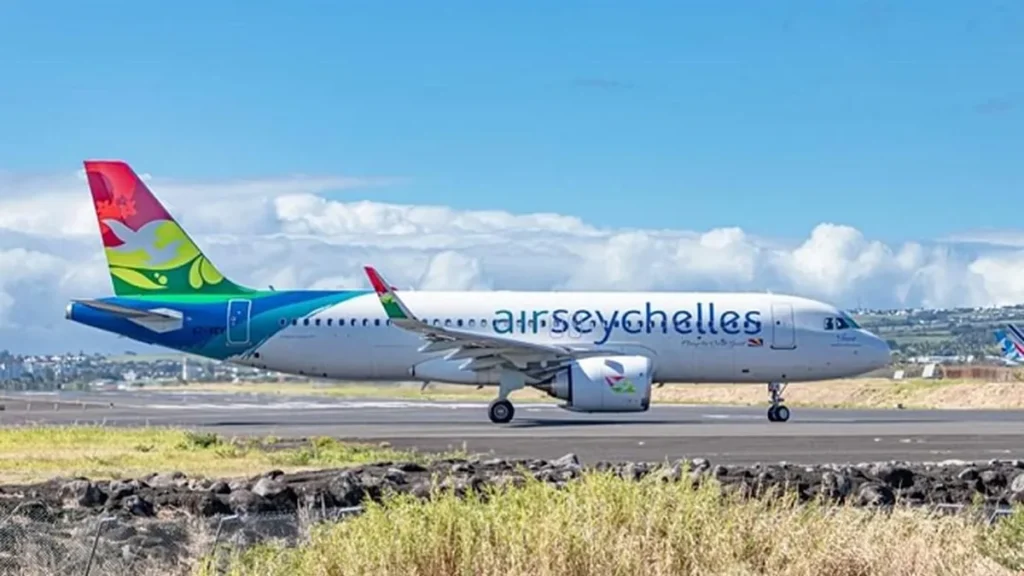
Air Seychelles has historically operated a mixed fleet calibrated to its dual role as an inter-island domestic operator and a medium- to long-haul international carrier. According to publicly disclosed fleet data and industry tracking sources, the airline’s international operations have centred on Airbus narrowbody and widebody types, with the Airbus A320 family providing the backbone of its regional and medium-haul network. The airline previously operated Airbus A330 widebody aircraft on longer intercontinental sectors, though the composition of the widebody fleet has shifted in line with network rationalisation.
For domestic inter-island operations, the airline has utilised smaller turboprop or light twin-engine aircraft suited to the short sectors and limited runway infrastructure of the outer islands. Industry estimates suggest the active fleet remains modest in total unit count, consistent with the airline’s strategy of disciplined capacity management. Any fleet renewal or order activity as of 2026 should be verified against the airline’s most recent official communications, as procurement decisions in this segment of the market can move quickly in response to lessor availability and network demand.
Destinations
Air Seychelles operates a network that radiates outward from SEZ across three broad categories. Domestically, it connects Mahé to Praslin and, on a charter or seasonal basis, to further outer islands. Regionally, the airline serves key Indian Ocean and East African points, with routes to destinations such as Johannesburg (OR Tambo International), Nairobi, Mauritius, and Réunion forming the core of its African and Indian Ocean connectivity. These routes serve both the leisure inbound market and the diaspora and business travel segment.
On an intercontinental basis, Air Seychelles has historically served European leisure markets — notably Paris Charles de Gaulle and London Heathrow — given the strong French and British tourist flows into the Seychelles. The precise configuration of long-haul services as of 2026 reflects ongoing network reviews; travellers and trade partners are advised to consult the airline’s current schedule directly, as intercontinental frequency and routing have been subject to seasonal and structural adjustment in recent years. The Middle East, particularly Abu Dhabi and Dubai, has also featured as a key intercontinental connection point, historically supported by codeshare arrangements.
Codeshare and Alliance
Air Seychelles is not a member of any of the three major global airline alliances — Star Alliance, SkyTeam, or oneworld — and operates as an independent carrier. During the period of Etihad’s equity partnership, the airline maintained a notable codeshare arrangement with Etihad Airways, providing connectivity through Abu Dhabi (AUH) and access to Etihad’s wider partner network. The status and depth of that codeshare relationship evolved as Etihad restructured its own operations. The airline has also maintained interline and codeshare arrangements with other carriers serving the Indian Ocean region; journalists and investors seeking current partner details should refer to Air Seychelles’ published interline agreements, as these arrangements are subject to commercial renegotiation.
Notable Incidents
Air Seychelles does not feature prominently in major accident databases for recent years, and the airline has no significant hull-loss or fatal accident on its public safety record within the period covered by this profile. As with any carrier, minor airworthiness directives and operational irregularities form part of routine regulatory oversight; readers requiring a comprehensive safety audit should consult the Aviation Safety Network, ICAO USOAP disclosures, and the Seychelles Civil Aviation Authority’s published records directly.
Financial and Operational Situation
Air Seychelles’ financial profile reflects the structural vulnerabilities common to small island developing state carriers: a narrow domestic market, high dependence on a single economic sector (tourism), exposure to fuel price volatility, and limited ability to spread fixed costs across a large network. The COVID-19 pandemic dealt a severe blow to the airline’s revenue base, as the Seychelles’ borders were closed and international arrivals collapsed. The subsequent recovery in tourism — the Seychelles reopened relatively early and benefited from strong high-end leisure demand — provided a meaningful tailwind for the airline’s traffic recovery.
Industry estimates suggest the airline has been working toward operational sustainability rather than aggressive expansion, with state support playing a role in bridging periods of structural loss. The Government of Seychelles has a clear strategic interest in maintaining the carrier’s viability given the absence of alternative flag-carrier options and the centrality of air access to the national economy. Precise profitability figures are not publicly disclosed in a form that permits reliable external verification; investors conducting due diligence should seek audited accounts through official Seychellois corporate registry channels.
Recent Developments
In the 24 months leading into 2026, Air Seychelles has navigated a period of cautious network rebuilding. The airline has focused on consolidating its most commercially viable routes — particularly those serving high-yield European and Middle Eastern leisure travellers — while exploring opportunities to deepen regional African connectivity in line with broader African Union single-sky ambitions under the Yamoussoukro Decision framework. Discussions around potential new partnerships and codeshare arrangements have been reported in regional aviation trade media, reflecting the airline’s awareness that independent operation limits its ability to offer seamless global connectivity.
Fleet strategy has remained a live topic, with the airline’s leadership publicly acknowledging the need to align aircraft type selection with both route economics and sustainability commitments — a pressure felt across the African carrier landscape as carbon reporting requirements tighten. Any confirmed fleet orders or significant route launches announced after mid-2025 should be verified against Air Seychelles’ official press releases and the Seychelles Civil Aviation Authority’s registry updates, as this profile reflects the best available open-source intelligence at time of publication.
Related Research
- Seychelles Expert Briefing — full country profile covering economy, tourism, and investment climate
- African Airlines — the complete pillar covering carriers across the continent
- African Airports — infrastructure profiles including SEZ and regional hubs
- Country Comparison Tool — benchmark Seychelles against peer island and African economies