ECAir (Equatorial Congo Airlines)
ECAir (Equatorial Congo Airlines)
About
ECAir — Equatorial Congo Airlines — is the Republic of the Congo’s national flag carrier, operating scheduled passenger and cargo services from its principal hub at Maya-Maya International Airport in Brazzaville (BZV). In a continent where flag carriers frequently oscillate between ambition and austerity, ECAir occupies a distinctive position: a mid-sized state-linked airline serving one of central Africa’s key oil-producing nations, competing for relevance on a network that bridges the Congo Basin with West Africa, Europe, and the wider continent.
ECAir was established in the early 2010s as the Republic of the Congo sought to reassert sovereign control over its aviation sector following the long decline of Lina Congo, the country’s previous national carrier. The airline launched commercial operations with a mandate to connect Brazzaville and Pointe-Noire to regional and international destinations, reducing the country’s dependence on foreign carriers for connectivity. The Congolese state has historically held a controlling interest in the airline, with the ownership structure reflecting the government’s broader ambition to use aviation as an instrument of economic development and national prestige.
The airline has navigated a turbulent corporate history, including periods of suspended operations, financial restructuring, and leadership changes that are well documented in regional aviation press. Industry observers have noted that ECAir’s trajectory mirrors that of several African flag carriers caught between the commercial discipline required to compete with larger pan-African operators and the political pressures that accompany state ownership. As of 2026, the airline is understood to be in an active phase of operational consolidation, working to stabilise its network and rebuild passenger confidence.
Bases and Hubs
Maya-Maya International Airport, Brazzaville (BZV) — ECAir’s primary hub and the centre of its scheduling and maintenance operations, located in the Republic of the Congo’s capital city directly across the Congo River from Kinshasa.
Agostinho Neto International Airport, Pointe-Noire (PNR) — The airline’s key secondary focus city, serving the Republic of the Congo’s commercial capital and its vital oil industry workforce, making it a strategically important domestic trunk route.
Fleet
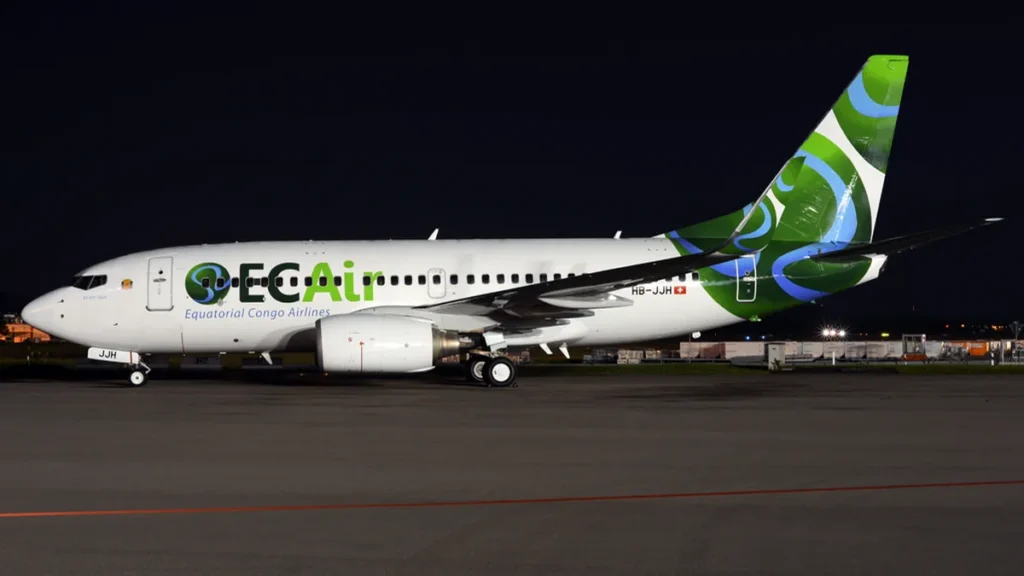
According to publicly disclosed fleet data and regional aviation tracking sources, ECAir has operated a mixed narrowbody and widebody fleet configured to serve both short-haul regional routes and longer intercontinental sectors. Aircraft types associated with the airline’s operational history include the Boeing 737 family for regional and domestic services, and widebody equipment — including the Boeing 767 — deployed on longer intercontinental routes to Europe. The airline has also been linked to turboprop operations for thinner domestic sectors within the Republic of the Congo. Fleet size has varied considerably across the airline’s operational phases; industry estimates suggest the active fleet has at times been modest in number, consistent with the airline’s scale and the financial constraints it has faced. Any confirmed fleet renewal programme or new aircraft orders should be verified against the airline’s most recent official communications and ACMI lease disclosures.
Destinations
ECAir’s network is shaped primarily around intra-African connectivity, with Brazzaville serving as the pivot point for routes across central and West Africa. Headline regional routes have historically included services to Douala (DLA) and Yaoundé (NSI) in Cameroon, Libreville (LBV) in Gabon, Kinshasa (FIH) across the river in the Democratic Republic of the Congo, and Luanda (LAD) in Angola — all commercially significant city pairs in the central African corridor. The airline has also operated or sought to operate West African services to destinations including Lagos (LOS) and Dakar (DSS), reflecting ambitions to position Brazzaville as a transit node. On the intercontinental side, Paris (CDG) has been the most prominent long-haul destination, serving the significant Congolese diaspora community in France and connecting the country to a major European hub. Domestic services between Brazzaville and Pointe-Noire form the backbone of the network by frequency.
Codeshare and Alliance
ECAir is not a member of any of the three major global airline alliances — Star Alliance, SkyTeam, or oneworld. The airline has pursued bilateral commercial arrangements with select regional and international partners, though confirmed and currently active codeshare agreements should be verified directly with the airline or through IATA partner disclosures. Given the airline’s IATA code LC and its intercontinental ambitions, interline ticketing arrangements with larger African and European carriers have been reported at various points in its history, but the current status of specific partnerships as of 2026 should be treated as subject to change.
Notable Incidents
No major safety incidents attributable to ECAir appear on its recent public safety record in a form that can be responsibly cited here with full verified detail. Readers requiring a comprehensive safety history are directed to the Aviation Safety Network database and the French Bureau d’Enquêtes et d’Analyses (BEA), which covers incidents involving French-registered or France-departing aircraft, as well as the Congolese civil aviation authority (ANAC-Congo) for domestically reported occurrences.
Financial and Operational Situation
ECAir’s financial profile is that of a state-supported carrier operating in a challenging market environment. The airline has experienced well-documented periods of financial stress, including suspension of operations, which have been reported in regional aviation and business press. Profitability has historically been difficult to sustain given the relatively small size of the Congolese domestic market, competition from larger pan-African carriers such as Ethiopian Airlines and Air France on intercontinental routes, and the structural costs associated with maintaining widebody equipment on thin long-haul sectors. The Republic of the Congo’s oil-dependent economy creates both an opportunity — a mobile, relatively high-spending business traveller base in Pointe-Noire — and a vulnerability, as commodity price cycles affect government capacity to support the airline. Industry observers characterise ECAir’s current operational situation as one of cautious rebuilding rather than expansion.
Recent Developments
In the 24 months to mid-2026, ECAir’s most significant developments have centred on efforts to restore and stabilise its scheduled network following earlier disruptions. Regional aviation sources have noted ongoing discussions around fleet rationalisation and the potential introduction of more fuel-efficient narrowbody equipment suited to the airline’s core African network. The airline’s relationship with Congolese aviation regulators and the broader CEMAC (Economic and Monetary Community of Central Africa) open-skies framework continues to shape its route development options. Travellers and investors monitoring the airline are advised to consult IATA travel agency notices and the airline’s official channels for the most current schedule and operational status, as ECAir’s timetable has historically been subject to revision at relatively short notice.