Congo Airways
Congo Airways
About
Congo Airways occupies a strategically significant position in Central African aviation: it is the Democratic Republic of the Congo’s principal state-backed carrier, tasked with binding together one of the continent’s largest and most geographically challenging nations at a time when demand for reliable domestic air connectivity in sub-Saharan Africa is growing faster than infrastructure can keep pace. Operating under IATA code 8Z and ICAO designator CGO, the airline serves as a commercial lifeline in a country where road and rail networks remain severely underdeveloped, making aviation not merely a convenience but an economic necessity for millions of Congolese.
Congo Airways was founded in 2014 and commenced commercial operations in 2015, emerging in the wake of the collapse of Hewa Bora Airways, which had been the DRC’s dominant private carrier. The airline was established with backing from the Congolese state, and its ownership structure reflects a public-private model in which the government of the DRC holds a controlling interest. This structure has shaped both the airline’s strategic priorities — domestic connectivity above commercial margin — and its operational challenges, including exposure to the fiscal pressures that affect state-linked enterprises across the continent.
In the years since its founding, Congo Airways has navigated a turbulent operating environment shaped by currency volatility, fuel supply constraints, and the regulatory complexity of operating in one of Africa’s most demanding airspaces. More recently, the airline has undertaken efforts to stabilise its corporate governance and expand its network, positioning itself as a credible regional player rather than solely a domestic operator. Industry observers note that the airline’s trajectory will be closely tied to broader economic and political developments within the DRC.
Bases and Hubs
Kinshasa – N’Djili International Airport (FIH): The airline’s principal hub and operational headquarters, FIH serves as the gateway for both domestic trunk routes and the airline’s nascent regional international services, and is where the majority of the fleet is based and maintained.
Lubumbashi – Lubumbashi International Airport (FBM): The DRC’s second-largest city and the commercial capital of the Katanga mining region, Lubumbashi functions as a key focus city for Congo Airways, reflecting the economic importance of the copper and cobalt belt to the national economy.
Goma – Goma International Airport (GOM): Serving the volatile but commercially active eastern DRC, Goma is a critical node in the domestic network, connecting humanitarian, business, and government travellers in a region that has historically been difficult to reach by surface transport.
Kisangani – Bangoka International Airport (FKI): A secondary focus city in the country’s north-central interior, Kisangani underscores the airline’s mandate to serve provincial capitals that would otherwise be effectively isolated from the national economy.
Fleet
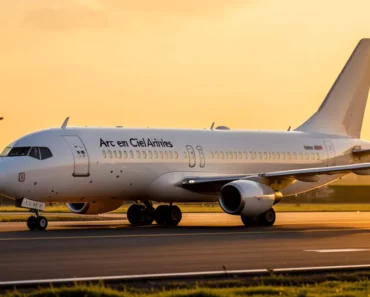
According to publicly disclosed fleet data, Congo Airways operates a narrowbody jet fleet built around the Bombardier CRJ series and, at various points in its history, has also operated the de Havilland Canada Dash 8 turboprop family for shorter and more remote domestic sectors. The airline has shown interest in transitioning toward more standardised narrowbody types — including aircraft in the Airbus A320 family — to improve operational efficiency and reduce the complexity of maintaining a mixed fleet in an environment where spare parts logistics are challenging. Industry estimates suggest the operational fleet remains modest in size relative to the scale of the country it serves, a gap that the airline and its government shareholders have publicly acknowledged as a constraint on network growth. Any confirmed fleet renewal or order activity should be verified against the airline’s most recent official communications and CAPA Fleet data at time of publication.
Destinations
The backbone of Congo Airways’ network is domestic, reflecting both its founding mandate and the acute need for intra-country connectivity across a nation roughly the size of Western Europe. Key domestic routes link Kinshasa with Lubumbashi, Goma, Kisangani, Mbuji-Mayi, Bukavu, and Kalemie, among other provincial cities. These routes serve a mix of government, humanitarian, mining-sector, and general commercial traffic.
Beyond its domestic footprint, Congo Airways has operated and periodically expanded regional international services to neighbouring capitals and commercial centres. Routes to Brazzaville (across the Congo River, one of the world’s shortest international air links), Nairobi, Johannesburg, and Douala have featured in the airline’s schedule at various times, though frequency and continuity have varied with aircraft availability and bilateral air services agreements. The airline’s intercontinental ambitions remain limited for now, with long-haul services dependent on future fleet expansion and partnership arrangements.
Codeshare and Alliance
Congo Airways is not a member of any of the three major global airline alliances — Star Alliance, SkyTeam, or oneworld — and as of the time of writing has not publicly announced imminent accession to any of them. The airline has explored interline and codeshare arrangements with regional African carriers as part of its effort to improve connectivity for passengers transiting through Kinshasa, though confirmed and currently active codeshare agreements should be verified directly with the airline or through IATA partner databases. Closer commercial integration with larger African carriers, potentially including Kenya Airways or South African Airways, has been discussed in industry forums as a logical strategic direction, but no binding partnership has been publicly confirmed at the time of publication.
Notable Incidents
Based on publicly available safety records reviewed at the time of writing, Congo Airways does not have a major hull-loss or fatal accident on its operational record since commencing services in 2015. The airline operates in one of Africa’s more demanding aviation environments — characterised by challenging weather, remote airstrips, and infrastructure limitations — and has faced scrutiny from regional safety oversight bodies on procedural and airworthiness compliance matters, as is common among carriers operating in the region. Readers requiring a definitive and current safety assessment are directed to the Aviation Safety Network database and the ICAO Continuous Monitoring Approach (CMA) reports for the DRC.
Financial and Operational Situation
Congo Airways’ financial profile reflects the structural tensions common to state-backed carriers in frontier aviation markets: a social and political mandate to maintain routes that may not be commercially self-sustaining, combined with exposure to hard-currency fuel costs, a volatile local currency environment, and limited access to international capital markets. Industry estimates suggest the airline has operated at or near breakeven on its stronger domestic trunk routes while cross-subsidising thinner provincial services. The airline’s reliance on government support has made it vulnerable to shifts in public expenditure priorities, and periodic reports of salary arrears and supplier payment delays have surfaced in Congolese business media, though the airline’s official communications have generally projected operational continuity. A sustained improvement in financial performance is likely contingent on fleet modernisation, network rationalisation, and the broader stabilisation of the DRC’s macroeconomic environment.
Recent Developments
In the 24 months leading to the time of writing, Congo Airways has been navigating a period of cautious consolidation and selective expansion. The airline has continued to press for fleet renewal, with discussions around the potential introduction of more fuel-efficient narrowbody aircraft reported in regional aviation media, though no firm order had been publicly confirmed at the time of publication. On the network side, the airline has sought to reinforce its eastern DRC services amid continued demand from humanitarian organisations and the mining sector, both of which represent stable revenue streams. Regulatory engagement with the DRC’s aviation authority, the Direction Générale de l’Aviation Civile (DGAC), and with ICAO’s African regional office has remained an ongoing priority as the country works to maintain and improve its safety oversight ratings. Investors and partners considering engagement with the airline are advised to monitor developments in the DRC’s broader aviation liberalisation agenda, including progress toward fuller implementation of the Single African Air Transport Market (SAATM) commitments, which could materially affect Congo Airways’ competitive landscape.