National Museum, Lagos
National Museum, Lagos
About
The National Museum Lagos is Nigeria’s oldest and most visited public museum, and one of the most significant repositories of African cultural heritage on the continent. Sitting in the heart of Onikan, Lagos Island, it holds objects that span millennia of Nigerian civilisation — from ancient fired-clay sculpture to royal court metalwork — and serves as a reference point for scholars, students, and travellers seeking to understand the depth and complexity of West African history.
The museum was established in 1957, two years before Nigerian independence, under the colonial Department of Antiquities. Its founding was driven in large part by the need to centralise and protect archaeological finds that were increasingly at risk of export and loss. Kenneth Murray, a British art teacher who had spent decades documenting Nigerian art and artefacts, was instrumental in building the early collection and institutional framework that would become the National Commission for Museums and Monuments after independence in 1960.
The post-independence decades saw the museum expand its mandate and collections under Nigerian curators and directors who worked to reframe the institution as a national cultural anchor rather than a colonial archive. Today it operates under the National Commission for Museums and Monuments, which oversees a network of museums across Nigeria, with Lagos remaining the flagship site for international visitors and researchers.
Country and city context
Nigeria is Africa’s most populous country and its largest economy, home to more than 200 ethnic groups and a cultural output — in music, film, literature, and visual art — that has reshaped global popular culture. Lagos, its commercial capital, is one of the fastest-growing megacities on earth, a place of extraordinary creative energy and deep historical layering. The city was a major node in the transatlantic trade networks of the eighteenth and nineteenth centuries, and its museums carry the weight of that history alongside the achievements of the civilisations that preceded and survived it. → Read the Nigeria expert briefing
Collection highlights
The museum’s permanent collection is anchored by several categories of object that are internationally recognised as among the most important in African art history.
- Nok terracottas — fired-clay human and animal figures dating from roughly 500 BCE to 200 CE, among the earliest known sculptural tradition in sub-Saharan Africa, with several examples on permanent display.
- Benin Bronzes — a selection of cast brass plaques and figurative works from the royal court of the Benin Kingdom, representing one of the world’s great traditions of lost-wax metalcasting.
- Ife brass heads — naturalistic portrait heads from the ancient Yoruba city of Ile-Ife, dated to roughly the twelfth to fifteenth centuries, which astonished European observers when first documented and challenged prevailing assumptions about African artistic history.
- Traditional regalia and ceremonial objects — royal stools, staffs, and textiles from across Nigeria’s diverse ethnic traditions, contextualised within their original social and political functions.
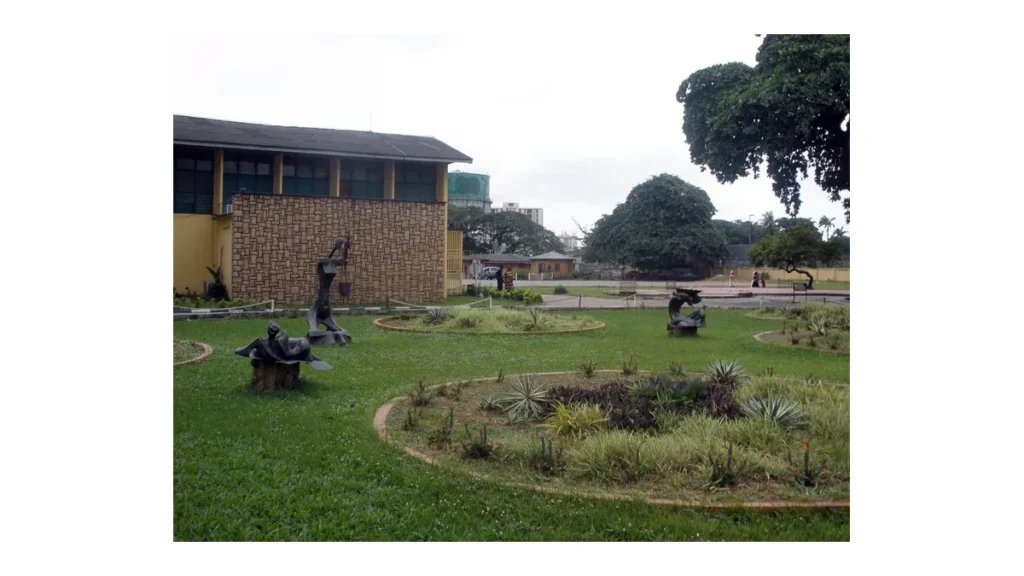
- The craft village — an open-air section of the museum grounds where traditional crafts including weaving, leatherwork, and calabash carving are demonstrated, offering a living dimension to the static collection.
Architecture and building
The main museum building on Onikan Road, Lagos Island, dates to the late colonial period and reflects the functional institutional architecture common to public buildings constructed in British West Africa during the 1950s. The architect of the original structure is not widely documented in public records. The complex includes gallery halls, storage facilities, and the surrounding craft village grounds. The building has undergone periodic maintenance and partial renovation over the decades, though the museum has faced well-documented challenges with funding for large-scale infrastructure upgrades. Visitors should expect a working institution rather than a recently refurbished showcase facility.
Visiting practical
The National Museum Lagos is located on Onikan Road, Lagos Island, close to the Tafawa Balewa Square area and accessible from Lagos Island’s main road network. The museum is generally open Tuesday through Sunday; visitors should confirm current opening hours directly with the National Commission for Museums and Monuments before travelling, as hours can vary. Admission falls in a low price band by international standards, with reduced rates typically available for students and Nigerian nationals. The site is partially accessible for visitors with mobility considerations, though the older building stock means full accessibility cannot be guaranteed throughout. Guided tours can be arranged and are recommended for first-time visitors seeking contextual depth.
Repatriation and debates
The National Museum Lagos sits at the centre of one of the most consequential repatriation debates in the world. A significant portion of the Benin Bronzes — looted by British forces during the punitive expedition of 1897 — remains held in European and North American institutions, including the British Museum, the Ethnologisches Museum in Berlin, and dozens of others. Nigeria has pursued the return of these objects through diplomatic channels for decades. In 2022 and 2023, a number of European institutions and governments announced transfers or agreements to return Benin Bronzes to Nigeria, though the terms, pace, and permanence of these returns have been contested. The establishment of the Edo Museum of West African Art (EMOWAA) in Benin City as a dedicated home for returned bronzes has added a new institutional dimension to the conversation. The Lagos museum, as part of the national museum network, is directly implicated in questions about where returned objects will be housed, how they will be interpreted, and who controls that process. These are live, unresolved debates that researchers and visitors should engage with critically.
Recent developments
In the period from 2023 to 2025, the National Museum Lagos has operated within a broader moment of heightened international attention on Nigerian cultural heritage, driven largely by the ongoing Benin Bronzes repatriation process. The National Commission for Museums and Monuments has been engaged in negotiations and planning discussions related to the reception and display of returned objects. There have been periodic calls from Nigerian cultural figures and academics for increased federal investment in the museum’s infrastructure and conservation capacity. Specific new permanent gallery openings or major leadership changes at the Lagos site have not been widely reported in verifiable sources during this window; visitors and researchers are advised to check directly with the Commission for the most current programming information.
Related research
- Nigeria expert briefing — political, economic, and cultural context for researchers and travellers
- Visa requirements — entry requirements for Nigeria by nationality
- Travel industry — analysis and reporting on African tourism infrastructure
- African airports — guide to major hubs including Murtala Muhammed International Airport, Lagos
- Country comparison — compare Nigeria with other African destinations by key indicators