Air Sierra Leone
Air Sierra Leone
About
Air Sierra Leone occupies a modest but strategically significant position in West African aviation, serving as one of the few carriers operating scheduled services to and from Freetown — a capital city that remains chronically underserved relative to its economic and humanitarian importance. Operating under ICAO code FNI and registered in Sierra Leone, the airline represents an attempt to give the country a credible domestic and regional air link at a time when West Africa’s aviation landscape is being reshaped by new entrants, fleet modernisation programmes, and growing intra-continental demand.
Air Sierra Leone has operated through several iterations since its founding, reflecting the broader turbulence that has characterised commercial aviation in Sierra Leone — a market shaped by a devastating civil conflict in the 1990s, the 2014–2016 Ebola crisis, and the logistical challenges posed by Lungi International Airport’s estuary location. The airline’s ownership structure has historically involved a combination of private Sierra Leonean investors and, at various points, international aviation partners, though the precise configuration of its current shareholding is not fully disclosed in public filings.
In recent years, the carrier has undergone a period of corporate repositioning, with reported efforts to stabilise its operating certificate, rationalise its network, and attract fresh capital. Industry observers note that any airline anchored in Freetown faces structural headwinds — including high fuel import costs, limited domestic traffic density, and competition from road and ferry alternatives on short sectors — but also a genuine opportunity as Sierra Leone’s economy and diaspora connections continue to develop.
Bases and Hubs
Freetown / Lungi International Airport (FNA) — The airline’s principal hub and sole operating base, FNA sits on the northern bank of the Sierra Leone River estuary, requiring onward ferry or helicopter transfer for most Freetown-bound passengers; this geography defines much of the airport’s competitive dynamic.
Fleet
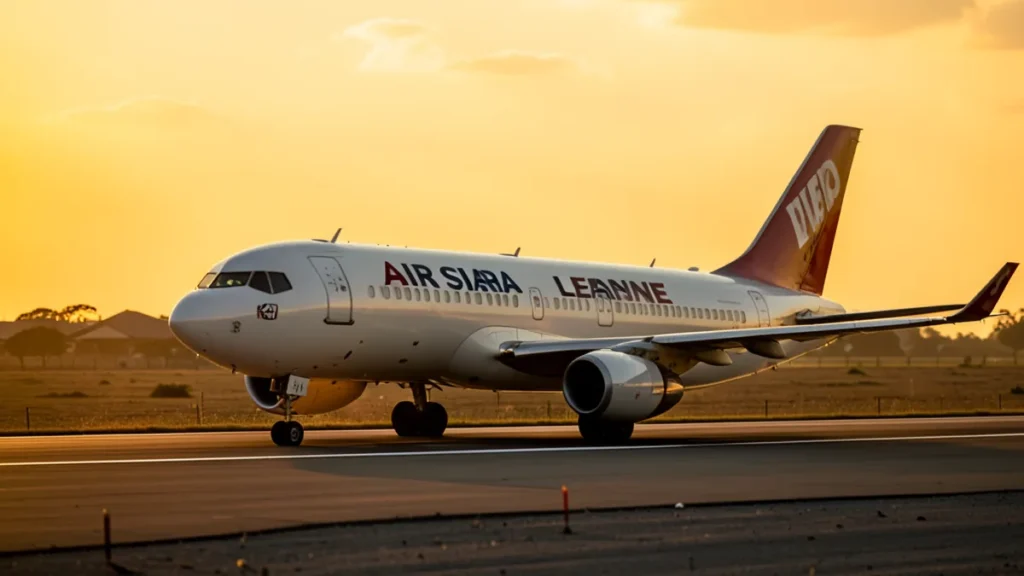
According to publicly disclosed fleet data and civil aviation registry records, Air Sierra Leone has historically operated small, narrowbody or turboprop equipment suited to thin regional routes and short-field operations. Aircraft types associated with the carrier in various periods include the ATR 42 and ATR 72 family — twin-turboprops widely used across sub-Saharan Africa for their ability to operate from shorter runways with lower fuel burn — as well as jet equipment in the narrowbody category on busier regional sectors. Industry estimates suggest the airline’s active fleet remains compact, consistent with the traffic volumes on its current network. No major publicly announced fleet order or wide-body acquisition has been confirmed at the time of writing, though regional operators of this scale frequently lease aircraft on short-term agreements that do not always generate formal press releases.
Destinations
Air Sierra Leone’s network is primarily regional in character, focused on connecting Freetown to key West African hubs and neighbouring capitals. Historically documented routes have included services to Conakry (Guinea), Monrovia (Liberia), and Abidjan (Côte d’Ivoire) — cities that together form the core of the airline’s commercial rationale, serving business travellers, government officials, and diaspora passengers moving within the Mano River Union corridor. Connections to Accra (Ghana) and Dakar (Senegal) have featured in the network at various points, reflecting the gravitational pull of those two cities as West African aviation hubs. The airline does not currently operate intercontinental services; long-haul demand from Freetown is largely captured by carriers such as Brussels Airlines, which has maintained a longstanding presence on the Freetown route, and by connecting itineraries via Casablanca, Addis Ababa, and Accra.
Codeshare and Alliance
Air Sierra Leone is not a member of any of the three major global airline alliances — Star Alliance, SkyTeam, or oneworld. No formal codeshare agreements with major international carriers have been publicly confirmed in recent disclosures. This is not unusual for an airline of its scale and market position; most comparable West African regional operators rely on interline ticketing arrangements and ground-handling partnerships rather than formal codeshare structures. Should the airline pursue growth, alliance affiliation or a bilateral codeshare with a larger African carrier would represent a logical strategic step, and this is an area that industry analysts continue to watch.
Notable Incidents
No major safety incidents attributable to Air Sierra Leone appear on its recent public safety record. Aviation safety databases and press archives do not surface a confirmed hull loss, fatal accident, or serious incident involving the carrier in the period covered by this profile. Readers requiring a comprehensive safety history should consult the Aviation Safety Network database and the Sierra Leone Civil Aviation Authority’s published records directly.
Financial and Operational Situation
Air Sierra Leone’s financial profile is not publicly disclosed in detail, and no audited accounts are available in the public domain at the time of writing. Qualitatively, the airline operates in one of West Africa’s more challenging aviation markets: Sierra Leone’s GDP per capita remains low by regional standards, discretionary air travel demand is limited, and the structural cost of operating through FNA — including fuel logistics, airport charges, and the estuary-crossing challenge that suppresses passenger throughput — weighs on unit economics. Industry observers characterise the airline as a carrier that has required periodic recapitalisation to sustain operations, and its long-term viability is understood to be closely linked to broader infrastructure investment in Sierra Leone, including the much-discussed Freetown bridge project that would transform surface access to Lungi. State support, whether direct or indirect, has historically played a role in sustaining scheduled services to and from Freetown, though the precise nature of any current government relationship is not publicly confirmed.
Recent Developments
In the 24 months to mid-2026, Air Sierra Leone’s most significant operational challenge has been maintaining schedule reliability and regulatory standing in a period of broader West African aviation reform. The Sierra Leone Civil Aviation Authority has been engaged in a process of aligning national oversight with ICAO standards, a development that affects all operators registered in the country. On the commercial side, there have been reported discussions around expanding the airline’s regional footprint to capture growing demand on the Freetown–Accra corridor, which has seen increased traffic driven by business and diaspora travel. The broader West African market has also been affected by the continued expansion of Ethiopian Airlines and RwandAir as pan-continental operators, creating both competitive pressure and potential interline opportunity for smaller national carriers. Observers will be watching whether Air Sierra Leone can secure the fleet and capital commitments needed to participate meaningfully in the region’s post-pandemic traffic recovery.
Related Research
- Sierra Leone Expert Briefing — full country profile, economic context, and aviation market analysis
- African Airlines — the complete pillar covering carriers across the continent
- African Airports — infrastructure profiles including Lungi International (FNA)
- Country Comparison Tool — benchmark Sierra Leone’s aviation market against regional peers