Chileka International Airport
Chileka International Airport
About
Chileka International Airport (IATA: BLZ | ICAO: FWCL) serves Blantyre, Malawi’s commercial capital and its largest city by population. Positioned in the southern highlands of one of sub-Saharan Africa’s most landlocked nations, Chileka occupies a strategically modest but genuinely important place in the regional aviation map. For a country with no coastline and limited surface transport corridors, the airport is not merely a convenience — it is a critical artery connecting Malawian business, humanitarian logistics, and diaspora travel to the wider continent and beyond.
The airport’s origins date to the colonial era, when it was developed as a functional airfield serving the then-Nyasaland Protectorate. Following Malawi’s independence in 1964, Chileka was progressively upgraded to handle jet-age commercial traffic, eventually receiving international designation. The facility is owned by the Government of Malawi and falls under the operational oversight of the Malawi Airports Development Limited (MADL), the state body responsible for the country’s principal airports, which also includes Kamuzu International Airport in the capital Lilongwe.
Over the decades, Chileka has undergone incremental improvements to its terminal infrastructure, apron capacity, and navigational aids, though it has not experienced the large-scale transformation seen at some peer airports in the Southern African Development Community (SADC) region. Its classification remains that of a small-to-medium international gateway, serving a mix of scheduled commercial services, charter operations, and humanitarian and cargo flights that are particularly significant given Malawi’s reliance on international aid supply chains.
Country
Malawi is a landlocked republic in southeastern Africa, bordered by Zambia to the northwest, Tanzania to the northeast, and Mozambique to the south, east, and west. The capital is Lilongwe, though Blantyre — served by Chileka — remains the country’s economic and commercial hub. With a population estimated in the tens of millions and a predominantly agrarian economy, Malawi is classified among the world’s lower-income nations, yet it maintains a stable democratic tradition and a growing services sector. Its position within the SADC bloc makes it a participant in regional integration frameworks that increasingly shape aviation policy, trade flows, and tourism development across southern Africa.
→ Read the Malawi expert briefing
Airlines Based Here
Chileka International Airport does not currently host a full-service hub carrier in the traditional sense. Malawi’s national carrier, Air Malawi, ceased operations in 2013 following financial difficulties, and its successor entity, Malawian Airlines — launched as a public-private partnership with Ethiopian Airlines holding a significant stake — has historically operated out of Kamuzu International Airport in Lilongwe as its primary base. Chileka therefore functions primarily as a focus city rather than a hub, receiving visiting carriers rather than originating a home airline’s network. Malawian Airlines does serve Blantyre on domestic and select regional rotations, making it the closest thing to a resident carrier at the airport. Ethiopian Airlines, by virtue of its partnership stake in Malawian Airlines and its own codeshare arrangements, maintains a commercial presence at the airport. Charter operators and humanitarian aviation organisations, including those affiliated with United Nations agencies active in Malawi, also make regular use of Chileka’s facilities.
Flights and Destinations
The scheduled network at Chileka International Airport is focused primarily on regional African connectivity, with intercontinental services limited but present. Domestically, flights connect Blantyre to Lilongwe, providing a vital air bridge between the commercial south and the administrative capital. Regionally, the airport has supported services to Johannesburg (South Africa), Nairobi (Kenya), Dar es Salaam (Tanzania), Lusaka (Zambia), and Harare (Zimbabwe) — destinations that reflect Malawi’s principal trade and diaspora corridors. South African Airways and its low-cost affiliate have at various points operated or codeshared on the Johannesburg route, which consistently ranks as the airport’s highest-demand international service. Ethiopian Airlines connectivity, routed through Addis Ababa, provides the most significant intercontinental gateway for passengers travelling onward to Europe, the Middle East, and Asia. Industry observers note that the Blantyre–Addis Ababa–international corridor is particularly important for business travellers and the NGO sector. Seasonal and charter services to destinations in the United Kingdom have also been recorded, catering to the Malawian diaspora community concentrated in cities such as London.
Facilities and Capacity
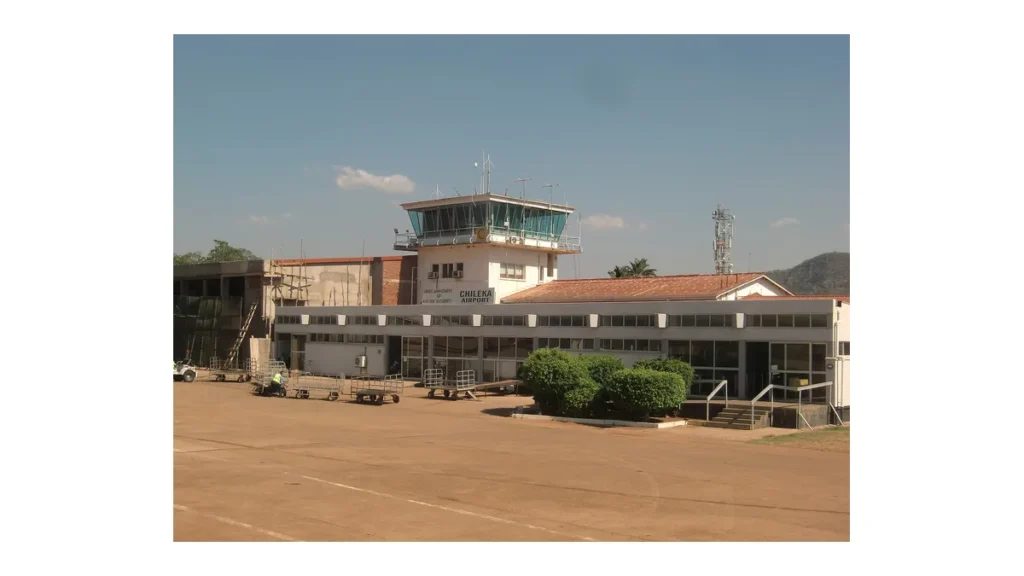
Chileka International Airport operates a single passenger terminal building that handles both domestic and international arrivals and departures, with segregated processing zones for immigration and customs on the international side. The airport has one principal paved runway, oriented to accommodate the prevailing wind patterns of the Blantyre highlands; runway length is sufficient for narrow-body jet operations, including Boeing 737 and Airbus A220-family aircraft, though it imposes practical constraints on wide-body movements with full payload at the airport’s elevation. The apron capacity is limited, and simultaneous handling of multiple wide-body aircraft is not standard. Cargo facilities exist but are modest in scale, serving primarily perishable agricultural exports — tea and tobacco being historically significant — as well as humanitarian import flows. According to publicly disclosed traffic data reviewed by regional aviation analysts, Chileka falls within the small international gateway category by African standards, handling passenger volumes that are meaningful for Malawi’s economy but well below the throughput of major SADC hubs such as OR Tambo or Jomo Kenyatta. Planned and ongoing infrastructure works under MADL’s development mandate have been discussed in government budget frameworks, though the scope and timeline of any major expansion remain subject to financing confirmation.
Visa Regulations
Travellers arriving at Chileka International Airport are subject to Malawi’s national visa regime, administered by the Department of Immigration. As of the most recently published policy guidance, Malawi offers visa-free entry to citizens of a number of African Union member states under bilateral and regional agreements, reflecting the country’s commitment to the African Continental Free Trade Area’s broader mobility aspirations. Citizens of the United Kingdom, the United States, and many European Union member states have generally been eligible for visa-on-arrival facilities at Malawi’s international airports, including Chileka, though conditions, fees, and permitted durations of stay are subject to periodic revision by the Malawian government. An eVisa system has been introduced to streamline pre-travel authorisation for eligible nationalities, allowing travellers to obtain clearance before departure and reduce processing time at the port of entry. Regional African passport holders from SADC countries typically benefit from simplified entry arrangements. Visa policy changes frequently and without extended public notice — travellers, journalists, and researchers are strongly advised to verify current requirements before travel. → Check the live visa requirements lookup
Recent Developments
In the 24-month window leading into 2026, Chileka International Airport has been the subject of renewed attention from both the Malawian government and regional aviation stakeholders. Discussions around improving the airport’s instrument landing systems and night-flying capabilities have featured in civil aviation authority communications, reflecting a broader recognition that operational limitations reduce the airport’s commercial attractiveness to carriers evaluating new route launches. The question of a second or expanded runway, long discussed in planning documents, remains unresolved pending capital mobilisation. On the commercial side, industry estimates suggest that post-pandemic traffic recovery at Chileka has followed the broader African aviation rebound trend, with leisure, diaspora, and business travel all contributing to improved load factors on the Johannesburg and Addis Ababa routes. There have been reports in regional aviation media of exploratory conversations between MADL and potential new carrier partners regarding direct or codeshare services, though no confirmed new scheduled entrants had been publicly announced at the time of publication. Humanitarian and cargo operations have remained a consistent and significant component of the airport’s activity, particularly in periods when Malawi has faced climate-related food security challenges requiring international logistics support.
News and Reports
Researchers, journalists, and analysts seeking current operational intelligence on Chileka International Airport should consult several authoritative source categories. The Malawi Airports Development Limited periodically publishes operational updates and press releases through official government communication channels. The Malawi Department of Civil Aviation, as the national regulatory body, issues safety, licensing, and policy notices relevant to all airports under its jurisdiction. At the continental level, the African Airlines Association (AFRAA) and IATA’s Africa and Middle East regional office produce periodic market analysis reports that contextualise Malawian aviation within broader SADC and pan-African trends. The ICAO regional office for Eastern and Southern Africa (ESAF), based in Nairobi, is the appropriate point of reference for safety oversight findings and infrastructure compliance assessments. Regional aviation trade publications, including ch-aviation and Anna.aero, provide route-level tracking and carrier news that frequently covers smaller African markets such as Blantyre. For on-the-ground reporting, Malawian national newspapers and broadcasters with dedicated business desks are valuable primary sources for airport authority statements and government policy announcements.
Related Research
- Malawi Expert Briefing — in-depth country analysis for researchers and investors
- Malawi Statistics — key demographic, economic, and trade data
- African Airports Directory — profiles of airports across the continent
- African Airlines Guide — carrier profiles, route maps, and fleet data
- Visa Requirements Lookup — live, country-by-country entry requirement checker
- Country Comparison Tool — benchmark Malawi against peer economies and aviation markets