Madagascar Airlines
Madagascar Airlines
About
Madagascar Airlines is the flag carrier of the Republic of Madagascar, operating scheduled passenger and cargo services from its principal hub at Ivato International Airport in Antananarivo (TNR). Registered under IATA code MD and ICAO designator MDG, the airline occupies a strategically important but commercially challenging position in African aviation: it is the primary air link between one of the world’s largest island nations and the broader global network, serving a market that is geographically isolated, economically developing, and underserved by international competition.
The airline traces its origins to Air Madagascar, which was established in 1962 following Madagascar’s independence and operated for decades as a state-owned enterprise under various configurations of government and private partnership. For much of its history, Air Madagascar was the dominant — and often sole — provider of both domestic and international air connectivity for the island, a role that brought both strategic importance and persistent financial strain.
A significant corporate rebranding took place in recent years when the carrier adopted the Madagascar Airlines identity, signalling an effort to modernise its public image and reposition itself commercially. The Malagasy state retains a controlling ownership interest in the airline, as is common among African flag carriers, though the precise structure of any private or institutional co-investment has evolved through successive restructuring rounds. Industry observers have noted that the rebranding was accompanied by broader operational reform efforts intended to improve efficiency and customer experience.
Bases and Hubs
Antananarivo – Ivato International Airport (TNR): The airline’s primary hub and main operational base, handling the majority of international departures and arrivals as well as connections to the domestic network.
Nosy Be – Fascene Airport (NOS): A key focus city serving Madagascar’s premier tourist destination in the northwest, with seasonal and scheduled links to international leisure markets.
Toamasina – Ambalamanasy Airport (TMM): The country’s principal east-coast port city, served as part of the domestic network connecting commercial and regional traffic.
Mahajanga – Amborovy Airport (MJN): A secondary domestic focus point in the northwest, supporting regional connectivity within Madagascar’s dispersed geography.
Fleet
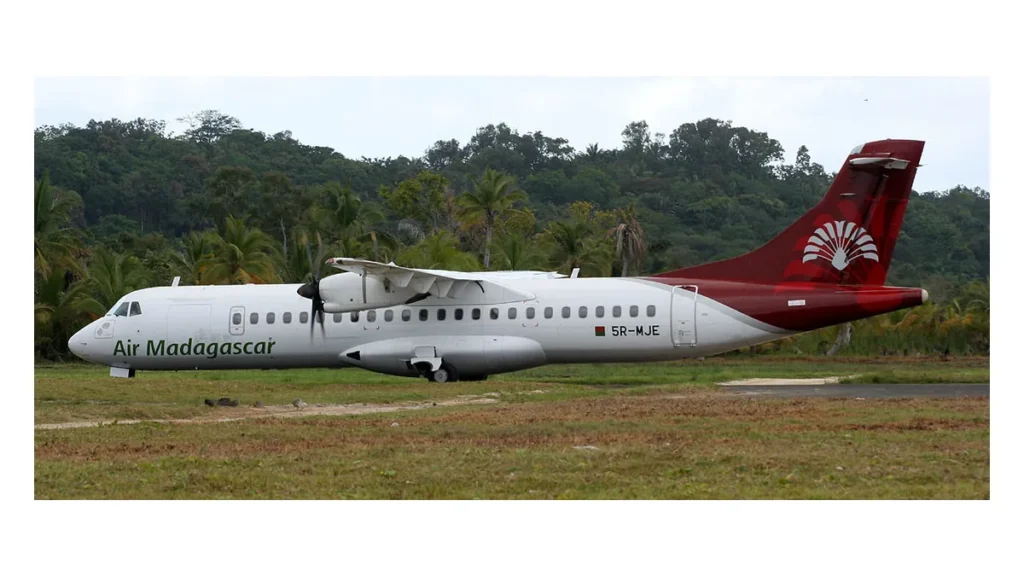
According to publicly disclosed fleet data and industry tracking sources, Madagascar Airlines operates a mixed fleet suited to both its thin long-haul international routes and its extensive domestic network across an island where road infrastructure remains limited. The airline has historically operated ATR 72 turboprop aircraft on domestic and regional short-haul sectors, a type well-suited to the shorter runways and lower-density routes found across Madagascar’s provincial airports. For medium and longer-haul international services, the carrier has utilised Boeing 737 family narrowbody jets. Fleet renewal has been an ongoing topic for the airline’s management, with industry estimates suggesting the average fleet age has been a point of focus in recent operational planning discussions. Any confirmed orders or lease agreements for next-generation aircraft types should be verified against the airline’s official communications at the time of research.
Destinations
Madagascar Airlines operates a network that spans three broad categories: an extensive domestic web, a regional Indian Ocean cluster, and a limited set of intercontinental routes. Domestically, the airline connects Antananarivo with a significant number of provincial towns and cities, fulfilling a public service obligation role in a country where surface transport is often impractical. Within the Indian Ocean region, the carrier serves key island destinations including Réunion, Mauritius, and the Comoros, markets that carry both leisure and diaspora traffic. On intercontinental routes, Paris (CDG) has historically been the airline’s most significant long-haul destination, reflecting Madagascar’s Francophone heritage and the importance of the French market for both tourism and business travel. Connections to other points in continental Africa, including Nairobi and Johannesburg, have featured in the network at various times, positioning TNR as a transit option for travellers moving between the island and the African mainland.
Codeshare and Alliance
Madagascar Airlines is not a member of any of the three major global airline alliances — Star Alliance, SkyTeam, or oneworld. The airline has historically maintained codeshare and interline arrangements with select partners to extend its commercial reach beyond what its own network can support. Air France has been a notable partner given the importance of the Paris route and the broader Air France–KLM group’s presence in Francophone Africa and the Indian Ocean. Travellers and travel trade professionals are advised to verify the current status of any codeshare arrangements directly with the airline or through GDS systems, as partnership agreements in this segment of African aviation can be subject to change.
Notable Incidents
Madagascar Airlines, under its current brand identity, does not have major incidents prominently recorded on its recent public safety record. Researchers requiring a comprehensive safety history of the airline’s predecessor operations under the Air Madagascar name should consult the Aviation Safety Network database and the French Bureau d’Enquêtes et d’Analyses (BEA) records, which maintain authoritative documentation of historical occurrences. This profile does not reproduce incident details that cannot be independently verified at the time of writing.
Financial and Operational Situation
Like many African flag carriers, Madagascar Airlines operates in a financially demanding environment characterised by high fuel costs relative to yield, thin route economics on long-haul sectors, and the structural challenges of serving a low-income domestic market. The airline has historically depended on state support to sustain operations, and industry observers have noted that achieving sustainable profitability remains a medium-term goal rather than a current reality. Restructuring efforts have been a recurring theme in the airline’s recent corporate history, with management changes and operational reviews forming part of a broader effort to align costs with revenues. Investors and analysts researching the airline’s financial position are strongly advised to consult the Malagasy government’s official disclosures and any audited accounts made available through regulatory filings, as precise financial figures are not publicly disclosed in a consistent or independently verifiable format.
Recent Developments
In the period leading into 2026, Madagascar Airlines has continued to navigate the post-pandemic recovery of Indian Ocean and African aviation markets, with leisure traffic to Madagascar showing resilience driven by the country’s appeal as an ecotourism destination. The airline has been engaged in discussions around fleet modernisation, with the replacement of older turboprop and narrowbody assets a stated operational priority. Network adjustments, including the review of underperforming international routes and the reinforcement of core Indian Ocean services, have been reported in regional aviation trade media. Regulatory engagement with the Malagasy civil aviation authority and alignment with ICAO safety oversight standards have remained areas of institutional focus. Journalists and investors tracking the airline should monitor announcements from the Malagasy Ministry of Transport and official airline communications for confirmed developments on fleet, routes, and ownership structure.