Kenya Airways
Kenya Airways
About
Kenya Airways (IATA: KQ / ICAO: KQA) is East Africa’s largest full-service carrier and one of the continent’s most strategically significant airlines, operating a hub-and-spoke network from Nairobi’s Jomo Kenyatta International Airport (NBO) that connects sub-Saharan Africa to Europe, Asia, and North America. Often described as “The Pride of Africa” — a tagline the airline has carried for decades — KQ occupies a pivotal position in African aviation: large enough to compete on intercontinental routes, yet deeply embedded in the intra-African connectivity that remains chronically underserved across the continent.
Kenya Airways was founded in 1977, shortly after the dissolution of East African Airways, the shared regional carrier that had served Kenya, Uganda, and Tanzania. The Kenyan government established KQ as a wholly state-owned successor, and the airline grew steadily through the 1980s and into the 1990s. A landmark moment came in 1996 when KLM Royal Dutch Airlines acquired a significant equity stake, making Kenya Airways one of the first African carriers to undergo meaningful privatisation and strategic partnership with a major European airline. That relationship shaped KQ’s operational culture, training standards, and network strategy for the following two decades.
Ownership has evolved considerably since. The Kenyan government retains a substantial shareholding, and KLM’s parent Air France-KLM remains a strategic partner, though the precise balance of ownership has shifted through successive restructuring rounds. The airline is publicly listed on the Nairobi Securities Exchange, giving it a degree of market accountability unusual among African state-linked carriers. In recent years, the Kenyan government has explored various models for the airline’s long-term capitalisation, including discussions around a potential national carrier restructuring framework, reflecting the broader tension between commercial viability and strategic national interest that defines many African flag carriers.
Bases and Hubs
Nairobi – Jomo Kenyatta International Airport (NBO): Kenya Airways’ principal hub and operational centre, handling the vast majority of the airline’s passenger and cargo throughput; NBO serves as the primary connecting point between African regional routes and long-haul intercontinental services.
Mombasa – Moi International Airport (MBA): A secondary focus city serving Kenya’s coastal tourism market, with domestic and select regional connections operated by KQ and its subsidiary Jambojet.
Kisumu – Kisumu International Airport (KIS): A domestic focus point in western Kenya, reflecting the airline’s role in supporting internal connectivity across a geographically dispersed country.
Fleet
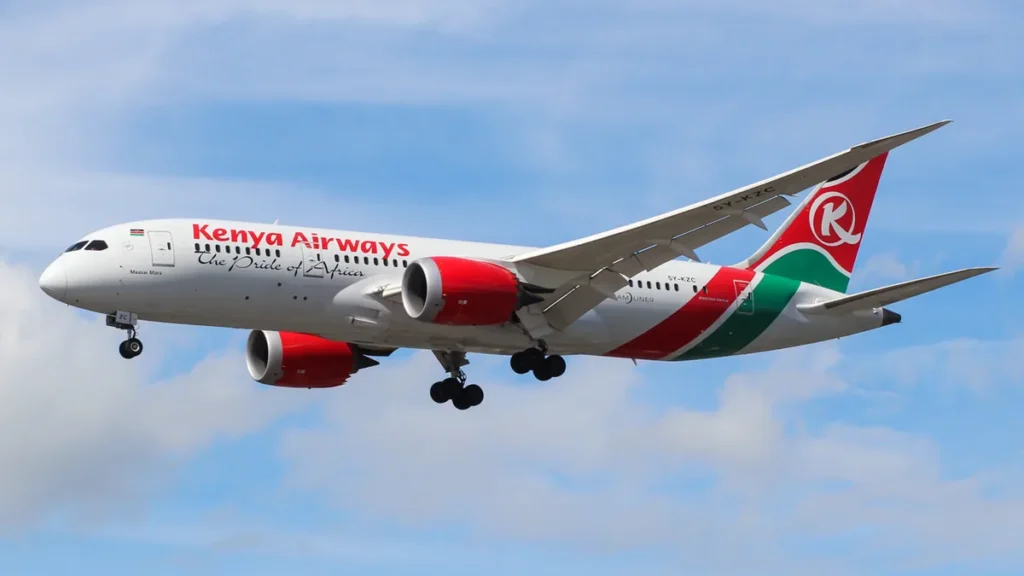
Kenya Airways operates a mixed fleet centred on Boeing widebody and narrowbody aircraft. The workhorse of its long-haul network is the Boeing 787 Dreamliner, which the airline has deployed on intercontinental routes to Europe, Asia, and North America, benefiting from the type’s fuel efficiency and passenger comfort credentials. For medium and short-haul routes — including the dense intra-African network — KQ operates Boeing 737 variants, with the 737-800 forming the backbone of regional operations. According to publicly disclosed fleet data, the airline has also operated Embraer E190 jets, which have been particularly suited to thinner regional routes where full narrowbody capacity would be uneconomical. The airline’s low-cost subsidiary Jambojet operates a separate fleet of turboprop and narrowbody aircraft focused on domestic Kenyan routes. Industry observers have noted that fleet renewal and right-sizing remain ongoing priorities for management, with decisions on future aircraft orders closely tied to the airline’s financial recovery trajectory.
Destinations
Kenya Airways operates one of the broadest pan-African route networks of any carrier on the continent, serving destinations across West, Central, East, and Southern Africa from its Nairobi hub. Headline intra-African routes include Nairobi to Lagos (LOS), Accra (ACC), Johannesburg (JNB), Dar es Salaam (DAR), Entebbe (EBB), and Addis Ababa (ADD), among many others. On intercontinental routes, the airline’s Boeing 787 services connect NBO to London Heathrow (LHR), Amsterdam (AMS), and Paris (CDG) in Europe, as well as to Bangkok (BKK) and Guangzhou (CAN) in Asia. A notable strategic ambition has been the New York (JFK) route, which Kenya Airways has operated — making it one of very few African carriers to maintain a direct transatlantic service to the United States — though the commercial sustainability of that route has been subject to periodic review. Domestically, KQ and Jambojet together provide connectivity between Nairobi, Mombasa, Kisumu, Eldoret, and other Kenyan cities.
Codeshare and Alliance
Kenya Airways is a member of the SkyTeam global airline alliance, aligning it with partners including Air France, KLM, Delta Air Lines, and China Southern Airlines, among others. This membership underpins a significant portion of KQ’s codeshare activity and provides passengers with reciprocal frequent-flyer benefits and lounge access across the alliance network. The relationship with KLM is particularly deep-rooted, extending beyond codeshare into areas of technical cooperation and commercial coordination. KQ also holds codeshare arrangements with a range of other carriers to extend its effective reach beyond its own operated network.
Notable Incidents
Kenya Airways has experienced serious incidents in its operational history. The most significant on public record is the loss of Flight KQ507, a Boeing 737-800 that crashed shortly after departure from Douala, Cameroon, in May 2007, with no survivors among those on board. The accident was extensively investigated and attributed to spatial disorientation. This remains the most consequential safety event in the airline’s history. In more recent years, Kenya Airways has not featured prominently in major incident reporting, and industry safety databases do not indicate significant hull losses or fatal accidents in the period since. As with all carriers, travellers and researchers are encouraged to consult authoritative sources such as the Aviation Safety Network for the most current safety record data.
Financial and Operational Situation
Kenya Airways has faced a prolonged and well-documented period of financial difficulty. The airline reported significant losses in the years following an ambitious expansion phase in the early 2010s, a period during which it grew its network and fleet rapidly but struggled to generate sufficient revenue to service the associated debt. The COVID-19 pandemic compounded these pressures severely, grounding international operations for an extended period and accelerating balance-sheet deterioration. The Kenyan government has intervened on multiple occasions to provide financial support, and restructuring negotiations with lenders have been a recurring feature of the airline’s corporate story. Industry estimates suggest the airline has made progress in reducing its cost base and rebuilding passenger volumes in the post-pandemic period, though a return to sustained profitability has remained elusive and is closely watched by investors and creditors alike. The airline’s dual status as a listed company and a strategically important national carrier creates a complex governance environment that analysts frequently cite as a structural challenge.
Recent Developments
In the 24 months leading into 2026, Kenya Airways has pursued a strategy of measured network rebuilding and operational stabilisation. The airline has worked to restore and in some cases expand its intra-African route map, capitalising on recovering regional travel demand. Cargo operations — always a meaningful revenue stream given Nairobi’s role as a hub for fresh produce and pharmaceutical exports — have remained a focus, with KQ Cargo continuing to develop its freighter and belly-hold capacity. The airline has engaged in ongoing dialogue with the Kenyan government regarding its long-term ownership and capitalisation structure, with proposals for a revised public-private framework attracting attention from regional aviation analysts. Fleet decisions, including the potential rationalisation of aircraft types to reduce maintenance complexity and cost, have also been under active consideration. Partnerships within the SkyTeam framework have been leveraged to support revenue recovery, and the airline has invested in customer experience improvements as competition on key African routes intensifies from carriers including Ethiopian Airlines and RwandAir.