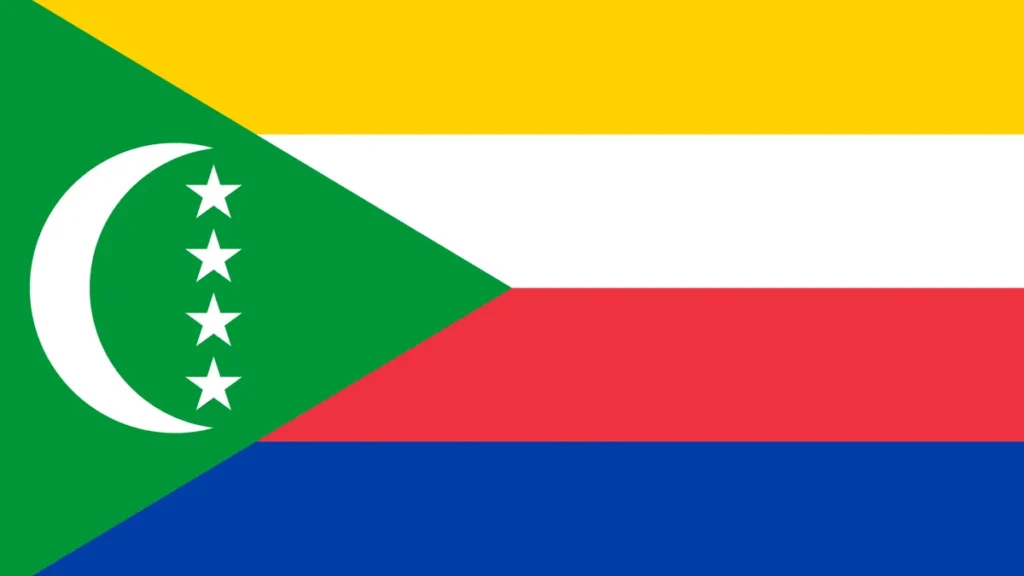
Comoros — Expert Briefing
Comoros at a glance: A small but strategically positioned Indian Ocean archipelago navigating the tensions between democratic consolidation, climate vulnerability, and an economy heavily dependent on diaspora remittances and a single cash crop.
Overview
The Union of Comoros — officially l’Union des Comores — is an archipelago nation of three main islands (Grande Comore, Anjouan, and Mohéli) situated in the northern Mozambique Channel between Madagascar and the East African coast. Its capital and largest city is Moroni, located on Grande Comore. The population is estimated at approximately 870,000 to 900,000 (UN Population Division, 2024 revision), though this figure is complicated by a large and economically significant diaspora concentrated in metropolitan France, particularly in Marseille and the Paris region, which may number 350,000 or more. Official languages are Comorian (Shikomori), Arabic, and French, reflecting the country’s layered colonial, Islamic, and regional identities. The currency is the Comorian franc (KMF), pegged to the euro through a monetary agreement with France — a structural anchor that constrains monetary policy but provides inflation stability. GDP per capita sits in the lower-middle-income band, estimated at roughly USD 1,600 to 1,800 in nominal terms (World Bank, 2023–24 data cycle), placing Comoros among the smaller and more economically fragile states in sub-Saharan Africa. In 2026, Comoros matters for two reasons that extend beyond its size: it holds the rotating presidency of the Arab League and is increasingly cited in climate-finance discussions as a frontline small island developing state whose adaptation needs are structurally underfunded relative to its exposure.
Government and Politics
Comoros is a federal presidential republic with a rotating presidency among the three islands — a constitutional arrangement unique in the world and designed to manage the persistent inter-island tensions that have produced more than twenty coups or coup attempts since independence from France in 1975. The current head of state is President Azali Assoumani, a former military officer who first came to power in a 1999 coup, was subsequently elected in democratic contests, and has dominated Comorian politics for most of the past two decades. Assoumani was re-elected in January 2024 in a first-round result that the opposition and international observers characterised as deeply flawed, with credible reports of ballot stuffing, voter intimidation, and the exclusion of opposition candidates on procedural grounds. The African Union and the Southern African Development Community (SADC) both expressed concern, though neither issued a formal condemnation. The legislature is the Assembly of the Union (Assemblée de l’Union), a unicameral body of 33 seats; legislative elections were held in January 2025 and returned a strong majority for Assoumani’s Convention for the Renewal of the Comoros (CRC) party, consolidating executive dominance over the legislature. The most consequential recent constitutional change was the 2018 referendum — itself contested — which abolished the island-rotation presidency, extended presidential terms to five years with the possibility of re-election, and centralised power in the executive, effectively dismantling the power-sharing architecture that had been the country’s primary conflict-management mechanism since the 2001 constitution. Civil society organisations and opposition coalitions remain active but operate under significant legal and practical constraints, including restrictions on assembly and selective prosecution of critics.
Economy
Comoros has a nominal GDP estimated at approximately USD 1.35 to 1.5 billion (IMF World Economic Outlook, 2024), making it one of the smallest economies in Africa by absolute size. The economy rests on three structural pillars, none of which provides robust or diversified growth. First, remittances from the diaspora — primarily in France — constitute an estimated 20 to 25 percent of GDP, making Comoros one of the most remittance-dependent economies in the world relative to its size; this flow is both a lifeline and a source of macroeconomic vulnerability, as it is sensitive to French labour market conditions and immigration policy. Second, ylang-ylang and cloves remain the dominant agricultural exports; Comoros is the world’s leading producer of ylang-ylang essence, used in the global perfume industry, but the sector is exposed to commodity price volatility and climate-related yield disruption. Third, vanilla cultivation has grown in importance, though Comoros competes directly with Madagascar and faces quality-certification challenges in premium export markets. Tourism contributes modestly and has recovery potential, but infrastructure constraints limit scale. The euro peg provides price stability but removes exchange-rate flexibility as an adjustment tool. Public debt has risen to approximately 30 to 35 percent of GDP, manageable by regional standards but with limited fiscal space given narrow tax revenues. The single most consequential economic story of the past 24 months has been the renegotiation of Comoros’s relationship with Gulf state investors, particularly from the UAE and Saudi Arabia, who have committed to infrastructure financing — including port upgrades at Moroni and a new desalination facility — in exchange for expanded economic and diplomatic alignment. This shift has raised questions among Western donors about governance conditionality and transparency in project contracting.
Demographics and Society
The population is overwhelmingly Comorian in ethnic identity — a Bantu-Arab-Malagasy synthesis that reflects centuries of Indian Ocean trade, Arab settlement, and East African migration. There are no significant ethnic minorities in the conventional sense, though inter-island identities (Ngazidja, Ndzuani, Mwali) carry real social and political weight and have historically been mobilised in separatist movements, most notably Anjouan’s repeated secession attempts in the late 1990s and 2000s. The population is overwhelmingly Sunni Muslim — estimates consistently place Islam at 98 to 99 percent of the population — and Islamic institutions, including Quranic schools and mosque networks, play a central role in social organisation, dispute resolution, and education. Arabic is a language of religious instruction and formal prestige; French is the language of administration and higher education; Shikomori (in its island variants) is the language of daily life. Urbanisation is increasing but remains relatively low by regional standards, with approximately 30 to 35 percent of the population living in urban areas; Moroni is the only city of significant size. The population is young — median age estimated at around 20 years — and growing at roughly 2.2 to 2.5 percent annually, creating substantial pressure on employment, education, and public services. The defining social trend of the current moment is youth emigration pressure: a generation of educated young Comorians, unable to find formal employment at home, is seeking pathways to France, the Gulf states, and Tanzania, creating a brain-drain dynamic that simultaneously sustains remittance flows and depletes domestic human capital.
Key Issues Right Now
Democratic backsliding and political repression. The consolidation of power under President Assoumani following the disputed 2024 presidential election and the 2025 legislative sweep has produced what several civil society organisations describe as the most centralised executive authority in Comoros since the coup era. Opposition figures have faced arrest or exile; independent media outlets have been subjected to licensing pressures; and the constitutional court — whose members are presidential appointees — has consistently ruled in the government’s favour on electoral disputes. The African Union’s limited response has drawn criticism from democracy-monitoring organisations, who argue that the Comorian case illustrates a broader pattern of democratic regression in small island states going largely unaddressed by continental institutions.
Climate vulnerability and adaptation financing. Comoros is classified by the United Nations as among the most climate-vulnerable nations in the world. Cyclone exposure, coastal erosion, saltwater intrusion into freshwater aquifers, and coral reef degradation are all accelerating. The islands experienced significant storm damage in 2023 and 2024, and the agricultural sector — particularly clove and ylang-ylang cultivation — faces growing yield instability. Despite its frontline status, Comoros receives a disproportionately small share of global climate adaptation finance relative to its vulnerability index. The government has engaged actively in Loss and Damage negotiations under the UNFCCC framework and has positioned itself as a spokesperson for small island developing states in multilateral forums, but translating diplomatic advocacy into bankable adaptation projects remains a structural challenge given limited institutional capacity.
The Mayotte question and regional migration dynamics. The island of Mayotte — geographically part of the Comorian archipelago but administered as a French overseas department following a contested 1974 referendum — remains a source of deep bilateral tension between Comoros and France. Tens of thousands of Comorians attempt the dangerous crossing to Mayotte each year in small boats known locally as kwassa kwassa; French authorities intercept and deport the majority, but the flow continues, driven by the stark income differential between Mayotte (with French public services and wages) and the Union islands. In late 2024 and into 2025, France intensified deportation operations and proposed constitutional changes to restrict birthright citizenship in Mayotte — measures that Moroni has formally protested but has limited leverage to contest. The issue sits at the intersection of sovereignty, migration policy, and post-colonial relations, and shows no sign of resolution.
Travel and Connectivity
The principal international gateway is Prince Said Ibrahim International Airport (HAH) on Grande Comore, near Moroni, which handles the majority of international traffic. Anjouan has its own airport (AJN) with regional connections. International air links are limited: the main scheduled services connect Moroni to Nairobi, Dar es Salaam, Addis Ababa, Antananarivo, and Paris (via Réunion or direct seasonal services), with regional carriers including Kenya Airways, Ethiopian Airlines, and Air Austral providing the most reliable connectivity. There are no direct flights to the Gulf despite growing economic ties, though connections via Nairobi or Addis Ababa are straightforward. Tourism remains a niche market — the islands offer volcanic landscapes, marine biodiversity, and an uncrowded diving environment, but visitor numbers are modest (estimated at 30,000 to 50,000 arrivals annually in recent years) due to limited accommodation stock, high airfare costs, and low international profile. Moroni is the only city with significant hotel infrastructure. Internet penetration is estimated at 25 to 35 percent of the population, with mobile internet the dominant access mode; fixed broadband infrastructure is minimal. Mobile money adoption is growing but lags behind East African regional leaders such as Kenya and Tanzania; Telecom Comoros and regional operators have expanded mobile financial services, but cash remains dominant in rural and inter-island commerce. Visa-on-arrival is available to most nationalities, which is a positive factor for business travellers.
Further Research
Analysts and journalists seeking to deepen their understanding of Comoros should consult the following institutions and resources. The Banque Centrale des Comores (Central Bank of Comoros) publishes monetary statistics, balance of payments data, and annual reports that are the primary source for macroeconomic figures. The World Bank Comoros Country Page provides regularly updated development indicators, project documentation, and the most accessible synthesis of poverty and growth data. The IMF Article IV Consultation reports on Comoros — published periodically through the IMF’s country report series — offer the most rigorous independent assessment of fiscal sustainability and structural economic challenges. The Africa Center for Strategic Studies (Washington, D.C.) has produced briefings on Comorian political dynamics and Indian Ocean security that are freely accessible and analytically credible. For climate and environmental data, the UNDP Comoros Country Office and the Indian Ocean Commission (Commission de l’Océan Indien), of which Comoros is a member, publish regional assessments relevant to adaptation planning and maritime governance. Finally, the Institut National de la Statistique et des Études Économiques et Démographiques (INSEED) of Comoros is the official national statistics body and the authoritative source for census and demographic data, though publication schedules are irregular and capacity constraints affect data timeliness.