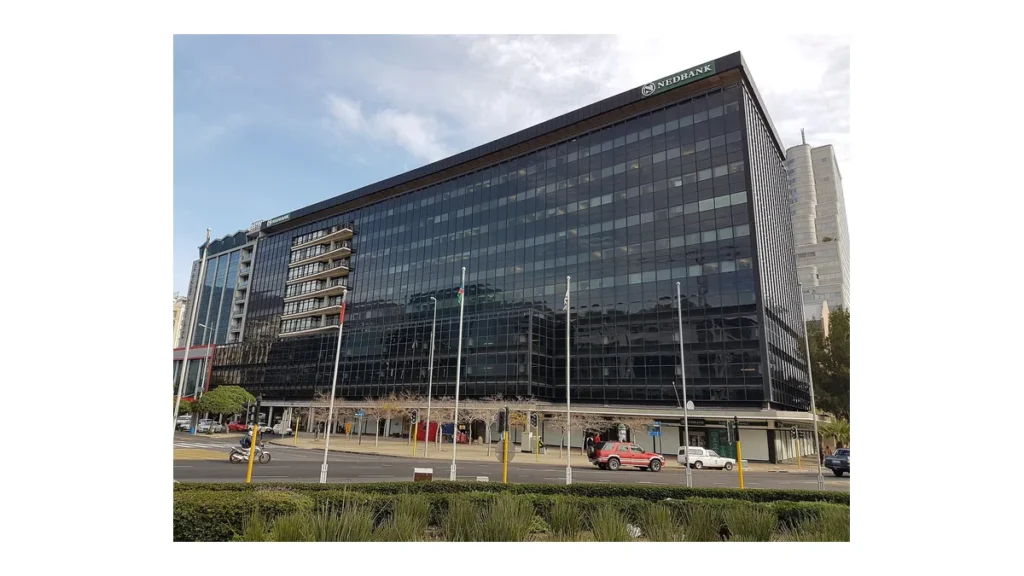
Nedbank Group
Nedbank Group
Nedbank Group is one of South Africa’s four largest commercial banks and a significant financial services institution across Southern Africa, offering a full spectrum of wholesale, retail, and investment banking services to individuals, corporates, and governments.
About
Nedbank Group traces its origins to 1888, when the Nederlandsche Bank en Credietvereeniging voor Zuid-Afrika was established in Cape Town, making it one of the oldest banking institutions on the African continent. Over more than a century of consolidation, rebranding, and expansion, the institution evolved into the Nedbank brand recognised today. A pivotal moment came in the early 2000s when Old Mutual, the diversified financial services group, became the majority shareholder — a relationship that has shaped Nedbank’s capital structure and strategic direction for decades.
Old Mutual holds a controlling stake in Nedbank Group, though the bank operates as a separately listed entity on the Johannesburg Stock Exchange (JSE) under the ticker NED. This dual identity — as both an independent listed company and a subsidiary within the Old Mutual ecosystem — is a defining feature of Nedbank’s governance and investor profile. The group is headquartered in Sandton, Johannesburg, South Africa’s financial hub.
Nedbank has positioned itself as a purpose-led institution, with sustainability and transformation commitments embedded in its public corporate identity. Its long history gives it deep roots in South African retail and commercial banking, while its listed status provides transparency for institutional and retail investors alike.
Sector and competitive position
Nedbank operates in South Africa’s highly concentrated banking sector, where four institutions — Standard Bank, FirstRand (which operates the FNB and Rand Merchant Bank brands), Absa Group, and Nedbank itself — collectively dominate the market. A fifth challenger, Capitec Bank, has disrupted the retail segment significantly over the past decade and is increasingly relevant in the competitive landscape. Nedbank is generally regarded as the fourth-largest of the traditional big four by total assets, though rankings shift depending on the metric applied. The bank competes across corporate and investment banking, retail and business banking, wealth management, and insurance. Its green finance credentials and focus on sustainable lending have become a differentiating narrative, particularly in attracting ESG-conscious institutional investors and corporate clients.
Operations and footprint
South Africa remains Nedbank’s core market, where it operates a substantial branch and ATM network serving millions of retail and business clients. While the bank has rationalised its physical footprint in line with broader industry trends toward digital banking, it maintains a meaningful presence in major metropolitan areas and key regional centres across all nine South African provinces.
Beyond South Africa, Nedbank has a selected presence in Southern Africa through its associate relationship with Ecobank Transnational Incorporated (ETI), which provides indirect access to markets across sub-Saharan Africa. Nedbank holds a strategic stake in ETI, giving it a pan-African distribution channel without requiring direct operational investment in each country. The group also has direct banking operations in Namibia, Lesotho, Eswatini, Mozambique, and Zimbabwe through subsidiaries and associated entities. Nedbank employs tens of thousands of staff across its operations, according to its most recent annual report, making it one of South Africa’s larger private-sector employers.
Products and brands
Nedbank’s customer-facing offering is organised across several business clusters. Nedbank Retail and Business Banking serves individual consumers and small-to-medium enterprises with transactional accounts, home loans, vehicle finance, personal loans, and card products. Nedbank Corporate and Investment Banking (CIB) caters to large corporates, public-sector entities, and financial institutions with structured finance, trade finance, treasury, and advisory services. Nedbank Wealth encompasses private banking, asset management through Nedbank Private Wealth, and insurance solutions. The bank’s digital banking platform, the Nedbank Money app, has been a focus of ongoing investment and is central to its retail growth strategy. Nedbank also markets green and sustainable finance products, including green bonds and sustainability-linked loans, under its broader ESG positioning.
Financial situation
Nedbank Group is listed on the JSE (ticker: NED) and is subject to full disclosure requirements under South African company law and JSE Listings Requirements. According to its most recent annual report, the group has reported a recovery trajectory in headline earnings following the disruption of the COVID-19 period, with return-on-equity metrics trending back toward pre-pandemic levels. Net interest income remains the dominant revenue driver, supplemented by non-interest revenue from transactional banking and wealth management fees. The group maintains capital adequacy ratios above regulatory minimums set by the South African Reserve Bank, and industry analysts generally regard its balance sheet as adequately capitalised for its risk profile. Credit impairment charges — a key variable in South African banking given the macroeconomic environment — have been a closely watched line item. Precise revenue, profit, and share-price figures should be verified against the group’s most recent published results and JSE filings.
Recent developments
Over the past 24 months, Nedbank has continued to invest in its digital transformation agenda, with the Nedbank Money app and broader platform modernisation remaining central to management’s stated priorities. The group’s strategic stake in Ecobank Transnational Incorporated has remained a subject of analyst scrutiny, with questions around the long-term value and strategic logic of the ETI relationship periodically resurfacing in investor communications. On the regulatory front, Nedbank — in common with all South African banks — has navigated the implications of South Africa’s greylisting by the Financial Action Task Force (FATF) in 2023, which placed additional compliance and reputational pressures on the sector, though South Africa subsequently made progress toward addressing the identified deficiencies. Nedbank has also continued to advance its ESG commitments, including green bond issuances and sustainability-linked financing structures for corporate clients, reinforcing its positioning as a leader in responsible finance within the South African market.
Outlook
Nedbank’s strategic priorities centre on deepening its digital banking capabilities, growing its retail and business banking client base, and leveraging its ETI stake for broader African exposure without the capital intensity of direct market entry. The South African macroeconomic environment — characterised by subdued GDP growth, elevated unemployment, and persistent infrastructure constraints including energy and logistics — represents a structural headwind for loan growth and credit quality. However, any improvement in South Africa’s economic trajectory, including progress on energy supply and the implementation of structural reforms, would be a meaningful tailwind for the group. Competition from Capitec in the retail segment and from specialist fintech players in payments and lending remains an ongoing challenge. Nedbank’s green finance positioning and its established corporate and investment banking franchise are seen by analysts as relative strengths as the group navigates a complex operating environment through the mid-2020s.
Related research
- South Africa Expert Briefing
- African Business Coverage
- African Business Research
- Country Comparison Tool