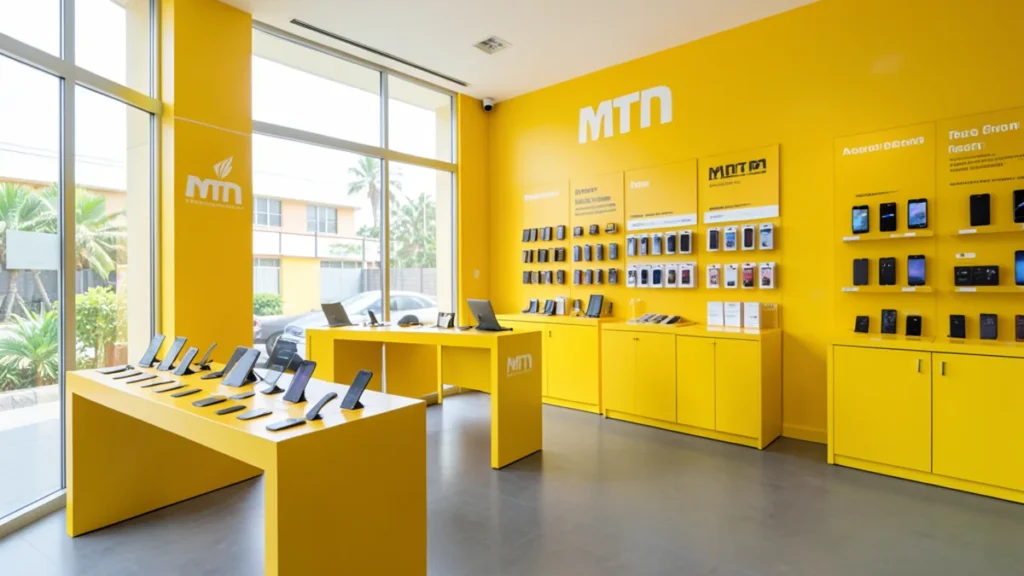
MTN Ghana
MTN Ghana
About
MTN Ghana is the country’s leading mobile network operator by most industry measures, operating under the pan-African MTN Group brand and holding a commanding position in a market that has become one of West Africa’s most closely watched for digital growth. Headquartered in Accra, the operator runs commercial services across 2G, 3G, 4G, and 5G network generations, and its mobile money platform, MoMo, has evolved into a significant financial-services business in its own right.
MTN Ghana traces its origins to 1994, when Scancom Limited was incorporated and awarded one of Ghana’s earliest GSM licences. The network launched commercially in 1996 under the Areeba brand before MTN Group — then expanding aggressively across sub-Saharan Africa — acquired a controlling stake in Scancom in 2006 and rebranded the operation MTN Ghana. The transition brought the operator into MTN Group’s unified technology and procurement frameworks, accelerating network rollout and product development.
A landmark in the operator’s corporate history came in 2018, when MTN Ghana listed on the Ghana Stock Exchange (GSE) under the ticker MTNGH, making it one of the largest listings in the exchange’s history at the time. MTN Group retains a majority controlling stake, while a meaningful portion of shares is held by Ghanaian institutional and retail investors — a structure that has given the operator a degree of local accountability and public visibility unusual among its regional peers.
Country market context
Ghana’s mobile market is regulated by the National Communications Authority (NCA), which oversees a competitive landscape that, as of 2026, includes several licensed mobile operators — among them Telecel Ghana (formerly Vodafone Ghana) and AirtelTigo — though industry estimates suggest MTN Ghana and its nearest rival account for the substantial majority of active SIM connections. Mobile penetration has risen steadily, supported by a relatively young, urbanising population and government-backed digital-inclusion initiatives, yet rural connectivity gaps and affordability constraints remain structural challenges for the sector as a whole. The NCA has in recent years tightened quality-of-service enforcement and pushed operators toward greater spectrum efficiency, shaping the competitive environment in ways that tend to favour operators with the deepest capital resources. → Read the Ghana expert briefing
Network and technology
MTN Ghana operates across 2G, 3G, 4G LTE, and 5G network generations, with 4G coverage extending to all regional capitals and a growing number of peri-urban and rural districts. The operator holds spectrum across multiple bands, including holdings in the 800 MHz, 1800 MHz, and 2100 MHz ranges that underpin its broad geographic footprint, and it was among the first operators in Ghana to conduct 5G trials and move toward limited commercial 5G deployment in Accra. Fibre backhaul investment has been a stated priority in recent capital expenditure cycles, reducing reliance on microwave links and improving latency on the data network. MTN Ghana also benefits from MTN Group’s international gateway relationships and submarine cable connectivity, positioning it competitively for enterprise and wholesale data services.
Products and services
The operator’s consumer portfolio spans prepaid and postpaid voice, mobile broadband, and device financing schemes. Its most strategically significant product line beyond connectivity is MoMo — MTN Mobile Money — which offers peer-to-peer transfers, merchant payments, bill settlement, savings products, and micro-lending through partnerships with licensed financial institutions. MoMo has registered tens of millions of wallets across MTN’s African markets, and Ghana is among its more mature deployments. On the enterprise side, MTN Ghana provides dedicated internet access, cloud connectivity, SD-WAN solutions, and managed ICT services to corporate and government clients. Fixed broadband and home internet offerings, delivered via LTE and fibre-to-the-home in select Accra districts, round out the portfolio as the operator pursues convergence.
Subscribers and market position
According to the most recent data published by the NCA, MTN Ghana holds the largest share of active mobile subscriptions in the country, positioning it clearly as the market leader rather than merely one of the country’s two largest operators. Industry estimates suggest its subscriber base spans a broad cross-section of income segments, with prepaid customers representing the overwhelming majority of connections. The MoMo wallet base is separately tracked and, by most analyst assessments, represents one of the largest active mobile money user communities in West Africa. MTN Ghana’s network quality scores and brand recognition consistently rank among the highest in NCA-published quality-of-service reports.
Financial situation
MTN Ghana’s revenue trajectory has been shaped by Ghana’s broader macroeconomic turbulence — including the currency depreciation and sovereign debt restructuring that characterised the 2022–2024 period — which compressed cedi-denominated earnings in dollar terms even as local-currency service revenues continued to grow. The operator has nonetheless maintained profitability, with MTN Group’s quarterly and annual results consistently identifying Ghana as one of its operationally stronger markets in terms of EBITDA margin, according to group financial disclosures. As a GSE-listed entity, MTN Ghana publishes standalone audited accounts, providing a level of financial transparency that analysts covering the West African telecoms sector find useful. Capital expenditure commitments tied to 5G rollout and fibre backhaul have weighed on free cash flow in recent reporting periods, though management has framed this as investment-phase spending.
Recent developments
The 24 months to mid-2026 have been eventful for MTN Ghana on several fronts. The operator progressed from 5G trials to limited commercial launch in Accra, making Ghana one of a small number of West African markets with live fifth-generation services. Regulatory relations have been active: the NCA issued quality-of-service directives affecting all operators, and MTN Ghana publicly committed to accelerated rural coverage expansion as part of its licence obligations. On the financial-services side, MoMo has deepened integrations with Ghana’s interoperability framework, enabling cross-network mobile money transfers that regulators have promoted as a financial-inclusion measure. MTN Group’s broader Ambition 2025 strategy — which frames the group’s transition toward a platform and fintech business — has been visible in Ghana through expanded MoMo merchant acquisition campaigns and the piloting of MoMo-linked insurance and pension products in partnership with local financial institutions.