The African food industry — agriculture, processing, exports
Agriculture remains the backbone of the African economy, employing more people and shaping more livelihoods than any other sector on the continent. From the cocoa belts of West Africa to the tea highlands of East Africa and the citrus groves of the Western Cape, the food and agriculture industry touches virtually every dimension of African economic life. As global food systems face mounting pressure from climate disruption, supply chain fragility, and shifting consumer preferences, Africa’s position as a critical supplier of raw commodities — and increasingly as a processor, brand builder, and food innovator — is drawing serious attention from investors, policymakers, and development institutions alike.
Agriculture’s Weight in the African Economy
Agriculture’s contribution to GDP varies significantly across the continent, but its aggregate importance is difficult to overstate. In countries such as Ethiopia, Uganda, and Mali, the sector accounts for a substantial share of national output and employs the majority of the working population. Even in more diversified economies like South Africa and Egypt, agribusiness — spanning primary production, processing, logistics, and retail — remains a major employer and foreign exchange earner. Industry estimates suggest that agriculture contributes roughly 15 to 20 percent of Africa’s combined GDP when measured broadly, though this figure rises considerably in lower-income, agrarian-dependent economies. The sector’s employment footprint is even more pronounced: according to the latest sector reports, agriculture accounts for more than half of total employment across sub-Saharan Africa, with women making up a disproportionately large share of that workforce. The challenge for policymakers has long been how to raise productivity and value addition within a sector that remains, in many countries, dominated by smallholder farming with limited access to credit, inputs, and markets.
Major Export Commodities: Cocoa, Coffee, Tea, Palm Oil, and Citrus
Africa’s role in global commodity markets is anchored by a handful of high-value crops, each with its own geopolitical and economic weight. Côte d’Ivoire and Ghana together account for the majority of the world’s cocoa supply, making West Africa the undisputed centre of global chocolate production at the raw material level. Both governments have pushed for higher farmgate prices and, more ambitiously, for greater local processing — a goal that has gained traction but remains constrained by the pricing power of multinational confectionery companies headquartered in Europe and North America. Ethiopia is the birthplace of coffee and remains one of the world’s most important producers, with its Yirgacheffe, Sidama, and Harrar varieties commanding premium prices on international specialty markets. Uganda, meanwhile, has steadily expanded its coffee export volumes and in recent years has positioned itself as a significant robusta supplier to European roasters. Kenya and Rwanda dominate East African tea exports, with Kenyan tea in particular moving through the Mombasa auction — one of the largest tea trading platforms in the world — to buyers across Asia, the Middle East, and Europe. Nigeria is the continent’s leading producer of palm oil, a commodity with enormous global demand across food manufacturing, cosmetics, and biofuels, though the country has struggled to fully capitalise on this position due to infrastructure deficits and processing bottlenecks. South Africa’s citrus industry, centred in the Western Cape, Limpopo, and Eastern Cape provinces, has grown into one of the country’s most dynamic agricultural export sectors, with fresh oranges, lemons, and soft citrus reaching markets in the European Union, the United Kingdom, and increasingly Southeast Asia. The Citrus Growers’ Association of Southern Africa has reported consistent volume growth over recent seasons, driven by expanding orchards and improving logistics.
The Food Processing Industry: Closing the Value-Addition Gap
One of the most persistent critiques of Africa’s agricultural economy is that the continent exports raw materials and imports finished goods — effectively exporting jobs and value along with its commodities. The food processing sector is where this dynamic is most visible and where the stakes are highest. Industry estimates suggest that a significant proportion of Africa’s agricultural output is lost to post-harvest spoilage before it ever reaches a processing facility, representing both a food security failure and a commercial opportunity. Governments and private investors have responded with varying degrees of urgency. In Nigeria, companies such as Dangote Industries have invested heavily in food processing infrastructure, including flour milling, sugar refining, and tomato paste production, with the ambition of substituting imports and capturing domestic demand at scale. In Kenya, the horticulture and dairy processing sectors have attracted foreign direct investment from European and Asian firms seeking reliable supply chains. Ethiopia has developed industrial parks — including the Hawassa Industrial Park — that incorporate food and agro-processing as anchor industries. South Africa’s food and beverage manufacturing sector is the most industrialised on the continent, home to major companies including Tiger Brands, Pioneer Foods (acquired by PepsiCo in 2020 for approximately $1.7 billion), and RCL Foods. Across North Africa, Morocco and Egypt have developed competitive food processing industries oriented toward both domestic consumption and export to European and Gulf markets. The trajectory is positive, but the gap between Africa’s raw commodity output and its processed food exports remains wide, and closing it will require sustained investment in cold chain infrastructure, energy reliability, and skills development.
The CAADP Framework and Regional Policy Ambitions
The African Union’s Comprehensive Africa Agriculture Development Programme, known as CAADP, has been the continent’s primary policy architecture for agricultural transformation since its launch under the Maputo Declaration in 2003. The programme set a landmark target for African governments to allocate at least ten percent of national budgets to agriculture — a benchmark that relatively few countries have consistently met, though the commitment has shaped budget debates and donor alignment across the continent. CAADP was reinvigorated under the Malabo Declaration in 2014, which set more specific targets around agricultural growth rates, trade, and food security, with a review cycle that has kept governments nominally accountable. The AU’s Agenda 2063 framework situates agricultural transformation as central to the continent’s broader development ambitions, and the African Continental Free Trade Area (AfCFTA), which entered its operational phase in 2021, holds significant implications for intra-African agricultural trade by reducing tariff barriers and harmonising standards. In practice, implementation has been uneven. Political instability, currency volatility, and the lingering effects of the COVID-19 pandemic disrupted supply chains and fiscal commitments across the continent in the early 2020s. Nevertheless, CAADP remains the most coherent continent-wide framework for agricultural policy coordination, and its emphasis on domestic resource mobilisation — rather than aid dependency — gives it a structural credibility that earlier frameworks lacked.
Food Security Challenges and Climate Pressures
Despite Africa’s agricultural endowments, food insecurity remains a defining challenge for hundreds of millions of people across the continent. The causes are structural and intersecting: smallholder farmers face erratic rainfall, degraded soils, limited access to improved seeds and fertilisers, and weak market linkages that make it difficult to convert production into income. Conflict-affected regions — including parts of the Sahel, the Horn of Africa, and eastern Democratic Republic of Congo — face acute humanitarian crises that overwhelm domestic food systems. Climate change is intensifying these pressures. Shifting rainfall patterns are disrupting planting calendars in West Africa’s cocoa belt, threatening long-term yields. Prolonged droughts have devastated harvests in the Horn of Africa in multiple consecutive seasons, driving displacement and dependence on food aid. At the same time, Africa’s rapidly growing urban population is changing the nature of food demand, with rising consumption of processed and packaged foods creating new market opportunities but also new import dependencies. The fertiliser price shock triggered by the Russia-Ukraine war in 2022 had lasting effects on input costs for African farmers, many of whom reduced application rates and absorbed yield losses as a result. Addressing food security in this environment requires not only increased production but smarter distribution, reduced post-harvest loss, and social protection systems that buffer the most vulnerable against price volatility.
African Food Brands Going Global and the Role of Women in Agriculture
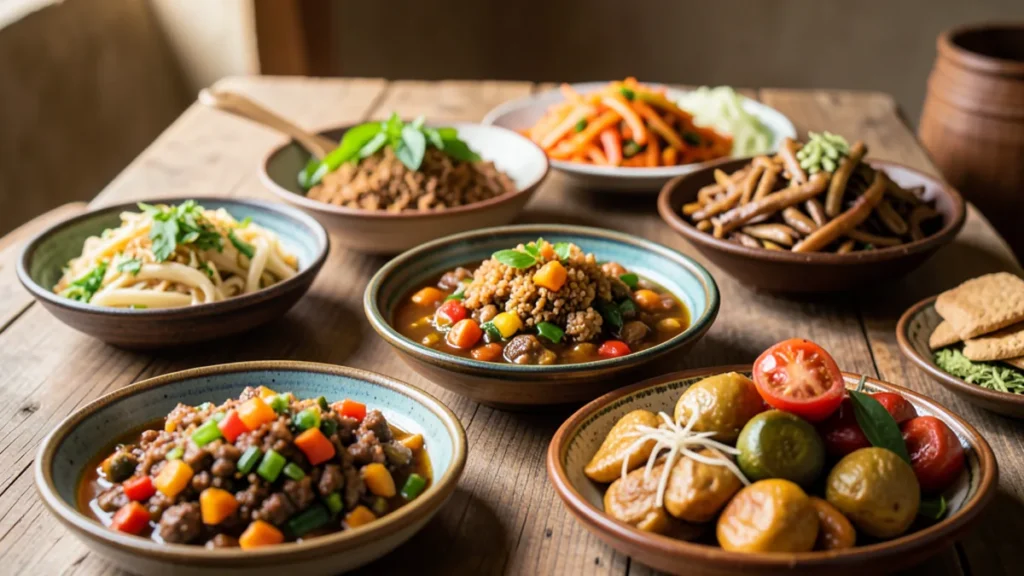
Two of the most consequential and underreported trends in African food are the globalisation of African cuisines and the growing recognition of women as the sector’s primary productive force. Nigerian cuisine — built around dishes such as jollof rice, egusi soup, suya, and puff-puff — has achieved genuine international visibility, driven by diaspora communities in the United Kingdom, the United States, and Canada, and amplified by food media, social platforms, and a new generation of African chefs gaining recognition in global culinary circles. Ethiopian cuisine, anchored by injera and a rich tradition of spiced stews, has long had a foothold in Western cities and is expanding further as Ethiopian restaurants proliferate in Europe and North America. Moroccan food, with its tagines, preserved lemons, and argan oil, has been successfully commercialised for export markets, with Moroccan olive oil and specialty food products finding shelf space in European supermarkets. South African brands, particularly in the wine, rooibos tea, and biltong categories, have built durable export identities. The commercial opportunity in African food branding is significant: as the global appetite for diverse culinary experiences grows, African food entrepreneurs are increasingly moving from informal catering to packaged goods, restaurant chains, and e-commerce. Simultaneously, women — who according to the latest sector reports produce the majority of food consumed on the continent — remain systematically underserved by land tenure systems, financial institutions, and extension services. Closing the gender gap in agricultural access and ownership is not merely a social equity imperative; it is, by any credible economic analysis, one of the highest-return investments available to African governments and development partners.
The African food and agriculture sector in 2026 is a study in contrasts: extraordinary natural endowments and human capital alongside persistent structural constraints; growing global brand recognition alongside deep food insecurity at home; ambitious policy frameworks alongside uneven implementation. The direction of travel, however, is broadly positive. Private investment in agro-processing is accelerating. African food brands are gaining international traction. The AfCFTA is beginning to reshape intra-continental trade flows. And a new generation of African agri-entrepreneurs — many of them women, many of them technology-enabled — is approaching the sector with a sophistication and ambition that earlier decades rarely produced. The question is not whether Africa’s food industry will grow, but how equitably and sustainably that growth will be distributed across the smallholder farmers, rural communities, and urban consumers who depend on it most.