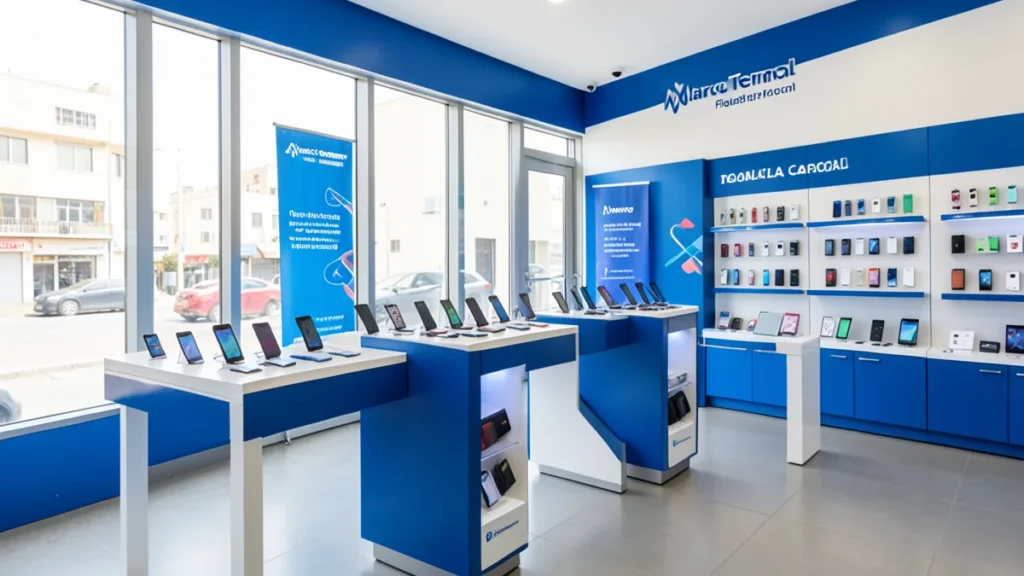
Maroc Telecom
Maroc Telecom
About
Maroc Telecom is Morocco’s incumbent telecommunications operator and, by most industry measures, the country’s dominant mobile and fixed-line provider. Headquartered in Rabat, the operator offers a full suite of services spanning mobile voice and data, fixed broadband, and enterprise connectivity, and holds a significant international footprint across sub-Saharan Africa through subsidiary operations in countries including Mauritania, Mali, Burkina Faso, Gabon, Côte d’Ivoire, Benin, Togo, Niger, Chad, and the Central African Republic. Its scale and heritage make it one of the most closely watched telecoms assets on the African continent.
Maroc Telecom traces its origins to the state postal and telecommunications monopoly, with its mobile operations formally launched in the 1990s under the Ittissalat Al-Maghrib brand. The Moroccan government progressively liberalised the sector in the late 1990s and early 2000s, awarding competing GSM licences that ended the operator’s exclusive position. Maroc Telecom was partially privatised in 2001 when France’s Vivendi acquired a strategic stake, bringing in Western management practices and capital investment that accelerated network modernisation.
The ownership structure shifted materially in 2014 when Abu Dhabi-based Etisalat — now rebranded as e& — acquired Vivendi’s stake in a transaction valued at approximately €4.2 billion, one of the largest telecom deals in African history at the time. Today, control is shared between e& and the Moroccan state, with the government retaining a significant minority shareholding. Maroc Telecom is listed on both the Casablanca Stock Exchange and Euronext Paris, giving it a dual capital markets profile that is relatively rare among African operators.
Country market context
Morocco’s mobile market is one of the most mature in Africa, with mobile penetration rates that, according to the most recent data published by the sector regulator ANRT (Agence Nationale de Réglementation des Télécommunications), consistently exceed 100 percent on a SIM basis, reflecting multi-SIM usage among consumers. The market is structured around three licensed mobile operators — Maroc Telecom, Orange Maroc, and Inwi — creating a competitive triopoly in which Maroc Telecom has historically held the leading position by subscriber share and revenue. Fixed broadband penetration remains lower than mobile but is growing, driven by fibre rollout and government digitalisation programmes. Regulatory oversight by ANRT has intensified in recent years, with the authority actively monitoring quality of service, spectrum allocation, and wholesale access obligations. → Read the Morocco expert briefing
Network and technology
Maroc Telecom operates across all four principal network generations — 2G, 3G, 4G, and 5G — and claims one of the broadest geographic coverage footprints in Morocco, including rural and mountainous regions where competitors have a thinner presence. The operator launched commercial 5G services following spectrum awards by ANRT, positioning itself as an early mover in next-generation connectivity within the North African region. Industry observers note that 4G LTE remains the primary data technology for the bulk of the subscriber base, with 5G rollout concentrated in major urban centres including Casablanca, Rabat, Marrakech, and Fès as of early 2026. Maroc Telecom also operates a substantial fibre-to-the-home (FTTH) and fibre-to-the-building (FTTB) infrastructure, and its international gateway and submarine cable connectivity — including participation in key Atlantic and Mediterranean cable systems — reinforces its position as Morocco’s principal wholesale carrier.
Products and services
The operator’s consumer portfolio covers prepaid and postpaid mobile voice, mobile broadband bundles, and convergent fixed-mobile packages marketed under the Maroc Telecom brand. In mobile financial services, Maroc Telecom operates a mobile money product branded as Mobicash, targeting unbanked and underbanked segments in Morocco and mirroring similar MFS deployments it runs across its African subsidiaries. Fixed broadband is offered via ADSL, VDSL, and increasingly FTTH connections, with the operator competing directly against Orange Maroc in urban fibre corridors. The enterprise and B2B division provides managed connectivity, cloud services, cybersecurity solutions, and data centre capacity, an area the operator has been actively developing to capture Morocco’s growing digital economy demand. International roaming and wholesale transit services round out a portfolio that spans both retail and carrier-grade segments.
Subscribers and market position
Maroc Telecom is widely regarded as the largest mobile operator in Morocco by total subscriber base, a position it has held since the market’s inception. Industry estimates suggest it commands a plurality of mobile SIM connections nationally, ahead of Inwi and Orange Maroc, though the gap with its closest competitor has narrowed over successive regulatory periods as rivals invested in network quality and promotional pricing. On the fixed side, Maroc Telecom retains a structurally dominant position inherited from its incumbent status, giving it an advantage in bundled service offerings that challengers have found difficult to replicate at scale. Across its pan-African subsidiaries, the group collectively serves tens of millions of additional subscribers, making the consolidated entity one of the larger operator groups on the continent by total connections, according to group-level disclosures.
Financial situation
Maroc Telecom has historically delivered stable revenue and strong operating margins relative to regional peers, a profile that reflects its incumbent advantages in both mobile and fixed markets. The operator is listed on the Casablanca Stock Exchange and Euronext Paris, and its financial results are published quarterly, providing a level of transparency uncommon among African telecoms. In recent reporting periods, industry analysts have noted modest top-line pressure in the domestic Moroccan market — attributable to competitive pricing dynamics and regulatory interventions on interconnection and roaming tariffs — partially offset by growth contributions from its sub-Saharan African subsidiaries. The dual shareholding structure, with e& as the strategic industrial partner and the Moroccan state as a long-term anchor investor, has provided balance sheet stability and has so far precluded the kind of ownership uncertainty that has affected other African operator groups. Profitability, measured by EBITDA margin, is generally described by analysts as among the stronger in the Middle East and Africa telecoms peer group, though precise figures should be drawn from the operator’s official filings.
Recent developments
The 24 months to early 2026 have been active for Maroc Telecom across several dimensions. The commercial rollout of 5G services following ANRT’s spectrum award process marked a strategic milestone, with the operator accelerating site upgrades in major cities and beginning to market fixed wireless access (FWA) propositions to enterprise and residential customers. On the regulatory front, ANRT has maintained scrutiny over wholesale access pricing and quality-of-service benchmarks, and the operator has navigated periodic disputes over interconnection terms with its domestic rivals. The e& parent group’s broader strategic pivot toward digital and fintech services has influenced Maroc Telecom’s own product roadmap, with increased investment in cloud infrastructure and an expanded Mobicash feature set aimed at deepening financial inclusion engagement. The operator has also continued to manage its portfolio of African subsidiaries, with governance and capital allocation across those markets remaining a focus for investor attention. No major ownership restructuring or merger activity involving the Moroccan domestic entity has been confirmed as of the time of writing.